
Memuat halaman...
Memuat halaman...
Unlimited Stock | Belum Termasuk Ongkir
Unlimited Stock | Belum Termasuk Ongkir

In the professional laundry industry, a stain is never just a cleaning issue — it's a reputation issue. A stubborn sugar stain on a hotel guest's shirt, a sweat mark that won't come out of a work uniform, or a sticky drink stain left permanently on restaurant linen can all lead to complaints, refunds, or even the loss of long-term clients. This is exactly why having the right spotting agent on your work table matters, and one of the most trusted products among laundry professionals worldwide is Frankosol by SEITZ, Germany.
This article takes a deep dive into what Frankosol is, how it works, the types of stains it handles, the correct application method, and why it deserves a permanent place in your spotting table inventory.
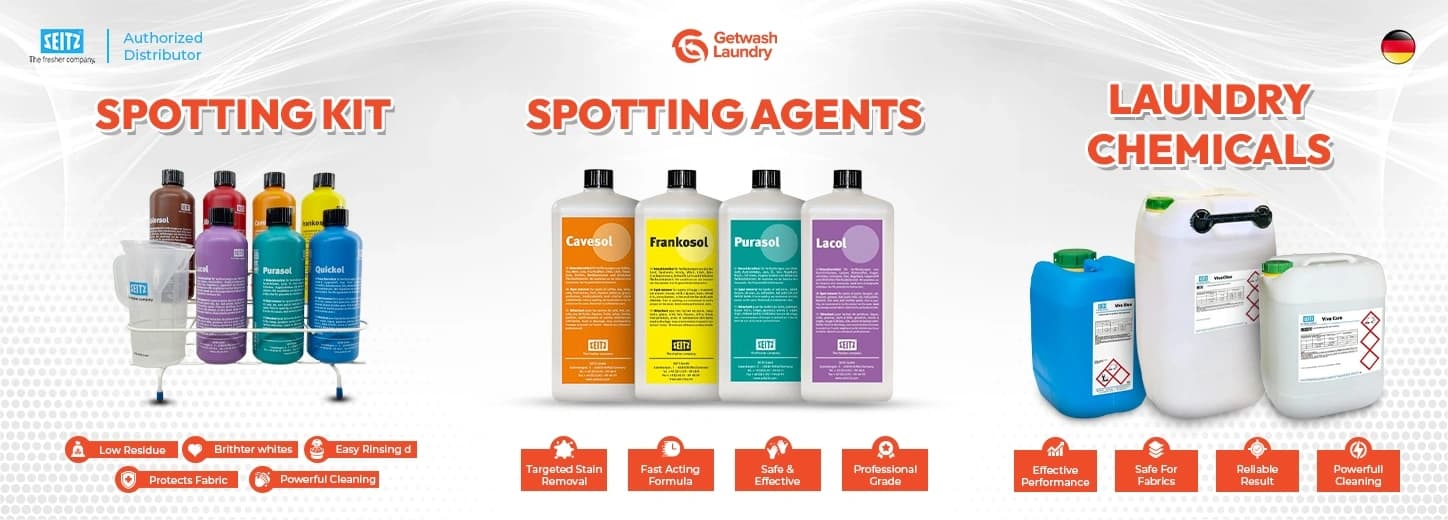
Frankosol is a professional spotting fluid produced by SEITZ GmbH, a company based in Kriftel, Germany, long recognized in the international laundry and dry-cleaning industry under their tagline, "The fresher company." SEITZ manufactures a wide range of professional laundry chemicals, and Frankosol is one of their flagship products, formulated specifically to target one very particular category of stains: water-soluble stains.
Unlike oil- or grease-based stains that require solvent-based cleaners, water-soluble stains have a different chemical nature altogether. They form from substances like sugar, proteins, salts, and other organic compounds that easily bind to fabric fibers and interact with water. If handled with the wrong product, these stains can actually set deeper into the fabric — especially if they've already been exposed to heat from a dryer or an iron.
Frankosol is the answer to this exact problem. Specially formulated to break down and dissolve the structure of water-based stains, it plays a key role in the pre-spotting process before garments or linens enter the main wash cycle.
Many newcomers to the laundry business tend to treat all stains the same way and use a single product for every situation. In reality, stains in the professional laundry industry generally fall into three broad categories:
Frankosol is specifically designed for the first category. Using the right product for the right stain category isn't just about effectiveness — it's also about saving time and cost for your spotting staff, since repeating a spotting process due to using the wrong product only adds work time and increases the risk of fabric damage.
As a professional spotting agent, Frankosol works by re-dissolving the molecules of stains that have dried and set into fabric fibers. When a water-based stain dries, sugar, protein, or salt molecules crystallize or harden within the fibers. A regular wash with standard detergent is often not strong enough to penetrate this structure, especially if the stain has already been "baked in" by an iron or dryer's heat.
When Frankosol is applied directly to a stain, the liquid penetrates the fiber structure and begins breaking the molecular bonds holding the stain in place. This process re-dissolves particles that were previously "locked in," making them far easier to lift during the subsequent wash cycle. This is why Frankosol is classified as a pre-treatment or pre-spotting agent — it doesn't replace detergent, but rather prepares the stain so it can be removed far more effectively by the main wash.
SEITZ designed Frankosol with a concentration strong enough for commercial use, which is why it is recommended for professional users only — people who understand proper spotting procedure, including the importance of testing on a hidden seam before applying it to the main area. This matters because different fabrics — cotton, silk, wool, or synthetic fibers — can react differently to spotting chemicals, and a small test on a seam can prevent permanent color or texture damage.
One of Frankosol's biggest strengths is its broad coverage within the water-soluble stain category. Below is a closer look at each type of stain the product is designed to handle.
Sugar stains are often dismissed as minor, but once dried, sugar residue leaves a stiff, slightly glossy mark on fabric — especially noticeable on dark-colored garments. Frankosol effectively dissolves sugar crystals that have bonded to the fibers.
Mustard contains strong pigments (such as curcumin) that tend to leave stubborn discoloration. Frankosol helps break down this pigment structure while also lifting the light grease residue that typically accompanies sauce stains.
Both of these stains are sticky and high in sugar content. Without proper spotting treatment, they can leave stiff patches and even attract insects if linens are stored in humid conditions. Frankosol effectively dissolves this sticky residue.
Milk contains casein protein, which can clump as it dries, while drinks like liqueur and beer contain sugar and natural pigments that easily soak into fabric fibers. Frankosol works to dissolve this combination of protein and sugar simultaneously.
This is one of the most common stains faced by hotel laundries and workwear services. Sweat contains salt and protein that, over time and with heat exposure, can leave yellowish marks that are difficult to remove with a regular wash. Frankosol is highly recommended as a pre-treatment for collars, underarms, and fold areas most exposed to sweat.
For laundries serving hospitals, clinics, or elderly care facilities, urine stains are a daily challenge. Beyond the visible mark, urine also carries the risk of odor if not treated properly from the start. Frankosol supports the pre-spotting process to ensure both the stain and the odor-causing residue are lifted as much as possible before entering the main wash cycle.
Street dirt is typically a combination of dust, mud, and water-soluble organic residue. Frankosol helps soften and dissolve these particles so they lift more easily, reducing the need for aggressive manual scrubbing that risks damaging the fabric.
Beyond the list above, Frankosol is also effective against a wide range of similar water-soluble stains, making it a versatile product that deserves a standard place on every professional laundry's spotting table.
The effectiveness of a spotting agent isn't determined by its formula alone — proper application technique matters just as much. Below is the recommended usage guide for Frankosol to achieve the best results.
Before applying the product, identify the type of stain and estimate how long it's been there. Fresh stains are generally much easier to lift than old, fully dried stains — especially ones that have already been exposed to iron heat.
This is a critical step that should never be skipped. Apply a small amount of Frankosol to an inner seam or hidden area of the fabric, wait a moment, then check for any change in color or texture. This step protects you from potential fabric-damage claims from customers.
Once you've confirmed it's safe, apply Frankosol directly to the stained area using just enough product. Avoid overusing it — excess product is wasteful and can slow down the rinsing process.
Allow the liquid to soak into the fabric fibers for a moment so the dissolving process can work optimally. This waiting time gives the active ingredients the chance to penetrate the hardened stain structure.
For older or more concentrated stains, one application may not be enough. Repeat the process a few times before the fabric goes into the main wash cycle, especially for old sweat stains or crystallized sugar stains.
Before moving on to who this product is for, it's worth understanding a few common mistakes made in the field that can prevent Frankosol from performing at its best.
This is the most common and riskiest mistake. Staff in a hurry often apply spotting agents directly to a visible stain without testing first. If the fabric reacts negatively — fading, texture change, or new discoloration — the damage happens on a visible area that's hard to fix.
More isn't always better. Overusing spotting fluid can leave the surrounding area overly damp, slow down rinsing, and in some cases leave a faint "ring" mark around the stain once dry.
Some staff rinse the fabric immediately after application, when the dissolving process actually needs time to work. Ideally, let Frankosol soak into the fibers before the fabric moves to rinsing or the main wash.
Stains that have already been exposed to an iron or a hot dryer tend to be "baked in" and bond more tightly to the fibers. This requires extra patience — repeated applications with pauses in between, rather than one large single application.
Many home-based laundry businesses that are just scaling up still rely on conventional methods like soaking fabric in concentrated detergent or manually scrubbing stains with a brush. Here's a quick comparison of why a professional spotting-agent approach like Frankosol is superior.
Conventional soaking treats the entire fabric evenly, even though stains are usually concentrated in specific spots. Frankosol allows staff to precisely target only the problem areas, so the rest of the fabric isn't unnecessarily exposed to extra chemicals.
Manually scrubbing fabric with a brush can lift some stains, but it risks damaging fibers — especially on delicate materials like silk or embroidered linen. With Frankosol, the dissolving process happens chemically, reducing the need for aggressive physical scrubbing.
Trial-and-error with conventional methods often takes longer due to inconsistent results. With a clear spotting SOP built around Frankosol, staff can work faster and results become far more predictable over time.
To make this more concrete, here are a few common scenarios where Frankosol is regularly applied.
Hotel restaurant table linens are especially prone to stains from sugary drinks like syrup, liqueur, and beer, particularly during large events like gala dinners or wedding receptions. By applying Frankosol as a pre-spotting step before the main wash, hotel laundry teams can restore linens to the premium standard guests expect — without needing to replace them, which is a far costlier option.
Laundries serving clinics or elderly care facilities deal with urine stains on a daily basis. Beyond appearance, handling this type of stain also ties directly into strict hygiene and odor-control standards. Using Frankosol as part of a pre-treatment SOP helps ensure linens come back clean and odor-free before being redistributed to the facility.
Work uniforms, especially in field or F&B industries, often accumulate sweat stains around the collar and underarm areas, which — if left untreated for months — can leave permanent yellowish marks. Regular Frankosol application as part of a weekly laundry cycle can prevent this buildup before it becomes permanent and difficult to remove.
To ensure Frankosol delivers consistent results across every shift, here's a simple SOP framework your laundry team can adapt.
A consistent SOP like this keeps laundry quality stable regardless of which staff member is on shift — an important factor for any laundry business aiming to build long-term trust with both institutional and retail customers.
With this broad range of applicable segments, Frankosol is a smart investment for both growing home-based laundries and high-volume industrial laundry operators.
As a provider of professional laundry and cleaning solutions operating across Greater Jakarta and Bali, Getwash understands the operational challenges laundry business owners face — from home-based operators to institutional clients like hotels and hospitals. Here's why Getwash is the right choice for your professional laundry chemical needs:
Getwash supplies authentic SEITZ products — not mixed or counterfeit alternatives that risk damaging your customers' fabrics.
Whether you need a 1-liter bottle for daily use or a 5-liter jerrycan for high-volume needs, Getwash offers both options to match the scale of your business.
The Getwash team is ready to guide you on proper product use and provide the Safety Data Sheet (SDS) for customers who need it — simply reach out to our admin via chat.
Frankosol is generally safe to use on a wide range of fabrics, but a hidden-area test is always required first, especially for colored fabrics or delicate materials like silk and wool.
Frankosol is designed for professional use. Beginners are advised to first learn basic spotting procedures, including hidden-area testing and correct application technique, to achieve the best results and minimize the risk of fabric damage.
Regular detergent is designed for overall cleaning during the main wash cycle, while Frankosol is a spotting agent that acts as a pre-treatment for specific stains before washing — resulting in a far better final outcome than relying on detergent alone.
Soaking time can vary depending on how concentrated the stain is. For light stains, a few minutes is usually enough, while stubborn stains may require several repeated applications before the fabric enters the main wash cycle.
For long-term use with a high daily stain volume, the 5-liter jerrycan generally offers better cost efficiency per liter compared to repeatedly buying 1-liter bottles.
Frankosol by SEITZ is one of the most reliable spotting solutions for tackling water-soluble stains commonly encountered in day-to-day laundry operations — from sugar, mustard, ice cream, and honey stains to milk, liqueur, beer, street dirt, sweat, and urine. With its professional German formulation and SEITZ's reputation as "the fresher company," this product deserves a permanent place in your laundry business's spotting table standard — whether you're a home-based operation scaling up or a high-volume industrial laundry operator.
Available in both 1-liter bottles and 5-liter jerrycans, Frankosol offers the flexibility to match your business's needs and scale. Get the genuine SEITZ Frankosol today at Getwash and elevate the quality standard of your laundry results starting now.
Want to learn more or need the Safety Data Sheet (SDS)? Chat with the Getwash admin today.