Suitcase Cleaning

- Rimowa - ClassicRp 400.000
- Rimowa - Classic CabinRp 400.000
- Rimowa - EssentialRp 400.000
- Rimowa - OriginalRp 400.000
- Rimowa - Original CabinRp 400.000
- Rimowa - TopasRp 400.000
- Tumi - Expandable 4Rp 300.000
- Tumi - Office 4Rp 375.000
- Tumi - Front LidRp 325.000
Contact us to schedule your order
09:00-20:00 (Weekday) & 09:00-17:00 (Weekend)
Premium Suitcase Cleaning by Getwash: A Guide to Caring for Rimowa, Tumi, and Other Luxury Luggage, Understanding Aluminium, Polycarbonate, and Nylon, Treating Mould and Stains, and a Before-and-After Travel Routine
By the Getwash Laundry Team | Updated 5 November 2026 | Reading time ±27 minutes
|
QUICK ANSWER Getwash cleans premium suitcases at a price per model: every Rimowa variant listed (Classic, Classic Cabin, Essential, Original, Original Cabin, Topas) is Rp400,000, while Tumi Expandable 4 is Rp300,000, Front Lid Rp325,000, and Office 4 Rp375,000. For heavy stains and mould there is stain removal with deep cleaning and anti-fungal treatment, with the note that results depend on condition and 100% removal is not guaranteed. The service page does not yet list a turnaround, so ask when you order. Pickup is charged by zone (Rp8,000, Rp15,000, or Rp22,000 per trip). Order through the order page or WhatsApp 0812-6610-0500; service hours are Monday–Friday 09.00–17.00 and Saturday 09.00–15.00, closed on Sundays. |
A suitcase is the most travelled item in your home, yet the least cleaned. In a single trip it can cross airport floors, baggage belts, trolleys, taxi boots, pavements, hotel lobbies, and bedroom floors, before finally coming home and going into the bedroom or a cupboard. Its wheels carry traces of all those places.
This article looks at suitcase cleaning service from that angle: the suitcase as an investment that covers thousands of kilometres, and how to keep it clean, hygienic, and looking good without damaging its materials. We explain the differences between premium luggage materials, the listed Rimowa and Tumi prices, what can and cannot be expected from cleaning, problems such as mould and odour, and a simple routine before and after travel. If you are looking for a laundry near me for suitcases, start with the table of contents below.
Table of Contents
1. The Suitcase: The Most Travelled, Least Cleaned Item
2. Premium Luggage Materials: Aluminium, Polycarbonate, Ballistic Nylon, Leather, and Small Parts
3. Suitcase Cleaning Prices: Rimowa, Tumi, and Other Brands
4. What Gets Cleaned, the Limits of the Result, and Turnaround
5. Common Suitcase Problems: Mould, Musty Odour, Stains, Dirty Wheels, and Scratches
6. Caring for Your Suitcase Before and After Travel, and How to Order
7. FAQ: Questions About Getwash Suitcase Cleaning
The Suitcase: The Most Travelled, Least Cleaned Item
Most people clean their clothes after a trip, but put the suitcase straight into a cupboard or storeroom. Yet a suitcase holds dirty clothes, shoes, toiletries, and sometimes food souvenirs for days, then is closed tight without air.
The journey of a suitcase
Picture one suitcase's route on a single round trip. It is dragged along pavements and car parks, set on the floor of a taxi or ride-hailing car, moved by airport staff, circled on a baggage belt with hundreds of other bags, set on a damp hotel bathroom floor, then comes back by the same route. The outside, wheels, and handles touch many surfaces whose cleanliness we never see.
The inside is no better. Dirty clothes, damp towels, shoes, and leaking toiletry bottles leave the lining holding sweat, moisture, and stains. Once closed and stored, that moisture is trapped.
Why suitcases are rarely cleaned
There are several reasons. A suitcase looks sturdy, so it is assumed not to be dirty. People fear damaging costly materials such as aluminium or polycarbonate with the wrong cleaner. The lining is usually stitched in and hard to wash. And after a trip, energy usually goes into unpacking, not into caring for the case.
“Your suitcase protects your belongings on the road; caring for it is how you protect your next trip.” — Working principle of the Getwash team
Signs your suitcase needs cleaning
- A musty smell when the case is opened after storage.
- White, grey, or black spots on the lining or in the corners.
- A dull, sticky outer surface covered in old label and glue marks.
- Wheels that are jet black and leave tracks on the floor.
- Stains from spilled shampoo, perfume, or food on the lining.
- A telescopic handle and side handles that feel sticky.
Suitcases and hotel bed bugs
A common worry among travellers is bed bugs carried home from a hotel or guesthouse. These small insects hide in mattresses, bed frames, and furniture gaps, and can hitch a ride on luggage placed nearby. Travel guides generally advise not putting your suitcase on the hotel bed or carpet, but on a luggage rack or in the bathroom, and checking the seams and pockets when you get home.
We should be clear: suitcase cleaning is not pest control. If you see signs of bed bugs, such as small brown spots or live insects in the seams, contact a pest control service. Suitcase cleaning helps general hygiene but is not a substitute for proper pest treatment.
Children's and family suitcases
Children's suitcases are often used as toys, sat on, dragged across floors, and filled with snacks that spill. Family suitcases used in turn also hold items from many people. These cases tend to get dirty inside faster, especially in mesh pockets and corners, and are worth cleaning after every long holiday.
Suitcase wheels and your floors
One thing rarely noticed: suitcase wheels are the dirtiest part, and they often roll straight into the bedroom. Wheels that have just crossed streets, airport toilets, and pavements carry dust, dried mud, and other dirt. Cleaning the wheels before the suitcase comes in is a small habit that keeps the home clean.
Tropical humidity and stored suitcases
In four-season countries, a suitcase stored in a cupboard may stay fine for months. In Greater Jakarta, high humidity all year turns a closed suitcase into a small damp chamber. Even a case put away clean can grow mould if stored in an unventilated storeroom or under stairs near a damp wall. That is why how you store it matters as much as how you clean it.
The suitcase as an investment
Premium suitcases such as Rimowa or Tumi are bought to last for years, even to be passed down. They can cost millions to tens of millions of rupiah. Caring for them properly protects their looks, function, and value. Many owners of aluminium cases even like the dents and scratches as marks of travel, yet still want the case clean and odour-free.
Suitcases of high-profile customers
Getwash is trusted as the go-to laundry for officials and high-profile customers, and is used to handling top-end branded items. Suitcases often carry traces of private travel, baggage stickers, or name tags. Items are handled in an orderly way, the owner's privacy is protected, and no information is shared. Empty the suitcase completely before handing it over, including hidden pockets.
Part of your travel image
For business people and premium travellers, a suitcase is seen by others: in hotel lobbies, airport lounges, or when meeting clients straight from a trip. A clean, well-kept case reflects its owner. A dull case covered in sticker glue that smells when opened in front of others leaves a poor impression, whatever its brand.
Not an official brand service
To be open about it: Getwash is an independent care service, not an official service centre for Rimowa, Tumi, or any other brand. For warranty claims, wheel replacement, frame repairs, or locks, owners should contact the brand's official service. Our service focuses on cleaning and surface care, and the service page does not mention repairs.
Premium Luggage Materials: Aluminium, Polycarbonate, Ballistic Nylon, Leather, and Small Parts
Brand and model decide the material, and the material decides how to clean. Our service page lists Rimowa and Tumi models, which represent several different materials.

Figure 1. Suitcase materials and care notes (suitcase-materials-and-care-notes-getwash-en.png)
Identifying your suitcase material
If you are unsure of your case's material, look for a few signs. Aluminium feels cold to the touch, sounds metallic when tapped, and is usually grooved. Polycarbonate feels lighter, flexes slightly when pressed, and sounds duller. Fabric cases feel flexible with a clearly visible weave. A label inside the case or the brand's website usually names the material. State the material when ordering so the right method is used from the start.
Aluminium
Grooved aluminium cases are a hallmark of several Rimowa lines, such as Original, Classic, and Topas. Aluminium is strong and durable, but scratches and dents easily. Scratches and dents are not dirt; cleaning does not remove them. What can be done is clearing dust, grease, sticker glue, and stains without leaving new scuffs. Abrasive cleaners and rough scourers must be avoided.
Polycarbonate
Polycarbonate is used for light, flexible hard cases, such as the Essential line. The material resists impact by flexing, but its surface scuffs easily, especially glossy textures. Strong solvents can leave the surface dull or cloudy. Safe cleaning uses mild cleaners and soft cloths.
Ballistic nylon and technical fabrics
Many Tumi cases use ballistic nylon, a thick synthetic fabric highly resistant to tearing and abrasion. Its weakness is that it absorbs stains and odour more easily than a hard shell, and dust works into the weave. Cleaning this fabric calls for a different approach from hard cases, especially at corners and outer pockets.
Leather trim
Some premium cases have handles, tags, or accents in leather. Leather does not tolerate excess water or harsh cleaners; it can stiffen, crack, or discolour. If your case has leather trim, mention it when ordering so handling can be adjusted. For leather bags, we also offer Maison de Bag.
Wheels, handles, and telescopic rails
Wheels hold dirt around their axles and housings. Telescopic handles hold dust in their rails and often turn sticky from sweaty hands. Side and top handles are handled constantly too. These parts touch hands and floors most often, so they matter most from a hygiene point of view.
Locks and zips
TSA locks, combination locks, and zips are mechanical parts sensitive to water and dirt. Dust in a zip makes it stiff. Cleaning must avoid excess liquid in these areas. If a lock or zip was already faulty before handover, say so so it is recorded.
Pockets, dividers, and straps
Premium cases often have strapped dividers, zipped pockets in the lid, and compression straps. These small parts are easily forgotten in cleaning, yet the lid pocket is often where bottles leak, and straps absorb sweat from clothes. Make sure every pocket is empty before handover, because small items tucked away are easily missed.
The lining
A suitcase lining is usually polyester fabric stitched or fixed to the frame, complete with dividers and straps. This part holds odour, sweat, and spill stains. The service page asks whether the interior is cleaned too, but the answer is not shown yet, so ask Customer Service how far your case's interior is handled.
Why a suitcase must not be washed like fabric goods
A suitcase is not something to soak. Metal frames can rust at the joints, lining glue can come loose, locks can jam, and water trapped inside the frame becomes a new source of mould. That is why suitcase cleaning is done part by part with suitable methods, never by soaking or washing the whole case.
Hard case or soft case: which is easier to care for
Hard cases in aluminium and polycarbonate resist stains on the outside because their surface does not absorb liquid, but they show scratches easily. Fabric cases such as ballistic nylon hide scratches, but absorb stains and odours more deeply. Neither is absolutely better; each needs different care. What matters most is not treating them the same way.
Light colours and grooved surfaces
Light-coloured cases show baggage-belt grime and trolley marks more clearly. Grooved aluminium cases hold dust in the grooves that an ordinary cloth struggles to reach. The corners of hard cases, which take the most knocks, are usually both the dirtiest and the most scratched areas. These parts need special attention in cleaning.
Cabin and check-in models
Our pricelist lists Cabin and non-Cabin Rimowa variants at the same price, Rp400,000. Cabin cases are small enough for the aircraft cabin, while check-in cases are larger. The page does not explain why the price is the same; if you own a very large case, ask whether the price still applies.
Suitcase Cleaning Prices: Rimowa, Tumi, and Other Brands
Our service page lists prices per model, not per size or material. Here is the list shown.

Figure 2. Suitcase cleaning prices for Rimowa and Tumi (suitcase-cleaning-prices-rimowa-and-tumi-getwash-en.png)
- Rimowa Classic: Rp400,000.
- Rimowa Classic Cabin: Rp400,000.
- Rimowa Essential: Rp400,000.
- Rimowa Original: Rp400,000.
- Rimowa Original Cabin: Rp400,000.
- Rimowa Topas: Rp400,000.
- Tumi Expandable 4: Rp300,000.
- Tumi Front Lid: Rp325,000.
- Tumi Office 4: Rp375,000.
There is a show-more button under the Rimowa list, so other models may not be visible at first glance. The page does not list a turnaround or what the price includes.
What about Louis Vuitton and other brands
The page's meta description mentions specialist care for luxury luggage such as Rimowa, Tumi, and Louis Vuitton, but the pricelist only covers Rimowa and Tumi. If you own a case from another brand, send a photo, brand, model, and size to Customer Service for a quote. Do not assume the price matches a listed model.
A cost example for one family
Here is an illustration (not a real customer case). A family has just returned from holiday with two Rimowa Original check-in cases and one Tumi Expandable 4. The cost is 2 × Rp400,000 + Rp300,000 = Rp1,100,000, before pickup and delivery. Add a Rimowa Original Cabin and the total is Rp1,500,000.

Figure 3. Suitcase cleaning cost examples (suitcase-cleaning-cost-examples-getwash-en.png)
Another example: a business traveller with one Tumi Office 4 pays Rp375,000 per cleaning. A couple using a Rimowa Original and Original Cabin set pays Rp800,000.
Cost per trip
Another way to look at the price is to divide it by the number of trips. If a Rimowa is cleaned once a year and used for four trips, its care costs Rp100,000 per trip. For a business traveller using a Tumi Office 4 twelve times a year and cleaning it twice, the cost is about Rp62,500 per trip. That is small next to flights and hotels, yet makes a big difference to opening a clean, odour-free case.
Compared with the value of the suitcase
For a suitcase costing tens of millions of rupiah, a cleaning fee of Rp300,000 to Rp400,000 is relatively small, especially once or twice a year. More importantly, cleaning the wrong way at home, for example abrasives on aluminium or solvents on polycarbonate, can leave damage far more expensive to fix.
Why the price is per model, not per size
Our page sets prices by brand and model, not size. This makes sense because each premium luggage line has different materials, construction, and details, such as grooved aluminium shells, polycarbonate, or technical fabric with many pockets. That construction decides how and how long cleaning takes, more than size alone. For unlisted models, quotes are usually based on the same considerations.
When to clean a suitcase
The service page gives no figure. A sensible guide: after a long trip, after a spill inside, before long storage, or when odour and spots appear. Frequent travellers may clean their case several times a year, while those who travel once a year can clean it once after the holiday.
Cleaning several suitcases at once
Families back from holiday usually bring several cases at once. Handing them over in one pickup saves on the charge and ensures all come back clean together before storage. If one case will be needed again soon, say so, so it can be prioritised where possible.
Pickup and delivery rates
Since 20 June 2026, pickup and delivery is no longer free. The rate is charged per trip by distance from the nearest outlet: Zone 1 (0–3 km) Rp8,000, Zone 2 (3–7 km) Rp15,000, Zone 3 (over 7 km) Rp22,000. Customer Service confirms your zone when you order. The page FAQ asks whether suitcase pickup is available but the answer is not shown yet; confirm when you order.
Stain removal for heavy stains and mould
The only FAQ answered on our page explains that for heavy stains or mould, Getwash offers stain removal treatment, including deep cleaning and anti-fungal treatment. The page also states honestly that results depend on the stain and 100% removal cannot be guaranteed. It does not say whether this treatment carries an extra charge; ask when ordering.
What Gets Cleaned, the Limits of the Result, and Turnaround
Before handing over a suitcase, it is important to understand what cleaning can achieve and what lies beyond it. This section sets that out openly.

Figure 4. Suitcase cleaning scope and limits (suitcase-cleaning-scope-and-limits-getwash-en.png)
What cleaning can usually improve
- Dust, road grime, and a dull film on the outer surface.
- Baggage sticker and label glue.
- Stains on technical fabrics such as ballistic nylon, depending on type and age.
- Musty and absorbed odours, especially once the source is removed.
- Dirt on wheels, the telescopic handle, and side handles.
- Light mould spots, with the note that full removal is not guaranteed.
What lies beyond cleaning
- Dents in aluminium shells.
- Deep scratches that have cut into the material.
- Cracks in polycarbonate shells.
- Mechanically broken wheels, locks, zips, or handles.
- Permanent discolouration from sunlight or chemicals.
For damage like this, the brand's official service is the right route. We would rather state these limits up front than leave you expecting a result that cannot be achieved.
Risk of damage
Our page FAQ asks whether there is a risk of damage after cleaning, but the answer is not shown yet. The honest answer: handling any valuable item carries some risk, and that risk is reduced by choosing methods to suit the material, avoiding abrasives or harsh solvents, and never soaking the case. Photographing the starting condition, by you and by the team, helps both sides if questions arise later.
What is recorded when the suitcase arrives
A premium suitcase is best handed over with clear documentation of its starting condition. Usually recorded are the brand and model, existing dents and scratches, the condition of wheels and handles, how the locks and zips work, and any visible stains or mould. This is not a formality; it protects you and the team, and keeps any conversation after the work clear and fair.
The interior
The page FAQ also asks whether the interior is cleaned, with no answer shown. Because each model's lining differs, some removable and some permanently stitched, ask specifically about your case. If the odour comes from the interior, dealing with it is the most important part.
Why soaking a suitcase is a mistake
Some people try to clean a suitcase by hosing it in the bathroom or even soaking it. Water gets into frame joints, behind glued linings, and into wheel housings, then stays trapped. A few days later come a musty smell and small rust spots on metal joints. A part-by-part approach with just enough liquid is far safer, and that is the main difference between cleaning a suitcase and washing fabric goods.
Turnaround
The service page lists no turnaround, and the FAQ on how long it takes is not yet answered. Ask for the expected completion when you order, especially if you have another trip coming, and follow it on the tracking page. As a rule, do not hand your case over a few days before departure; allow enough time for it to be cleaned and dried thoroughly.
Why drying matters for suitcases
A suitcase closed while slightly damp is a recipe for mould. The enclosed space inside a case has no airflow, so dampness lingers, especially in the tropics. That is why drying the interior matters as much as cleaning it, and why suitcase cleaning should not be rushed.
What to ask when you order
Because our service page has not answered most of its FAQs yet, a few questions are worth asking before pickup: is the interior cleaned, does mould treatment cost extra, what is the expected completion, and how is the starting condition documented. Ask for the answers in writing over WhatsApp. That conversation becomes your record if questions come up later.
Planning around your travel schedule
The best time to clean a suitcase is right after a trip, when stains and smells are still fresh and you will not need the case soon. If you travel often, keep a spare case or schedule cleaning in a long enough gap between trips.
Common Suitcase Problems: Mould, Musty Odour, Stains, Dirty Wheels, and Scratches
These are the problems most often found on suitcases, their causes, the treatment, and an honest line on what can be expected.

Figure 5. Suitcase problems and treatments (suitcase-problems-and-treatments-getwash-en.png)
Mould in the lining
Mould is the most common problem on suitcases stored for long in humid climates. It usually appears as white, grey, or black spots in lining corners and pockets. The cause is almost always the same: the case was closed with moisture from clothes, towels, or the air still inside. Getwash treats mould with deep cleaning and anti-fungal treatment, with the note that old spots that have soaked in may leave marks.
Musty odour
A musty smell comes from damp and mould, while other odours may come from food, shoes, or spills. Fragrance only covers them. What works is finding the source, cleaning it, and making sure the case is fully dry before closing.
Shampoo, perfume, and food spills
Bottles that leak inside a case often leave stubborn stains on the lining. Shampoo and soap leave sticky residue, perfume can discolour fabric, and foods such as chilli sauce or oil leave greasy stains and smells. Mention the type of spill when ordering, because each is treated differently.
Dirty, stiff wheels
Wheels gather hair, threads, dust, and grime around their axles. This makes them roll stiffly and leave tracks on floors. Cleaning the outside of the wheels helps hygiene, but wheels jammed by broken bearings need repair, not cleaning.
Baggage sticker glue
Airport baggage stickers often leave sticky glue that collects dust. Scraping it with something sharp risks scratching, especially on aluminium and glossy polycarbonate. Glue marks should be removed with a method safe for the material.
A sticky telescopic handle
The telescopic handle is held by sweaty hands in hot weather, meets lotion or sunscreen, and collects dust in its rails. The result is a sticky surface and a handle that drags when pulled. Cleaning the outside of the handle helps, but a handle jammed by a bent rail or broken mechanism needs official repair.
Scratches and dents
Fine scratches and dents, especially on aluminium cases, are part of the character of a well-used suitcase. Cleaning makes the surface cleaner, so scratches may look more or less visible, but it does not erase them. Some owners treat them as memories of their travels.
Souvenirs and food in the suitcase
Souvenirs such as coffee, spices, chilli sauce, dried fish, or cakes are often carried home in a suitcase. Their strong aromas soak into the lining easily, and leaking packaging leaves greasy stains. Wrap strong-smelling souvenirs in double sealed bags, and take them out of the case as soon as you arrive.
Cigarette and cooking odours
A suitcase stored in a smoker's room or used to carry strong-smelling food can absorb the smell into its lining. Odours like these are harder to remove than dust because the particles soak into the fabric. Thorough cleaning and drying help, but odours years old may not disappear completely.
Beach sand and sea water
After a beach holiday, fine sand gets into wheels, zips, and lining seams. Dried sea water leaves salt that can fade fabric and speed up corrosion on metal parts. Clear out sand as soon as possible and do not leave a case exposed to sea water closed for long.
A suitcase caught in the rain
A suitcase waiting on the tarmac or caught in rain when leaving a car can get wet outside, and water can get in through the zip. Left closed, that dampness becomes the start of mould. Dry the case open as soon as you arrive.
Dull nylon fabric
Fabric cases such as ballistic nylon can look dull from dust in the weave and small stains building up. Cleaning usually restores their look, but areas worn by friction will not return to new.
Will the suitcase look brand new?
We do not promise a suitcase will return to the day it was bought. A case that has made many journeys has wear, scratches, and dents that cleaning cannot remove. What we can aim for is a suitcase that is cleaner, hygienic, odour-free, and neater, together with an honest assessment at the start.
Structurally damaged suitcases
A suitcase with a broken frame, a large crack in the shell, or a lining that has come away may be better handled by the brand's official service. In that case we give advice before work.
Caring for Your Suitcase Before and After Travel, and How to Order
Small habits before and after travel keep a suitcase clean far longer, and make professional cleaning more effective.

Figure 6. Suitcase care routine before and after travel (suitcase-care-routine-before-and-after-travel-getwash-en.png)
Before you leave
- Put liquids in sealed bags. Leaking shampoo and perfume bottles are the most common cause of interior stains.
- Wrap your shoes. Shoe soles carry the same dirt as suitcase wheels.
- Use a luggage cover if you want to protect the surface from scratches and baggage-belt grime.
- Remove old stickers before the glue hardens.
- Keep dirty clothes separate in a laundry bag during the trip.
After you return
- Empty the suitcase straight away; do not wait several days.
- Clean the wheels before the case goes into the bedroom.
- Leave the case open for a few hours to a day in a breezy room so moisture escapes.
- Wipe the outside with a soft damp cloth, without abrasives.
- Check for spills in the lining and deal with them at once.
- Store it dry, ideally in a cloth dust bag.
Cleaning the outside yourself, safely
- Vacuum or brush dust from grooves, corners, and wheels with a soft brush.
- Wipe the surface with a microfibre cloth dampened with water and a little mild soap.
- Avoid abrasives, bleach, acetone, and rough scourers, especially on aluminium and polycarbonate.
- Do not spray water directly at locks, zips, or handle rails.
- Dry with a clean cloth, then leave the case open until fully dry.
These simple steps are enough for routine care. For mould, interior spills, or a very dirty case, professional cleaning is usually safer and more thorough.
Suitcases after a long pilgrimage
Pilgrimages such as umrah or hajj are usually long, in hot climates, with many transfers and much luggage. Suitcases come home with clothes worn for days, dust, and sometimes water brought back. This is the right moment to clean the case before storage, because it will usually not be used for a long time.
Storing a suitcase properly
Store suitcases somewhere dry and ventilated, not in a damp storeroom or under a bed that is rarely moved. Leave the zip slightly open or add a moisture absorber for long storage. Do not stack heavy items on a polycarbonate case, as it can deform. If stored for years, open and air it occasionally.
Borrowed and lent suitcases
Suitcases often change hands within a family: borrowed by relatives for the Lebaran trip home, taken by children to study in another city, or carried by parents on a pilgrimage. A case that comes back after being lent should be checked and cleaned before storage, because we do not always know what was carried or where it was set down.
For frequent travellers and business people
Business people who travel every month use their luggage far more than holidaymakers. Schedule cleaning regularly, for example every few trips, and consider owning two cabin cases so one can be cared for without disrupting your schedule. For companies with many travelling staff, contact our business team about B2B laundry.
Services that often go with suitcase cleaning
After a trip, customers usually also bring clothes, shoes, and bags: per-kilo laundry, dry cleaning, shoe cleaning, bag cleaning, and Maison de Bag for luxury bags. Combining them in one pickup saves on the charge.
How to order
Our service page invites you to contact us to schedule your order. The most dependable way: message WhatsApp 0812-6610-0500 or use the order page. You can also visit the outlet at Jl. Ceger Raya No.42, Jurang Mangu Barat, Kec. Pd. Aren, Kota Tangerang Selatan, Banten 15222.

Figure 7. Six steps to order suitcase cleaning (six-steps-to-order-suitcase-cleaning-getwash-en.png)
- Empty the suitcase completely, including hidden and outer pockets.
- Photograph the case from several sides, the inside, the brand, model, and any existing damage.
- Customer Service confirms the price, interior scope, stain or mould treatment, estimate, and pickup zone.
- A courier collects the suitcase from your address.
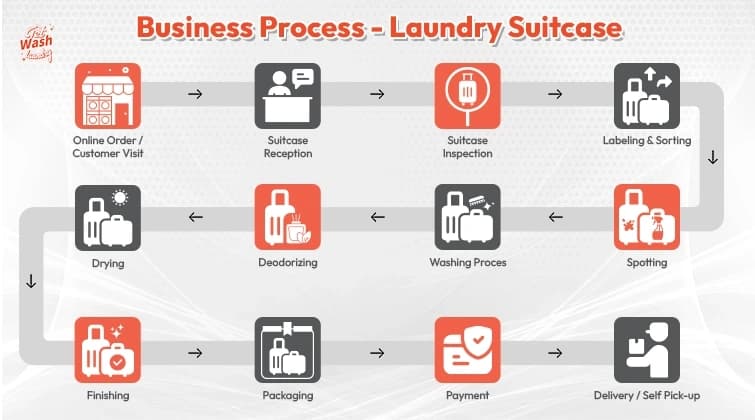
- The suitcase is cleaned and dried; follow progress on the tracking page.
- The suitcase is delivered back to your address or collected at the outlet.
Checklist before handing over your suitcase
- Empty all pockets and check twice.
- Remove name tags or personal labels if you want full privacy.
- Note the lock combination if it needs opening, or leave it unlocked.
- Photograph the starting condition, including dents, scratches, and wheels.
- State the type of stain or spill and whether there is odour or mould.
- Keep your order number for tracking.
Choosing a new suitcase that is easy to care for
If you plan to buy a new suitcase, think about its care. Textured surfaces hide scratches better than glossy ones. Dark or metallic colours show dirt less quickly than light ones. A removable lining is far easier to clean. Replaceable wheels extend a case's life. These small decisions make a suitcase last longer and cost less to maintain.
After your suitcase returns
Leave the case open for a few hours in a breezy room before storing it, to be sure no dampness remains. Store it in a dust bag if you have one, and use the after-travel routine on your next trip so the case stays clean longer.
Company luggage and business travel teams
Companies with pool luggage for business travel, sports teams, or event crews often have cases used by many people in turn. These get dirty faster and their hygiene matters more. A regular cleaning schedule after each major trip keeps them fit for use and stops them becoming a source of complaints.
Service hours and location
Service hours: Monday–Friday 09.00–17.00, Saturday 09.00–15.00, closed Sundays. Our main outlet is at Jl. Ceger Raya No.42, Jurang Mangu Barat, Kec. Pd. Aren, Kota Tangerang Selatan, Banten 15222. We serve customers in Pondok Aren, Bintaro, and around, as well as through other outlets and service areas listed on the outlets page.
One trip, sorted in one go
After a trip, the house is usually full of dirty clothes, dusty shoes, and unpacked cases. Rather than dealing with it bit by bit over weeks, many customers hand everything over at once: clothes to per-kilo laundry or dry cleaning, shoes to shoe cleaning, and suitcases to suitcase cleaning. Within days, everything is back clean and ready for the next journey.
Why we write this plainly
Premium suitcases are expensive, and their owners deserve to know exactly what to expect. We choose to state what is listed, what the page has not yet explained, and what cleaning cannot achieve, so you order with the right expectations. We would rather answer many questions at the start than one complaint at the end.
Ready to care for your suitcase after your travels? Order through the order page, contact WhatsApp 0812-6610-0500, or follow us on Instagram, TikTok, Facebook, and Threads.
FAQ: Questions About Getwash Suitcase Cleaning
Can all types of suitcases be cleaned at Getwash?
The pricelist covers Rimowa and Tumi models. For other brands, send a photo, brand, model, and size to Customer Service for a quote.
How much does suitcase cleaning cost at Getwash?
Rimowa Classic, Classic Cabin, Essential, Original, Original Cabin, and Topas Rp400,000. Tumi Expandable 4 Rp300,000, Front Lid Rp325,000, and Office 4 Rp375,000.
What if my suitcase has mould or stubborn stains?
Getwash offers stain removal with deep cleaning and anti-fungal treatment. Results depend on the stain and 100% removal is not guaranteed.
Is there a risk my suitcase will be damaged?
Handling any valuable item carries some risk, reduced by methods suited to the material and by never soaking the case. Photos of the starting condition help both sides.
Is the inside of the suitcase cleaned too?
The page has not shown the answer yet. Because each model's lining differs, ask specifically about your case when ordering.
Can dents and scratches be removed?
No. Dents, deep scratches, and cracks are physical damage, not dirt. For repairs, contact the brand's official service.
Is Getwash an official Rimowa or Tumi service centre?
No. Getwash is an independent care service focused on cleaning. Warranty and part repairs are handled by the brand's official service.
How long does suitcase cleaning take?
The page does not list an estimate yet. Ask for the expected completion when ordering and follow it on the tracking page; do not hand it over just before departure.
Is suitcase pickup and delivery available?
Confirm when you order. Since 20 June 2026 the rate is Rp8,000 (Zone 1), Rp15,000 (Zone 2), or Rp22,000 (Zone 3) per trip.
How often should a suitcase be cleaned?
After a long trip, after a spill, before long storage, or when odour or mould spots appear.
How do I stop my suitcase going mouldy?
Empty it straight after the trip, leave it open until dry, and store it somewhere dry and ventilated with a moisture absorber for long storage.
What are Getwash's service hours?
Monday–Friday 09.00–17.00 and Saturday 09.00–15.00. Closed on Sundays. Messages can be sent any time and are answered in the next service hours.
Does Getwash serve high-profile customers and high-value luggage?
Yes. Getwash is trusted as the go-to laundry for officials, public figures, business people, and celebrities, and is used to handling top-end branded items with privacy protected.
Sources
- Getwash Laundry suitcase cleaning service page
- Getwash Laundry Koper page (ID)
- Getwash Laundry tracking page
- New Policy Notice: Pickup & Delivery Rates (effective 20 June 2026)