Bedsheet Laundry Service
- Sprei - Double Set
1 Sprei Double Ukuran 120 x 200 – 140 x 200 ( 2 Sarung Bantal & Guling )
Rp 80.000 - Sprei - Queen Set
1 Sprei Queen Ukuran 160 x 200 ( 2 Sarung Bantal & Guling )
Rp 100.000 - Sprei - Super King Set
1 Sprei Super King Ukuran 200 x 200 ( 2 Sarung Bantal & Guling )
Rp 125.000 - Sprei - King Set
1 Sprei King Ukuran 180 x 200, ( 2 Sarung Bantal & Guling )
Rp 110.000 - Sprei - Single Set
1 Sprei Single Ukuran 90 x 200, ( 2 Sarung Bantal & Guling )
Rp 55.000
- Sprei - Single Set Express
1D | Cut off time 15.00
Rp 110.000 - Sprei - Double Set Express
1D | Cutt Off Time 15.00
Rp 160.000 - Sprei - Queen Set Express
1D | Cut Off Time 15.00
Rp 200.000 - Sprei - King Set Express
1D | Cut Off Time 15.00
Rp 220.000 - Sprei - Super King Set Express
1D | Cut Off Time 15.00
Rp 250.000
Contact us to schedule your order
09:00-20:00 (Weekday) & 09:00-17:00 (Weekend)
Ulasan Pelanggan
Belum ada ulasan untuk Bedsheet Laundry Service
Sudah pernah pakai? Ceritakan pengalamanmu supaya pelanggan lain bisa memilih dengan yakin.
Professional Bedsheet Laundry by Getwash: A Guide to How Often Sheets Should Be Changed, Choosing Size and Price per Set, Understanding Sheet Fabrics, and Keeping Your Bed Clean and Fresh
By the Getwash Laundry Team | Updated 4 November 2026 | Reading time ±27 minutes
|
QUICK ANSWER Getwash cleans bedsheets per set at Single Rp55,000, Double Rp80,000, Queen Rp100,000, King Rp110,000, and Super King Rp125,000. According to the service page, each set includes pillowcases and bolster covers. Pickup from homes, boarding houses, and hotels is charged by zone (Rp8,000, Rp15,000, or Rp22,000 per trip). The service page does not state a turnaround time, so ask for the expected completion when you order. Order through the order page or WhatsApp 0812-6610-0500; service hours are Monday–Friday 09.00–17.00 and Saturday 09.00–15.00, closed on Sundays. |
A bedsheet is the item closest to the body while we sleep. Eight hours every night, skin rests on the same fabric: sweat, skin oil, dead skin cells, hair, and traces of skincare all move onto it. Oddly, when it comes to how often sheets should be changed, almost every household has a different answer, and many quietly put it off because washing a large sheet at home is a chore.
This article looks at bedsheet laundry service from that angle: the bedsheet as a fabric that works hard every night, and how its changing rhythm can be designed rather than guessed. We explain what builds up in sheets, how fabrics differ, how to read the price per set, how to work out a monthly cost, and the small habits that keep a bed fresh. If you are looking for a laundry near me for bedsheets, start with the table of contents below.
Table of Contents
1. The Bedsheet: A Fabric That Works Every Night and What Builds Up in It
2. Sheet Fabrics: Cotton, Microfibre, Satin, and Why Each Is Washed Differently
3. Bedsheet Laundry Prices per Set: Single, Double, Queen, King, and Super King
4. The Changing Rhythm: How Often, How Many Sets to Own, and How to Plan
5. Common Bedsheet Problems: Musty Odour, Yellowing, Stains, Rough Fabric, and Colour Bleed
6. Caring for Bedsheets at Home, in Boarding Houses, and in Hotels, and How to Order with Pickup
7. FAQ: Questions About Getwash Bedsheet Laundry
The Bedsheet: A Fabric That Works Every Night and What Builds Up in It
A sheet looks simple: a piece of cloth covering the mattress. But think about it and the sheet is the only layer that catches everything the body releases before it reaches the mattress. That is why its condition helps decide how clean your bed is, not just how tidy it looks.
What actually builds up in a sheet
While we sleep, the body releases sweat and skin oil, and the skin keeps shedding dead cells in amounts we cannot see. All of it is absorbed into the fibres. Add shed hair, dust from room air, traces of lotion or hair oil, pet hair if animals share the bed, and crumbs if anyone eats in bed.
In a humid climate like Greater Jakarta, moisture makes it worse. Fabric that holds sweat and never dries fully becomes a place bacteria and mould like, and that is where the musty smell comes from on sheets that were washed and then dried not quite enough.
Why sheets get put off
There are three practical reasons. First, size: Queen or King sheets are large and heavy when wet. Second, extra work: removing, washing, drying, ironing, and re-fitting sheets, especially fitted ones, takes time. Third, availability: many people own only one or two sets, so washing means a bare bed for a while.
“A sheet that looks tidy is not necessarily clean; what matters is what remains inside its fibres.” — Working principle of the Getwash team
Signs your sheet needs washing now
- A sweaty or musty smell when the sheet is unfolded.
- Dull or yellowed colour, especially on white or light sheets.
- Marks around the pillow from hair oil or saliva.
- Itchy skin or a blocked nose on waking.
- Fabric feels sticky or rougher than when new.
- You have passed the changing rhythm you set yourself.
Myth: sheets do not need frequent washing because we shower before bed
Showering before bed does reduce what is carried into the bed, but it does not remove it. The body still sweats and releases oil and skin cells through the night. An evening shower slows the build-up; it does not stop it. So the habit stretches the interval a little, but does not remove the need.
Dust mites: the residents you cannot see
Dust mites are microscopic creatures living in mattresses, pillows, and sheets, and their main food is dead human skin cells. They like warm, humid places, so a bed in a tropical climate is an ideal habitat. What triggers sneezing or a blocked nose in sensitive people is not the mite itself but proteins from its waste and remains.
Regular washing does not remove mites forever, because the bed refills as it is used. But periodic washing and thorough drying reduce the particles clinging to the fabric, lightening the load in the bed. That is why we do not promise a mite-free bed, only sheets that are cleaner and fresher than before.
The pillowcase: the fastest to get dirty
Of the whole set, the pillowcase touches face, hair, and neck directly, so it receives the most oil, cosmetics, and sweat. Yellowish marks on pillows often begin there. That is why many people change pillowcases more often than the main sheet. In a Getwash set, pillowcases and bolster covers are included in the per-set price, so you need not separate them.
Sheets and sleep quality
Sleep quality depends on room temperature, light, noise, and the freshness of bedding. A fresh-smelling, smooth sheet is more comfortable for the body, while a damp or musty one can disturb sleep without our noticing. A clean sheet does not guarantee deep sleep, but it removes one disturbance that is easy to avoid.
Children, pets, and allergy-prone households
A child's bed often gets spilled milk, sweat, and diaper leaks, and a bed that pets also climb onto takes in more hair and dust. Family members sensitive to dust usually feel the difference once the sheets are changed. We do not claim washing cures allergies, but reducing dust and particles in the bed is a sensible step alongside other habits such as cleaning the room.
Sheets and the first impression of a room
Hotels build their reputation on white, smooth, fragrant sheets. Many homes, boarding houses, and homestays now want the same impression. A fresh sheet changes the mood of a room: its scent, its look, and how it feels to lie down. That is why many Getwash customers treat bedsheet laundry as routine care, not an occasional clean-up.
High-value sheets and private collections
Some customers own sheets of luxury fabric or well-known makers, and Getwash is trusted as the go-to laundry for officials and high-profile customers. That habit applies to sheets too: items are handled in an orderly way and privacy is protected. For high-value or special-fabric sheets, tell us the brand and the care label before work.
Sheet Fabrics: Cotton, Microfibre, Satin, and Why Each Is Washed Differently
Our service page groups prices by set size, not by fabric. Even so, fabric still decides how a sheet is handled, and understanding it helps you choose the right sheet and describe your item when you order.

Figure 1. Bedsheet fabrics and care notes (bedsheet-fabrics-and-care-notes-getwash-en.png)
Cotton: comfortable, absorbent, but can shrink
Cotton is the most common sheet fabric. Its fibres absorb sweat well so it feels cool, but for the same reason it holds more moisture and needs longer to dry. Cotton can shrink with too much heat, and dark colours can bleed in the first washes. Controlled washing and drying keeps its size and colour.
Microfibre and polyester: light and quick to dry
Microfibre sheets are popular because they are affordable, light, and quick to dry. Their weakness: synthetic fibre tends to hold odour and oil, and the surface can pill with friction or too-hot drying. That is why drying temperature matters.
Satin and sateen: smooth, but sensitive
Satin or sateen sheets feel slick and glossy, but the weave snags and chafes more easily. Hard friction or strong detergent can dull the sheen. This kind of sheet should be handled more gently and mentioned when you order.
Linen: creasing is its nature
Linen is known for being cool and durable, but it creases easily. Creases are not a sign of damage; they are the character of the cloth. Linen softens with use. Do not expect a satin-smooth finish from it.
Bamboo and tencel: fine fibres that need attention
Bamboo or tencel sheets are known to be soft and cool, but their fibres are relatively fine and can weaken if washed too roughly. Mention the fabric when ordering so handling can be adjusted.
White sheets: beautiful, but quick to yellow
White sheets give an impression of cleanliness and luxury, but they yellow faster from oxidised body oil and sweat, detergent residue, and light exposure. Yellow on white cloth is usually not surface dirt, so ordinary washing is less effective. Keep white sheets apart from coloured ones and tell us if they are already yellowing.
Thread count: not always better
Many sheet labels highlight thread count, the number of threads per square inch. A high number is often taken as a sign of quality, but fibre quality and weave matter just as much. A valuable sheet does not always mean the highest thread count; what matters more is the type of fibre, the density, and how the cloth is cared for over the years.
Fitted sheets and flat sheets
A fitted sheet has elastic corners so it hugs the mattress, while a flat sheet is one piece of cloth tucked under the mattress. Fitted sheets crease more easily, and their elastic can weaken with too much heat or hard wringing. They are also harder to fold, so many people put off washing them. That is one more reason a laundry service feels helpful.
What is in one set: check before ordering
According to the service page, prices are per set and each set includes pillowcases and bolster covers. The page notes the count, for example two pillowcases and two bolster covers, but it does not say more about whether the set contains a fitted or flat sheet or anything else, so confirm the contents with Customer Service when you order.
Should new sheets be washed before use
New sheets from a shop often carry factory finishing residue, storage dust, and sometimes starch to look crisp. New coloured sheets can also release dye in the first wash. Washing once before use makes the cloth softer and reduces the risk of colour bleeding onto other items. Mention that a sheet is new when you send it.
Fabric softener: friend or foe
Fabric softener makes cloth feel smooth and smell nice, but heavy use leaves a thin film that reduces absorbency, especially on cotton, which is chosen precisely for absorbing sweat. The film can also hold odour. For some people with sensitive skin, softener residue even irritates. Thorough, moderate rinsing matters far more than extra fragrance.
About washing temperature
Hotter water helps release oil and reduce microbes, but not every fabric suits it. White cotton is relatively tolerant of heat, while microfibre, satin, and fine fibres can be damaged or shrink. That is why the care label and an assessment of the fabric decide, not one setting for all sheets.
Reading the care label
Most sheets have a small label at one corner. It carries symbols: whether it may be washed in water, the maximum temperature, whether it may be tumble dried, and whether it may be ironed. Even if you hand your sheets to a professional, the label is still useful as a guide to the fabric and its limits. If the label is gone, send a photo and the likely fabric.
Bedsheet Laundry Prices per Set: Single, Double, Queen, King, and Super King
Getwash bedsheet laundry is priced per set by size. The service page lists five sizes with their dimensions, so you can match them to your own mattress.

Figure 2. Bedsheet laundry prices per set (bedsheet-laundry-prices-single-double-queen-king-super-king-getwash-en.png)
- Single (90 × 200): Rp55,000 per set.
- Double (120 × 200 to 140 × 200): Rp80,000 per set.
- Queen (160 × 200): Rp100,000 per set.
- King (160 × 200): Rp110,000 per set.
- Super King (200 × 200): Rp125,000 per set.
Why Queen and King are both 160 × 200
One thing stands out: the service page lists Queen and King with the same dimensions, 160 × 200, but at different prices (Rp100,000 and Rp110,000). The page does not explain why, and we will not invent a reason. The safest way is to state your actual mattress size and ask Customer Service which price group applies before pickup.
What to confirm before ordering
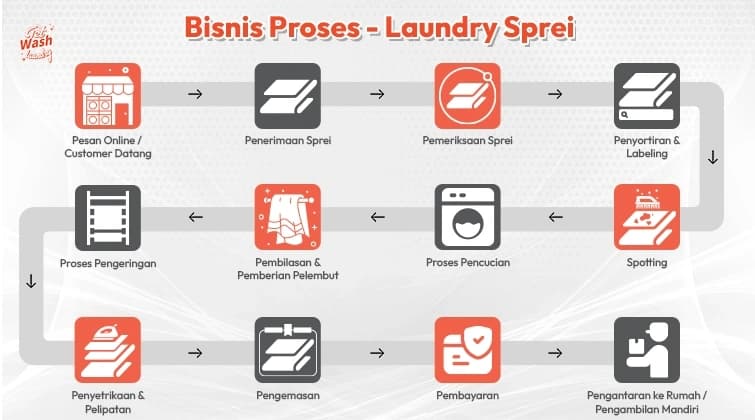
The service page does not list a turnaround time, process details, or a written FAQ, and the process section is an image only. So three things are best confirmed when you order: the set contents, the expected completion, and your pickup zone. A written confirmation over WhatsApp prevents surprises at the end.
One set, many layers: sheet, bedcover, and pillow
The sheet is only one layer of the bed. Above it is a blanket or bedcover, below it the mattress and protector, and at the head the pillows. Each layer has its own rhythm: sheets most often, bedcover cleaning less often, and pillows and mattress least often but still needing attention. Understanding this order helps you build a schedule that does not wash everything at once.
A monthly cost example
To make prices tangible, here is an illustration (not a real customer case). A house has a King master bedroom and two Single children's rooms. If each room is washed once a month, the cost is Rp110,000 + Rp55,000 + Rp55,000 = Rp220,000 before pickup and delivery. If the master bedroom is washed twice a month, add Rp110,000 for a total of Rp330,000.

Figure 3. Monthly bedsheet laundry cost examples (bedsheet-laundry-monthly-cost-examples-getwash-en.png)
Another example: a boarding house with ten Double rooms whose sheets are washed once a month spends 10 × Rp80,000 = Rp800,000 a month before pickup. For owners of boarding houses, homestays, or small hotels with regular volume, contact our business team to discuss B2B laundry.
Working out the cost per night
Another way to judge the price is to divide it by the nights of use. A King sheet washed at Rp110,000 and used for two weeks comes to about Rp7,900 a night. A Single at Rp55,000 over the same period is about Rp3,900 a night, and a Super King at Rp125,000 about Rp8,900. These are simple estimates, but they show that a fresh bed is a small daily cost compared with the benefit of a comfortable sleep.
Washing or buying new sheets
Some people buy new sheets when the old ones feel dull. Yet a sheet that is still strong often looks far fresher after proper washing. Buying new makes sense when the fibres are worn, torn, or the elastic is loose. While the cloth is still healthy, regular care is usually cheaper than replacing it.
Ways to save without sacrificing cleanliness
First, group items in one order: send sheets with other items so the pickup charge is not paid repeatedly. Second, own two or three sets in rotation so the bed is never bare. Third, set a fixed schedule, for example at the start of each month, so you never wash in a rush or need to pay for a faster service.
Compared with washing at home
Washing sheets yourself looks cheap, but there are hidden costs: electricity and water, detergent, the time spent drying and ironing, and the risk of sheets not drying fully in wet weather. At Rp55,000 to Rp125,000 per set, you pay for cloth that is washed, dried, and ready to fit, so your time can go elsewhere.
Pickup and delivery rates
Since 20 June 2026, pickup and delivery is no longer free. The rate is charged per trip by distance from the nearest outlet: Zone 1 (0–3 km) Rp8,000, Zone 2 (3–7 km) Rp15,000, Zone 3 (over 7 km) Rp22,000. Customer Service confirms your zone when you order. Send several items together in one order so the pickup charge is not paid repeatedly.
About promotions
The meta description of the English service page mentions a 20% discount and free pickup. Because the pickup rate policy changed on 20 June 2026 and the discount terms are not explained on the page, ask Customer Service about the promotion currently in force before ordering.
Express option
The service page mentions express service, without a price or time frame. If you need your sheets back sooner, ask Customer Service about the availability and cost of express laundry. For clothing we have express laundry, but for sheets, availability follows the queue and the condition of the items.
The Changing Rhythm: How Often, How Many Sets to Own, and How to Plan
The question asked most is not about price but about how often sheets should be changed. There is no single number that suits everyone, but there is a way of thinking that helps.
General guidance on how often to change sheets
Many sleep-hygiene guides suggest changing sheets roughly once a week to once every two weeks. Weekly suits those who sweat easily, sleep with pets, have allergies, or are unwell. Every two weeks can be enough for those who rarely sweat, sleep alone, and wear clean sleepwear. Treat that as a starting point, then adjust to the signs you notice.
Factors that shape the rhythm
- Sweat and climate: a room without air conditioning in humid weather makes sheets damp quickly.
- Pets: hair, dust, and outdoor dirt come up onto the bed.
- Allergies and sensitivity: dust-sensitive sleepers are usually more comfortable with shorter intervals.
- Showering and night creams: lotion, hair oil, and face masks move onto the pillow.
- Number of sleepers: a bed shared by two receives more than one used alone.
- Illness or travel: change earlier.
How many sets are ideal
A bed should not stand bare waiting for sheets to dry, so the key to a comfortable rhythm is owning enough sets. Two sets per bed is the minimum: one in use, one being washed. Three sets give slack: one in use, one at the laundry, one spare in the cupboard. If you use a laundry service with a turnaround of several days, three sets is the calmest option.
Planning a schedule for a house with several bedrooms
An illustration (not a real customer case): a house has a King master bedroom, two Single children's rooms, and a Double guest room. Instead of sending everything at once, schedule in turns: the master bedroom in the first week, the children's rooms in the second, and the guest room only before guests arrive. This spreads the cost, keeps the queue light, and means no room loses its sheets at the same time.
A realistic sheet schedule for a year
Imagine a home with two sleepers using three King sheet sets. With a change every two weeks, each set is used for about two weeks and then washed, so one set is always at the laundry or ready in the cupboard. That is about twenty-six changes a year. At Rp110,000 per set, it comes to roughly Rp2.86 million a year. This is a simple illustration and does not include pickup, but it helps you decide whether a two-week or monthly rhythm suits your budget.
If the budget feels tight, do not sacrifice cleanliness where fabric touches skin most, the pillowcase. Changing pillowcases more often while stretching the interval of the main sheet is a sensible compromise for many families.
A rhythm for office workers and young families
For workers who come home late and only have weekends, a fixed schedule matters more than an exact interval. Pick a date, for example the first Saturday of each month, and send sheets together with other laundry so the pickup charge stays low. Families with small children usually need a tighter rhythm, so three sets per child's bed makes the routine far calmer.
If you run a homestay or short-term rental
Short-term rental hosts face a different pressure: rooms must be ready before the next guest arrives. A practical rule is to own at least three times as many sets as the rooms that can be occupied at once, so one set is on the bed, one at the laundry, and one ready to use. That way a delay in turnaround does not immediately affect the guest schedule.
A hotel habit you can copy at home
The reason hotel sheets feel so fresh is discipline in rotation: they are changed at fixed intervals, dried fully, and stored dry. You can copy that discipline at home. Set a schedule, keep a spare set, and do not wait until the sheets smell. This simple habit matters more than any fragrance.
Sheets for boarding houses, homestays, and small hotels
Our service page says this service is for homes, boarding houses, and hotels. For businesses with many rooms, the most important thing is rhythm: how many sets per room, how often they are washed, and how to keep rooms ready to rent. We suggest at least two sets per room. For regular volume, Getwash B2B laundry can be scheduled; contact the business team through the contact form.
Rainy season and drying
In the rainy season, sheets dried indoors take long to dry and easily smell musty. This is when a professional laundry with controlled drying feels most useful. Where possible, order before the peak of the rains so you are not stuck with sheets that never quite dry.
Do not overdo it either
Washing sheets too often is not always better. Each wash and dry puts stress on the fibres, especially fine fabrics. A good balance: change at a sensible interval, wear clean sleepwear, and keep sheets dry in storage.
Common Bedsheet Problems: Musty Odour, Yellowing, Stains, Rough Fabric, and Colour Bleed
Every sheet owner has faced one of these problems. Here are the causes, the treatment, and an honest line on what can be expected.

Figure 4. Bedsheet problems and treatments (bedsheet-problems-and-treatments-getwash-en.png)
Musty odour
A musty smell comes from moisture trapped in the fibres and the growth of mould or bacteria. Spraying fragrance only masks it. The right treatment cleans down to the fibre, rinses thoroughly, and dries the whole cloth. A sheet stored while still damp will smell again even after washing.
Yellowing on white sheets
Yellow on white sheets usually comes from oxidised body oil and sweat, not surface dirt. So the result depends on how deep the yellowing is: light yellow is easier to recover than long-standing yellow. We do not promise the sheet returns to brand-new white.
Sweat, hair oil, and cosmetic stains
Marks around the pillow are the most common: hair oil, powder, cosmetics, and saliva. Treatment works better when the stain is recent and has not met heat. Avoid scrubbing hard. For particular stains such as ink, rust, or colour bleed, we offer ink stain removal, rust stain removal, and colour bleed removal.
Rough, pilled fabric
Old sheets often feel rough and fuzzy on the surface. That is a sign of fibres worn by friction and repeated washing, and it cannot be removed entirely. Proper washing and not-too-hot drying slow it down, especially on microfibre.
Colour bleed
Dark or patterned sheets can release colour when wet, especially new ones. This risk is assessed before washing, and it is why coloured sheets should not be mixed with white ones. Tell us if your sheet is new and its colour is still intense.
Loose elastic on fitted sheets
On fitted sheets, the elastic at the corners can weaken from heat and repeated stretching. That is one reason fitted sheets should not be dried too hot or wrung hard. Elastic that is already very loose cannot be restored by washing.
Snagged threads and pulls
On sheets that rub against nails, jewellery, or zips, threads can be pulled and form bumps. Do not cut them close to the weave, because that makes a hole; it is safer to tuck the thread back in. Tell us if your sheet already has pulled threads so they are not mistaken for new damage after washing.
Detergent and softener residue
A sheet that feels stiff or smells sharp sometimes holds detergent or softener that was not rinsed out. Too much softener can also reduce the cloth's absorbency. Thorough rinsing matters more than adding fragrance.
Fragrance: how much is enough
A fresh sheet should smell clean, not overpowering. A scent that is too strong can bother sensitive sleepers and can cover a musty smell without removing it. If you or a family member is sensitive to fragrance, say so when ordering so it can be noted.
Creases and fold lines
Sheets stored for long often carry sharp fold lines. That is only a matter of appearance and fades after a few hours on the bed or with a light iron. Linen and cotton crease more easily, while microfibre resists creasing. Creases are not a sign the sheet is dirty or damaged.
After illness or flu season
After someone at home has been ill, many people want to refresh the bedding. That is a natural step. Send those sheets separately from other items if you are concerned, and for particular medical conditions follow the advice of health professionals; a laundry service is not a substitute for medical advice.
Will the sheet look brand new?
We do not promise a sheet will return to its first day. A sheet used for years has natural wear and old stains that cannot all be removed. What we can aim for is a sheet that is cleaner, fresher, sweet-smelling, and brighter, together with an honest assessment at the start.
Torn or fragile sheets
A sheet with large tears or fibres that have become brittle cannot always be washed safely. In that case we give advice before work.
Caring for Bedsheets at Home, in Boarding Houses, and in Hotels, and How to Order with Pickup
The best results come from teamwork between professional laundry and daily habits. Here is how to keep sheets fresh between washes, and how to order our service.
Habits that keep sheets fresh
- Let the bed breathe. After waking, fold back the covers and let air reach the bed for a few minutes before making it.
- Wear clean sleepwear. Washed nightwear reduces what moves onto the sheet.
- Avoid eating in bed. Crumbs and spills are hard to clean.
- Deal with stains at once. Blot with a clean cloth; do not rub.
- Do not store damp. Make sure sheets are completely dry before folding.
- Use a mattress protector. A washable layer shields the mattress from sweat and spills.
Caring for sheets between washes
Besides changing sheets, a few small things extend freshness. Straighten the sheet each morning so it does not crease and pull. Rotate pillows and change pillowcases more often if you use hair oil. And keep clean sheets in a dry cupboard, away from damp clothing.
Storing clean sheets
Store clean, dry sheets somewhere cool and ventilated. Avoid airtight plastic for long periods because it traps moisture. One small habit often forgotten: label the stack with the date of the last wash, so you know which sets have been stored a long time and need airing.
Sheets for babies and small children
Baby bedding touches more sensitive skin. If the sheets are for a baby, say so when ordering, including if the child's skin is easily irritated by fragrance, so the note can be observed. Change a child's sheets more often because spilled milk and diaper leaks are unavoidable, and use a waterproof pad under the sheet if needed.
Services that often go with bedsheet laundry
Customers who wash sheets usually also have other bedding and household items needing similar care: bedcover cleaning, pillow care, carpet cleaning, wet cleaning, and per-kilo laundry. Handing everything over together saves on the pickup charge.
How to order
Our service page invites you to contact us to schedule your order. The most dependable way: message WhatsApp 0812-6610-0500 or use the order page. You can also visit the outlet at Jl. Ceger Raya No.42, Jurang Mangu Barat, Kec. Pd. Aren, Kota Tangerang Selatan, Banten 15222.

Figure 5. Six steps to order bedsheet laundry (six-steps-to-order-bedsheet-laundry-getwash-en.png)
- Check your mattress size (Single, Double, Queen, King, or Super King) and the sheet fabric if you know it.
- Send a message over WhatsApp or the order page, with a photo if there is a stain.
- Customer Service confirms the set contents, the price, the expected completion, and your pickup zone.
- A courier collects from your address.
- The sheets are washed, dried, and packed; follow progress on the tracking page.
- The sheets are delivered back to your address or collected at the outlet.
Checklist before handing over sheets
- Note the mattress size and the number of sets you are sending.
- Separate white sheets from coloured ones.
- Remove small items caught in the sheet, such as clips or mattress straps.
- Photograph any stain or damage that already exists.
- State special needs: allergies, fragrance, or sensitive skin.
- Ask for the expected completion and keep the order number for tracking.
How to fold a fitted sheet neatly
Fitted sheets are famously hard to fold. The trick: put your hands into two adjacent corners, fold one corner into the other, repeat with the other two so the shape becomes a rectangle, then fold it like ordinary cloth. This keeps the stack in the cupboard flat and easy to pick up.
Making the bed the hotel way
Clean sheets feel more special when fitted neatly. Pull the sheet taut at all corners, set pillows with the open end of the case facing in, and fold the blanket at the foot. These small details do not change cleanliness, but they change the impression of the room in an instant, and that is what makes people feel they are staying in a hotel.
When not to put it off any longer
There are moments when delaying a sheet wash no longer makes sense: after illness, after a spill, after overnight guests, after long travel, and when a musty smell appears. In those cases, sending the sheets promptly is better than waiting for the monthly schedule. This simple habit means you never sleep on sheets you already wished you had changed.
Preparing the guest room
Homeowners who often host overnight guests know the guest room tends to be forgotten: its sheets are rarely used, yet still hold dust and moisture. Wash the guest room sheets before the visiting season and store them dry, so the room is ready without a musty surprise when guests arrive.
Service hours and location
Service hours: Monday–Friday 09.00–17.00, Saturday 09.00–15.00, closed Sundays. Our main outlet is at Jl. Ceger Raya No.42, Jurang Mangu Barat, Kec. Pd. Aren, Kota Tangerang Selatan, Banten 15222. We serve customers in Pondok Aren, Bintaro, and around, as well as through other outlets and service areas listed on the outlets page.
How to choose a bedsheet laundry service
Before leaving sheets with any laundry, ask simple questions: how is the price worked out, what is in a set, how is drying done, what is the expected time, and what is the policy on complaints. Clear, consistent answers signal a service you can trust. The same questions apply to us.
Because some information on our service page sits in images or hidden sections, do not hesitate to ask Customer Service for a written breakdown before you agree. Customers who understand what they are buying are almost always happier with the result, and we would rather answer a hundred questions at the start than one complaint at the end.
Ready to refresh your bed? Order through the order page, contact WhatsApp 0812-6610-0500, or follow us on Instagram, TikTok, Facebook, and Threads.
FAQ: Questions About Getwash Bedsheet Laundry
What is the bedsheet laundry service at Getwash?
A service that washes bedsheets and bedding for homes, boarding houses, and hotels, with pickup from your location, and results that are clean, fresh-smelling, and hygienic.
How much does bedsheet laundry cost at Getwash?
Per set: Single (90 × 200) Rp55,000, Double (120 × 200 to 140 × 200) Rp80,000, Queen (160 × 200) Rp100,000, King (160 × 200) Rp110,000, and Super King (200 × 200) Rp125,000.
What is included in one set?
According to the service page, the sheet with pillowcases and bolster covers. Confirm the exact count and type of sheet with Customer Service when you order.
Why are Queen and King both 160 × 200 but priced differently?
The service page does not explain this. State your actual mattress size and ask Customer Service which price group applies.
How long does bedsheet laundry take?
The service page does not list a turnaround time. Ask for the expected completion when you order and follow it on the tracking page.
Is there an express option for sheets?
The service page mentions express service without a price or time frame. Ask Customer Service about availability and cost.
Does Getwash provide pickup and delivery for sheets?
Yes. Since 20 June 2026 the rate is Rp8,000 (Zone 1, 0–3 km), Rp15,000 (Zone 2, 3–7 km), or Rp22,000 (Zone 3, over 7 km) per trip.
How often should sheets be changed?
Many guides suggest once a week to once every two weeks, more often if you sweat easily, sleep with pets, have allergies, or are unwell.
How many sets of sheets should I own?
At least two per bed; three is more comfortable if you use a laundry service with a turnaround of several days.
Can white sheets return to white?
It depends on how deep the yellowing is. Light yellowing is easier to recover, but we do not promise a return to brand new.
How do I order?
Message over WhatsApp or use the order page, stating your mattress size and the fabric if known. Customer Service confirms the set contents, price, time, and zone.
What are Getwash's service hours?
Monday–Friday 09.00–17.00 and Saturday 09.00–15.00. Closed on Sundays. Messages can be sent any time and are answered in the next service hours.
Does Getwash serve high-profile customers and high-value sheets?
Yes. Getwash is trusted as the go-to laundry for officials, public figures, business people, and celebrities, and is used to handling high-value items with privacy protected.
Sources
- Getwash Laundry bedsheet laundry service page
- Getwash Laundry Sprei page (ID)
- Getwash Laundry tracking page
- New Policy Notice: Pickup & Delivery Rates (effective 20 June 2026)