Dry Cleaning
- SweaterRp 50.000
- Shirt / Kemeja
Estimasi 5 Hari Kerja
Rp 50.000 - Trouser / Celana PanjangRp 60.000
- Jas EmbellishedRp 75.000
- Bendera Indonesia
DRY CLEAN BENDERA INDONESIA FREE !
0 - Baju SafariRp 46.000
- Jas Full Payet
Jas full payet
Rp 84.000 - 1 Stel Safari
Atasan Dan Bawahan
Rp 68.000 - JaketRp 70.000
- Hoodie - GucciRp 150.000
- Premium Sofa Cushions
P 205 x T 70 cm
Rp 95.000 - Jacket - Moncler PufferRp 375.000
- Top LuxRp 75.000
- Blouse EmbellishRp 100.000
- Kebaya EmbellishedRp 115.000
- Kebaya Embellished SpcRp 210.000
- Veest / BustierRp 60.000
- Jas - Bespoke Tailor
Jas STD, Non Wool.
Rp 70.000 - Jas - 3 piece suit
[STD] • Jacket (Jas luar), • Waistcoat atau vest (Rompi) , • Trousers (Celana panjang)
Rp 175.000 - Jas - Bespoke Tailor Luxury
Loropiana, Zegna, Ceruti, Guabello dsb.
Rp 150.000 - Bespoke T-shirtRp 61.000
- TieRp 60.000
- Batik Tulis
Prada / ATBM / Sutra
Rp 150.000 - Batik
Estimasi 5 Hari Kerja
Rp 70.000
Contact us to schedule your order
09:00-20:00 (Weekday) & 09:00-17:00 (Weekend)
Ulasan Pelanggan
- Dedek ibnu efendi5.0
Layanan Dry Cleaning ini hasilnya bersih maksimal. Saya puas dan akan memakai lagi.
- lia faroh5.0
Saya kaget banget ternyata ada loundry yang se'bersih dan se-detail ini loh 😱 alasannya.. 1. Getwash loundry menerima segala jenis cucian dengan wetclean (cuci basah) ataupun dryclean (cuci kering) mulai dari pakaian, selimut, bedcover, karpet, sepatu, stroller dan lain-lain. 2. Pembersihan dilakukan dengan 7 cara: ✅Pengecekan bahan ✅pengecekan kotoran ✅pencucian dengan cara terbaik ✅pengecekan hasil finishing dengan tangan ✅pengecekan kancing, benang dan lain-lain ✅pengecekan ulang debu, kotoran, noda yang tertinggal ✅pengemasan 3. Pelayanan sangat bagus dan cepat. Jika ada keluhan akan dilayani dengan baik dan diproses kembali dengan gratis. 4. Pembayaran bisa cash, qris, kartu kredit ataupun bank tansfer. 5. Bisa antar jemput maksimal 2km dari lokasi Getwash.
- Agus Suharwan5.0
Amazing banget hasilnya, suka banget sama layanan home servicenya. Sangat di rekomendasikan
- Michelle Miracle5.0
Superb services !
- Rendy5.0
terbaiikkkk
- Erna Sari5.0
Laundry disini pelayanan nya bagus, petugas nya ramah2, kwalitas laundry nya juga TOP BeGeTe deh..
- Tris Sianti5.0
Best bangettt
- Mangku Balok5.0
Keren banget laundrynya, hasilnya bersih. Top markotop 🔥
- Argha Prasetya5.0
sangat recommended sekali, puas dengan service dan hasil loundrynya. mantapp🙌🏻
- Dias5.0
Layanan Dry Cleaning ini hasilnya bersih maksimal. Terima kasih atas pelayanannya.
Getwash Dry Cleaning: Price per Item, the 11-Step Process, and Pickup & Delivery
By the Getwash Laundry Team | Updated 11 October 2026 | ±24 min read
|
QUICK ANSWER Getwash dry cleaning is priced per item: vest Rp38,000, shirt and trousers Rp42,000, standard suit jacket Rp53,000, up to a fully sequinned jacket at Rp84,000. Turnaround is 5–7 working days, with pressing and neat folding or hanging included. Pickup and delivery has been paid by zone since 20 June 2026: Rp8,000 (0–3 km), Rp15,000 (3–7 km), Rp22,000 (over 7 km) per trip. |
A suit for a wedding, a kebaya that comes out once a year, a favourite silk shirt: clothes like these do not announce that they are valuable, but their owners know. One wrong wash is enough to turn good fabric dull, shrunken, or shapeless. That is why dry cleaning exists, and why questions like “how much”, “how long”, and “is it safe for my fabric” deserve honest and complete answers.
This guide is a full reference to dry cleaning at Getwash Laundry. You will find the price list per item, totals for real needs (office bundle, safari set, sequinned jacket), our 11-step process from pickup to delivery, an answer on whether pickup and delivery is free or paid, guidance on how often garments need dry cleaning, how to read care label symbols, and how to look after clothes between cleanings.
In this article
1. What Is Dry Cleaning and When Do You Need It
2. Getwash Dry Cleaning Price List 2026
3. The Getwash Dry Cleaning Process: 11 Steps from Pickup to Delivery
4. Dry Cleaning Pickup and Delivery: Free or Paid?
5. Caring for Your Clothes: How Often, Reading Labels, and Handling Stains
6. How to Choose a Dry Cleaner, Book, and Service Areas
What Is Dry Cleaning and When Do You Need It
Dry cleaning is a method of cleaning clothes without water, using a special liquid solvent in place of water and detergent. Because the fibres are not soaked, delicate fabrics are far less likely to shrink, stretch, or lose their shape. The solvent also works well on oily stains that water struggles to release.
Dry cleaning, wet cleaning, and regular washing: what is the difference?
- Regular washing (by the kilo) uses water and detergent on a standard cycle with machine drying. Suitable for everyday clothes, not for water-sensitive fabrics.
- Wet cleaning uses water and a special eco-friendly detergent with a very gentle technique. Suitable for delicate fabrics that can still take water, such as cotton, linen, viscose, and formal workwear.
- Dry cleaning uses a solvent without water. Chosen for fabrics that must not get wet or that have structure and details that are easily damaged.
In other words, the three are not “cheap, medium, expensive” tiers but three tools for three kinds of fabric. Choosing the wrong tool is the main reason clothes are damaged after washing.
When should you choose dry cleaning?
Getwash recommends dry cleaning for garments made of delicate fabric, that bleed colour easily, or that have special details such as embroidery, sequins, or a fabric structure that must not get wet. The ones we receive most often:
- Suits, blazers, and formal vests, especially wool, which have internal structure (canvas, shoulder padding).
- Kebaya, evening gowns, and traditional fabrics whose embroidery or sequins must not be soaked.
- Batik tulis and batik chosen for important occasions.
- Wool, silk, and other fine fabrics, which we strongly recommend dry cleaning to preserve their quality.
- Garments labelled “dry clean only”, whatever the material.
- High-value sweaters, jackets, and hoodies.
Garments that need a conversation first
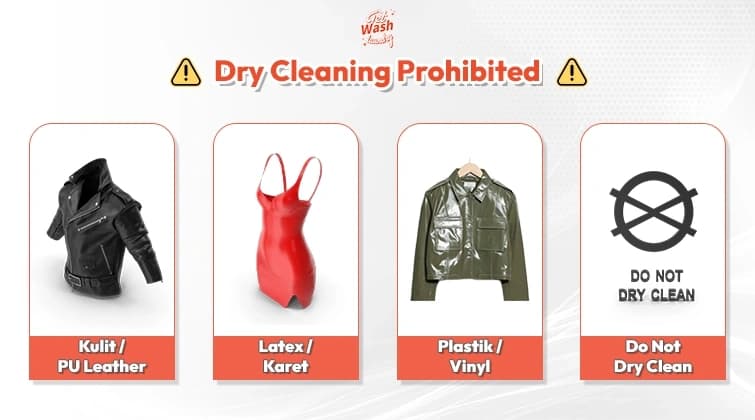
Leather, suede, and fur need special handling and equipment. Getwash has specialists for materials such as suede, but please ask Customer Service before booking.
Getwash and Hariom's Tailor
One sign of trust in our dry cleaning comes from the world of suit tailoring. Since December 2023, Getwash has been the dry cleaning partner for clients of Hariom's Tailor, a bespoke tailor in Pasar Baru, Central Jakarta, with more than 70 years of experience. Hariom's clients receive a 10–20% discount on dry cleaning at Getwash.
A tailor who builds suits by hand knows better than anyone how costly one care mistake is. Their advice to clients is simple, and we repeat it in the care section: do not dry clean too often, and do not store a suit in its protective plastic.
Getwash Dry Cleaning Price List 2026
Below is the official Getwash dry cleaning price list as shown on our service page (men's clothing category). Prices are per item.

Figure 1. Getwash dry cleaning price list per item
Full list in text
- Vest: Rp38,000
- Shirt: Rp42,000 (estimated 5 working days)
- Trousers (jeans, formal, and others): Rp42,000
- Batik: Rp46,000 (estimated 5 working days)
- Safari shirt: Rp46,000
- Sweater: Rp50,000
- Standard suit jacket (non-sequin): Rp53,000
- Batik tulis: Rp60,000
- 1 safari set (top and bottom): Rp68,000
- Jacket: Rp70,000
- Half-sequin suit jacket: Rp75,000
- Full-sequin suit jacket: Rp84,000
- Premium sofa cushion (205 × 70 cm): Rp95,000
- Gucci hoodie: Rp150,000
- Indonesian flag: free (promo)
What makes prices differ?
Price follows how complex the garment is to handle, not only its size. Three main factors:
- Garment structure. A suit has layers and padding, so it is more complex than a shirt.
- Decorative detail. Sequins and embroidery call for more careful handling.
- Fabric type and value. Batik tulis (Rp60,000) versus batik (Rp46,000), and a premium-brand hoodie (Rp150,000).
Insights from the price list

Figure 2. Price gaps: sequins, batik tulis, and the safari set
- Sequins add cost. A half-sequin jacket is Rp22,000 (about 42%) above a standard Rp53,000 jacket, and a full-sequin jacket is Rp31,000 (about 58%) above.
- Sets are cheaper. A safari shirt at Rp46,000 plus trousers at Rp42,000 comes to Rp88,000. Booked as 1 safari set it is only Rp68,000, saving Rp20,000 (about 23%).
- Batik tulis is Rp14,000 (about 30%) above regular batik, a fair gap for fabric whose wax-resist dyeing must not be damaged.
- Shirt and trousers are both Rp42,000, so a simple work outfit (shirt + trousers) is Rp84,000.
Real calculations: three sample orders
Office bundle: 1 suit jacket, 1 pair of trousers, 1 shirt
Rp53,000 + Rp42,000 + Rp42,000 = Rp137,000, excluding pickup and delivery. Because these are usually worn together, sending them in one order also saves on pickup cost.
Weekly needs: 3 shirts, 1 suit jacket, 2 pairs of trousers
(3 × Rp42,000) + Rp53,000 + (2 × Rp42,000) = Rp263,000 for six items.
Family event: batik tulis, trousers, and a shirt
Rp60,000 + Rp42,000 + Rp42,000 = Rp144,000. If the event is on a weekend, order at least 10 days ahead (see the turnaround section below).
Turnaround estimate
Average 5–7 working days, depending on fabric type and the condition of the garment. Shirts and batik are listed at 5 working days.
Working days are not calendar days. Assuming Monday–Friday.
- Order on Monday, back around Monday to Wednesday the following week.
- Order on Wednesday, back around Wednesday to Friday the following week.
- Order on Friday, back around Friday to Tuesday a week later.
For an event on a specific day, leave about 10 calendar days so there is room for adjustments or stain treatment.
What is included in the price?
- Inspection of garment condition and documentation with a digital notification.
- Stain pretreatment before the dry cleaning process.
- Dry cleaning in a water-free solvent machine.
- Drying, ironing or pressing, hand finishing, and detailing.
- Packaging, then neat folding or hanging according to the garment type.
- Rewash guarantee: if the result is not as expected, you can request a free re-clean via the rewash service form.
Pickup and delivery is not included in the per-item price. Details are in the next section.
Price comparison: we could not find public price lists from other providers that can be compared fairly, so we do not quote competitor figures. Our advice is to compare not just the number but what is covered: stain pretreatment, hand finishing, a re-clean guarantee, and order tracking.
The Getwash Dry Cleaning Process: 11 Steps from Pickup to Delivery
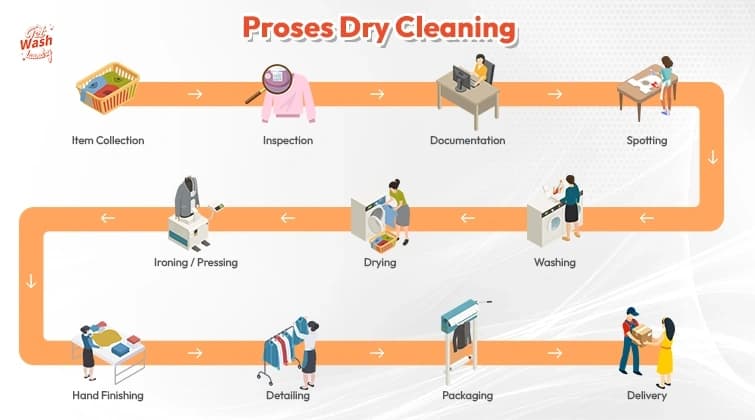
Dry cleaning results are decided by things you cannot see on a price tag: how carefully the garment is inspected, how stains are handled before the machine, and how neat the finishing is. Here are the 11 steps your clothes go through at Getwash.

Figure 3. The Getwash dry cleaning process in 11 steps
Steps 1–3: Pickup, inspection, and documentation
A courier collects your clothes from your location. On arrival at the outlet, our team inspects the condition of each garment: fabric type, care label, stains, buttons and zips, and any existing damage. The findings are documented and sent to you as a digital notification, so there are no surprises at the end.
Step 4: Stain treatment (spotting)
Stubborn stains are treated before the garment goes into the machine, because solvent alone does not always lift certain stains. At this stage the type of stain decides the product used. Getwash is an official distributor of professional spotting agents from SEITZ (Germany) and A.L. Wilson (United States), and uses them in our own process.
Step 5: Dry cleaning in a water-free solvent machine
This is the core of the process: garments are cleaned in a special machine using solvent, without water. Getwash states that it uses environmentally friendly technology and solvents tested to be safe for premium fabrics.
Steps 6–9: Drying, pressing, hand finishing, and detailing
After drying, garments are ironed or pressed according to fabric. Hand finishing and detailing are where the result shows most: a collar that stands neatly, a sharp trouser crease, a jacket shoulder without wrinkles, and sequins that do not snag.
Steps 10–11: Packaging and delivery
Garments are packaged and delivered to your address on the agreed schedule. You can follow your order at getwashlaundry.id/id/lacak using the order number from our digital receipt.
“Yes, all clothes will be ironed and folded or hung neatly according to the garment type.” — Official Getwash answer to “Will clothes be ironed after dry cleaning?” (translated from Indonesian)
About solvents: what you should ask
The longest-used solvent in dry cleaning is perchloroethylene (PERC or PCE), in use since the 1940s. A scientific review in the open-access journal archive PubMed Central notes that PERC irritates the respiratory system and skin, is neurotoxic, and is considered “likely to be carcinogenic to humans”. The US Environmental Protection Agency (EPA) even required PERC machines to be removed from residential buildings by 21 December 2020.
Alternatives discussed in the same review include professional wet cleaning (water and detergent in computer-controlled machines), liquid CO₂, and high-flashpoint hydrocarbon solvents, each with its advantages and limits. So the question worth asking any dry cleaner is simple: “Which solvent do you use?” A clear answer is the sign of a transparent provider.
Dry Cleaning Pickup and Delivery: Free or Paid?
The direct answer: since 20 June 2026, Getwash pickup and delivery is no longer free. The rate is charged per trip based on the distance between your address and the nearest Getwash outlet.
Pickup and delivery rates by zone
- Zone 1 (0–3 km): Rp8,000 per trip
- Zone 2 (3–7 km): Rp15,000 per trip
- Zone 3 (over 7 km): Rp22,000 per trip
One complete order involves two trips (pickup and delivery), so the total is Rp16,000, Rp30,000, or Rp44,000. The reasons for the adjustment are set out in our article “Getwash Laundry Pickup and Delivery Price Update”.
Same-day pickup is possible, depending on courier availability in your area. Contact Customer Service for details.
What share of the bill is pickup and delivery?

Figure 4. Pickup fee share: 1 suit jacket versus 6 items
Insights from this calculation
- Sending 1 suit jacket alone (Rp53,000) in Zone 3 spends Rp44,000 on pickup and delivery, about 45% of the Rp97,000 total.
- Sending 6 items (Rp263,000) in the same zone, pickup and delivery is only about 14% of the Rp307,000 total.
- In Zone 1, the share falls from about 23% (1 jacket) to about 6% (6 items).
The point: because the pickup fee is fixed per trip, collecting garments and sending them at once is the most economical approach. Gather suits, shirts, and batik that need cleaning into one order, especially if you are in Zone 2 or 3.
When should you drop off yourself?
If an outlet is on your daily route, dropping off yourself means no zone rate. This is most sensible for 1–2 items in a far zone. If you are comfortable using your own online courier, that is open to you too, especially for addresses outside the service area.
Payment
You can pay by cash, bank transfer, e-wallet (GoPay, OVO, DANA, LinkAja), and credit or debit card, either through the tracking page or at pickup or delivery.
Caring for Your Clothes: How Often, Reading Labels, and Handling Stains
Dry cleaning is not a habit to repeat as often as possible. Good clothes are looked after correctly, not frequently. This section summarises the guidance we find most useful.
How often do garments need dry cleaning?
Common guidelines give a rule of thumb based on number of wears. Laundryheap, for example, suggests business suits every 4–5 wears, button-down blouses every 3–4 wears, silk blouses after every wear, and jackets and coats once per season. Orami (Indonesia) suggests dresses and suits every 1–2 wears.

Figure 5. General guide to how often garments need dry cleaning
Note that these sources disagree, and suit tailors take a more sparing view. Hariom's Tailor, a tailor with more than 70 years of experience, answers the same question this way:
“Not too often, unless you have had a spill, a stain or an odour. For regular care, simply have the suit pressed from time to time.” — Hariom's Tailor, official FAQ page
Reconciling the two views
The wear-count guideline is an upper limit for intensively worn garments. The tailor's view is a lower limit to protect the fibres. Our rule of thumb, based on both:
- Dry clean when there is a reason: a stain, spill, odour, or a change of season before storage.
- In between, light care: hang so it can “breathe”, steam or press, and treat small stains locally.
- Do not schedule by calendar alone. A suit worn twice a month does not need the treatment of one worn daily.
Cost per wear
If a Rp53,000 suit jacket is dry cleaned every 4–5 wears, it costs about Rp10,600–13,250 per wear. If you wear it twice a week, that is under Rp27,000 per week. Compare that to the price of the suit itself: correct care is cheap insurance on a much more expensive investment.
Reading care label symbols
The label inside a garment is the maker's “recipe”. These symbols are the most relevant for dry cleaning:

Figure 6. Meaning of dry clean symbols on garment care labels
- Plain circle: the garment can be professionally cleaned.
- Circle crossed out: do not dry clean.
- Letter P or F inside the circle: marks the group of solvents that may be used (P relates to perchloroethylene, F to hydrocarbon solvents).
- Bar under the circle: one bar means gentle treatment, two bars mean very gentle.
If the label is missing or unreadable, do not guess. Bring it to us and the team will check the fabric before deciding how to handle it.
Care by garment type
Each type of garment has its own vulnerabilities. Here is what we find most worth paying attention to.
Suits and blazers
A suit is built from several layers: outer cloth, lining, and in the chest and lapel usually a canvas or reinforcement. That structure is what makes a suit drape beautifully, and it is what must not be soaked and scrubbed. Dry cleaning protects the shoulder and lapel shape, while good pressing restores the lines of the jacket without damaging the canvas.
Kebaya, evening gowns, and beaded or sequinned garments
Sequins and beads are sewn or glued on, and the adhesive and thread can weaken with water and friction. That is why sequinned jackets and beaded garments carry a higher rate: handling must be slower and more careful. Tell us if any beads are already loose before handing the garment over, so its condition is recorded from the start.
Batik and batik tulis
Batik tulis is made by drawing hot wax on cloth, then dyeing it in layers. Those rich colours are exactly what is most likely to bleed if washed wrongly. Dry cleaning avoids water and helps preserve colour and motif, which is why batik chosen for important occasions is safer handled by dry cleaning.
Wool, silk, and sweaters
Wool can shrink and felt when exposed to water, heat, and agitation. Silk is prone to water marks and loses its sheen. Both are fabrics we strongly recommend dry cleaning. For sweaters, avoid hanging them, because their weight will stretch the shoulders. Fold and store flat.
High-value jackets and hoodies
Garments with prints, embroidery, and premium brand labels (like the branded hoodie on our price list, Rp150,000) need a detailed inspection before processing. Details such as prints or embroidery are often the first part damaged by rough handling.
Sofa cushions and fabric furnishings
Our price list also includes a premium sofa cushion measuring 205 × 70 cm at Rp95,000, a sign that dry cleaning is not limited to clothing. Upholstery fabric that must not get wet is safer handled this way.
Care between dry cleanings
Most day-to-day care does not require dry cleaning. These five small habits lengthen the gap between visits:
- Hang after wearing in a ventilated place for a few hours before putting it in the wardrobe, so perspiration vapour can evaporate.
- Brush gently wool with a clothes brush to lift dust and loose fibres.
- Steam, do not iron directly, to remove creases on delicate fabrics.
- Treat small stains straight away by blotting, not rubbing, and hand over if it does not lift.
- Rotate garments. Do not wear the same suit or blazer on consecutive days. Rest between wears gives the fibres time to recover.
These simple habits match the tailor's message above: what keeps clothes in good condition is a patient care rhythm, not a high frequency of dry cleaning.
Handling stains: what works and what does not
Dry cleaning does not automatically remove every stain. Our service page says so plainly: not all stains can be removed, especially old stains or certain chemical stains. Several things decide the odds:
- Age of the stain. The sooner it is treated, the better the odds. For Getwash's add-on stain removal services, new stains generally have about a 70–90% chance and old stains about 25–60%, depending on stain and fabric.
- Type of stain. Protein stains (blood, milk, egg), tannin stains (coffee, tea, wine), oily stains, and paint stains each need different spotting agents.
- Type of fabric. Some materials, such as silk and acetate, are sensitive to certain agents.
- Earlier processing. Stains exposed to heat, such as an iron or dryer, tend to set and are harder to lift.
First aid before handing over
- Blot, do not rub. Rubbing pushes the stain into the fibres.
- Do not apply water or bleach to dry-clean-only fabrics.
- Avoid heat. No iron or dryer before the stain is treated.
- Note the cause and when it happened, then tell the team at pickup or write it in the special instructions.
Storing clothes after dry cleaning
One common mistake happens right after dry cleaning: leaving garments permanently in their protective plastic. Hariom's Tailor explains it well:
“Never store a suit in its protective dry-cleaning bag, as it encourages mildew and hardens fabric. Like an aged wine, a fine suit needs to breathe. Hang it on a shaped hanger.” — Hariom's Tailor, official FAQ page
- Remove the plastic as soon as the garment arrives, especially for long-term storage.
- Use a shaped hanger for suits, not a wire hanger.
- Rest between wears. Hariom's suggests hanging a suit for about a week between wears, because wearing it repeatedly without rest can burn the face fibres and cause a shiny finish.
- Store in a dry, ventilated place. Humidity is the main cause of mildew and musty smells.
- Clean before long storage. Garments stored dirty can attract insects and make stains harder to lift.
Myths and facts about dry cleaning
Myth: dry cleaning means no chemicals
Fact: “dry” only means without water. Garments are still cleaned with a liquid solvent, which is why the choice of solvent and how it is managed matters. Ask your provider.
Myth: the more often you dry clean, the cleaner and longer-lasting your clothes
Fact: the sources we reference warn that excessive dry cleaning can shorten a garment's life. Suit tailors recommend doing it only when needed.
Myth: dry cleaning always removes every stain
Fact: results depend on the type of stain and fabric. Old stains and certain chemical stains cannot always be removed. That is why we state the odds up front.
Myth: the protective plastic is safe for storing a suit
Fact: the plastic is for the trip home only. For storage, plastic traps moisture and invites mildew. Use a shaped hanger and let the suit breathe.
How to Choose a Dry Cleaner, Book, and Service Areas
Five questions for any dry cleaner
Whether or not you choose Getwash, these questions help you judge a dry cleaning service objectively:
- Which solvent is used, and are alternatives available for sensitive fabrics?
- How are inspection and documentation of garment condition done before processing?
- Is there stain pretreatment before the machine, and who handles it?
- What is the policy if the result is not right, is there a rewash guarantee?
- Are pricing, turnaround, and pickup fees explained upfront, and can the order be tracked?
At Getwash, the answers to all five are in this article, and our Customer Service team is ready to explain more at any time.
A timeline for important events
For a wedding, graduation, or large family event, count backwards from the day:
- 14 to 10 days before: hand over the suit, kebaya, or batik. This leaves room for the 5–7 working day estimate and stain treatment if needed.
- 7 to 5 days before: receive the garments, check the result, and request a rewash if anything is off.
- 3 days before: try everything on with accessories, then hang on the right hanger.
- 1 day before: steam or lightly press if needed, and keep it somewhere not humid.
Sending one week ahead may be enough, but it leaves no room for a rewash. A few extra days is a very cheap price for peace of mind.
Five common mistakes when handing over clothes
- Forgetting to empty pockets. Keys, cards, and pens can damage garments and machines.
- Not mentioning stains. A stain mentioned upfront lets the team choose the right spotting agent.
- Sending too close to the deadline. 5–7 working days is not 5–7 calendar days.
- Mixing dry-clean items with ordinary laundry in one order without saying so, so the service used does not match.
- Ignoring a missing label. Without a label, the fabric must be checked by the team before processing. Tell us so handling is not guessed.
How to book dry cleaning at Getwash
- Contact Customer Service via WhatsApp 0812-6610-0500, the website, or the Getwash app, and choose Dry Cleaning.
- Fill in the Pickup & Delivery form and send your pickup address. Customer Service will tell you the zone and rate for your address.
- Prepare your clothes. Empty pockets, separate dry-clean items from ordinary laundry, and mention any particular stains.
- Our team collects, inspects, then sends a digital notification about the condition of your garments.
- Track and receive. Follow the order at getwashlaundry.id/id/lacak, then receive neatly finished garments at your address.
Dry cleaning for office uniforms and business
Besides individual customers, Getwash serves institutional clients such as hotels, hospitals, and commercial facilities, and offers B2B partnerships for guesthouses and hospitality businesses with consistent delivery schedules. For companies, dry cleaning is most often used for office uniforms, management suits, and corporate event attire.
- Regular schedules avoid order spikes before events and reduce the pickup cost per item.
- A clear price list makes monthly or annual budgeting easier.
- Digital notifications and tracking help HR or general affairs follow orders without phone calls.
- Contact our team for regular volume, because partnership schemes can be tailored.
Complementary services
Dry cleaning is often combined with other Getwash services: wet cleaning for delicate fabrics that can take water, laundry by the kilo for everyday clothes, baby laundry, shoe and bag cleaning, curtains and carpets, and alterations and repairs. Sending everything on one pickup schedule also reduces pickup cost, as calculated above.
Customer experience
The 11-step process above only matters if it is felt by the customer. Google Maps reviews are the best mirror.
"Best dry cleaner in jakarta" — Steve, Getwash Laundry Google Maps review
Service areas, location, and opening hours
The dry cleaning service area covers West Jakarta, South Jakarta, Tangerang, South Tangerang, Bintaro, Pondok Aren, Ciledug, Meruya, and Puri Kembangan.
- Address: Jl. Ceger Raya No.42, Jurang Mangu Barat, Pondok Aren, South Tangerang, Banten 15222
- Opening hours: Monday–Friday 9:00 am–8:00 pm, Saturday–Sunday 9:00 am–5:00 pm
- WhatsApp: 0812-6610-0500
- Order tracking: getwashlaundry.id/id/lacak
Conclusion
Getwash dry cleaning is made for garments that must not be washed wrongly: vest Rp38,000, shirt and trousers Rp42,000, suit jacket Rp53,000, up to a full-sequin jacket at Rp84,000, with an 11-step process, a 5–7 working day estimate, and a rewash guarantee. Pickup and delivery is now paid by zone (Rp8,000–Rp22,000 per trip), but its share shrinks sharply when you send many items at once. And as suit tailors advise: care for clothes correctly, not as often as possible.
Ready to trust us with your best clothes? Contact us on WhatsApp or visit your nearest outlet. You Leave it, We Clean it!
FAQ: Getwash Dry Cleaning
How much does dry cleaning cost at Getwash?
Priced per item: vest Rp38,000, shirt and trousers Rp42,000, batik Rp46,000, safari shirt Rp46,000, sweater Rp50,000, standard suit jacket Rp53,000, batik tulis Rp60,000, jacket Rp70,000, half-sequin suit Rp75,000, and full-sequin suit Rp84,000. 1 safari set is Rp68,000. Pickup and delivery are charged separately.
What is dry cleaning?
Dry cleaning is a method of washing clothes without water, using a special solvent that is safe for sensitive fabrics such as suits, kebaya, evening gowns, and silk.
When should I choose dry cleaning instead of regular washing?
Choose dry cleaning for garments made of delicate fabric, that bleed colour easily, or that have special details such as embroidery, sequins, or a fabric structure that must not get wet, as well as garments labelled “dry clean only”.
How long does dry cleaning take?
On average 5–7 working days, depending on volume, fabric type, and garment condition. Shirts and batik take about 5 working days.
Is Getwash dry cleaning pickup and delivery free?
No. Since 20 June 2026 pickup and delivery is charged per trip: Rp8,000 (0–3 km), Rp15,000 (3–7 km), and Rp22,000 (over 7 km), measured from the nearest Getwash outlet. Customer Service will tell you the zone and rate for your address when you order.
Are clothes ironed after dry cleaning?
Yes. All clothes are ironed and folded or hung neatly according to the garment type.
Can dry cleaning remove stubborn stains?
In many cases yes, but the result depends on the type of stain and fabric. We use special pretreatment before the dry cleaning process. Not every stain can be removed, especially old stains or certain chemical stains.
Does Getwash accept formal suits and kebaya for dry cleaning?
Yes. We handle formal clothing such as suits, kebaya, evening dresses, and traditional fabrics.
Are wool and silk safe for dry cleaning?
Yes. Wool, silk, and other fine fabrics are strongly recommended for dry cleaning to preserve their quality. If in doubt, bring the garment and our team will check the label and fabric.
What if I am not satisfied with the dry cleaning result?
You can request a free re-clean by filling in the rewash service form. Getwash offers a satisfaction guarantee.
How often should a suit be dry cleaned?
Not too often. General guidelines suggest 4–5 wears for a business suit, while suit tailors advise dry cleaning only after a spill, stain, odour, or at the change of season, with regular pressing in between.
How should I store a suit after dry cleaning?
Remove the protective plastic, hang it on a shaped hanger in a dry, ventilated place, and rest it for about a week between wears.
Is dry cleaning environmentally friendly?
That depends on the solvent and how it is managed. Getwash states that it uses environmentally friendly technology and solvents.
How much is dry cleaning for 1 safari set?
1 safari set (top and bottom) is Rp68,000, which saves Rp20,000 compared with a safari shirt at Rp46,000 and trousers at Rp42,000 booked separately.
What is the Indonesian flag dry cleaning promo?
The price list shows dry cleaning of the Indonesian flag as free (Rp0) as a promo.
Do Hariom's Tailor clients get a dry cleaning discount?
Yes. As a partner since December 2023, Hariom's Tailor clients receive a 10–20% discount on dry cleaning at Getwash.
How do I pay and track my order?
Pay by cash, bank transfer, e-wallet (GoPay, OVO, DANA, LinkAja), or credit/debit card. Track status at getwashlaundry.id/id/lacak with the order number from your digital receipt.
Where does Getwash dry cleaning operate?
West Jakarta, South Jakarta, Tangerang, South Tangerang, Bintaro, Pondok Aren, Ciledug, Meruya, and Puri Kembangan.