Alterations Repair
- Ganti Resleting 90-100cm | YKK
Tersedia Warna Gold & Silver
Rp 120.000 - Ganti Resleting 70-80cm | YKK
Tersedia Warna Gold & Silver
Rp 110.000 - Ganti Resleting 50-60cm | YKK
Tersedia Warna Gold & Silver
Rp 100.000
- Restich - Inner Tops CarrierRp 100.000
Contact us to schedule your order
09:00-20:00 (Weekday) & 09:00-17:00 (Weekend)
Ulasan Pelanggan
- Riyan kusuma putra5.0
Layanan Alterations Repair ini hasilnya bersih maksimal. Saya puas dan akan memakai lagi.
- AGUS BUDIARTO5.0
Layanan Alterations Repair ini hasilnya bersih maksimal. Terima kasih atas pelayanannya.
- Setyo Bagiyanto5.0
Sangat puas dengan hasil potong dan permak pakaian di sini. Pengukurannya akurat, pengerjaan cepat, dan jahitannya tidak berkerut. Pakaian yang tadinya kebesaran jadi pas dan nyaman. Senang sekali menemukan penyedia jasa yang jujur dan mengutamakan kualitas.
- syafri yanto5.0
Layanan Alterations Repair ini hasilnya bersih maksimal. Sangat direkomendasikan.
- Carlo Pradipta Barus5.0
Layanan Alterations Repair ini pengerjaannya rapi dan cepat. Layanan seperti ini yang saya cari.
- Setyo Bagiyanto5.0
Sangat puas dengan hasil potong dan permak pakaian di sini. Pengukurannya akurat, pengerjaan cepat, dan jahitannya tidak berkerut. Pakaian yang tadinya kebesaran jadi pas dan nyaman. Senang sekali menemukan penyedia jasa yang jujur dan mengutamakan kualitas.
- syafri yanto5.0
Sangat puas dengan hasil potong dan permak pakaian di sini. Pengukurannya akurat, pengerjaan cepat, dan jahitannya tidak berkerut. Pakaian yang tadinya kebesaran jadi pas dan nyaman. Senang sekali menemukan penyedia jasa yang jujur dan mengutamakan kualitas.
- Riyan kusuma putra5.0
Sangat puas dengan hasil potong dan permak pakaian di sini. Pengukurannya akurat, pengerjaan cepat, dan jahitannya tidak berkerut. Pakaian yang tadinya kebesaran jadi pas dan nyaman. Senang sekali menemukan penyedia jasa yang jujur dan mengutamakan kualitas.
- AGUS BUDIARTO5.0
Sangat puas dengan hasil potong dan permak pakaian di sini. Pengukurannya akurat, pengerjaan cepat, dan jahitannya tidak berkerut. Pakaian yang tadinya kebesaran jadi pas dan nyaman. Senang sekali menemukan penyedia jasa yang jujur dan mengutamakan kualitas.
- SUPARDI5.0
Sangat puas dengan hasil potong dan permak pakaian di sini. Pengukurannya akurat, pengerjaan cepat, dan jahitannya tidak berkerut. Pakaian yang tadinya kebesaran jadi pas dan nyaman. Senang sekali menemukan penyedia jasa yang jujur dan mengutamakan kualitas.
Hiking Backpack Zipper Replacement and Restitching at Getwash Alterations & Repair: Recognising Zipper Damage, Choosing the Right Length, Emergency Fixes on the Trail, and Caring for Your Pack So It Is Ready for Every Trip
By the Getwash Laundry Team | Updated 6 November 2026 | Reading time ±27 minutes
|
QUICK ANSWER Getwash replaces hiking backpack (carrier) zippers with YKK zippers and restitches seams that have come loose: zipper replacement 50–60 cm Rp100,000, 70–80 cm Rp110,000, 90–100 cm Rp120,000 (gold and silver colours available), and restitching of the carrier's inner top section Rp100,000. A zipper needs replacing when teeth are missing, the tape is torn, or the slider is broken; a zipper that only sticks often just needs cleaning. The page does not yet list turnaround times, so mention your hiking date when you order. For clothing alterations, ask Customer Service about availability and pricing. Contact WhatsApp 0812-6610-0500; service hours are Monday–Friday 09:00–17:00 and Saturday 09:00–15:00, closed Sunday. |
For hikers, a broken backpack zipper is more than a small annoyance. A zipper that opens by itself mid-trail can drop your gear, let rain into the main compartment, and soak essential equipment. More often, the damage is only noticed while packing the night before departure: the slider has come off, a section of teeth is missing, or the stitching inside the top lid has started to open.
This article covers Getwash's Alterations & Repair service for hiking backpacks and outdoor gear: the parts of a zipper and what causes damage, signs that a zipper must be replaced or can simply be fixed, emergency fixes on the trail, prices and how to measure zipper length, the replacement process, and how to care for your pack's zippers and seams. If your pack is starting to show symptoms, or you are heading out on a hike in the next few weeks, start from the table of contents below.
Table of Contents
1. Getwash Alterations & Repair: Focused on Backpack Zippers and Seams
2. Understanding Backpack Zippers: Anatomy and Causes of Damage
3. Replace or Just Fix? Warning Signs and Emergency Repairs on the Trail
4. Zipper Replacement and Restitching Prices, and How to Measure Zipper Length
5. The Repair Process and How to Order Before Your Hike
6. Caring for Backpack Zippers and Seams So They Last
7. FAQ: Backpack Zipper Replacement and Restitching
Getwash Alterations & Repair: Focused on Backpack Zippers and Seams
The service is called Alterations & Repair, but the price list currently shown on the page focuses on two jobs: replacing zippers with YKK zippers in three length ranges, and restitching the inner top section of hiking backpacks. This article covers both jobs in depth.
Why this service sits next to outdoor gear cleaning
Getwash also handles outdoor and hiking gear cleaning, including backpacks, sleeping bags, jackets, and tents. When a backpack is cleaned, zipper and seam damage is often found at the same time. With repairs available in the same place, a pack can be cleaned and repaired in a single drop-off instead of being taken to two different places.
What about clothing alterations?
The page title mentions alterations, which in garment services usually means tailoring work such as shortening trousers or taking in a shirt. However, the page does not yet list prices for clothing alterations. We have chosen not to publish prices that are not official. If you need clothing altered or repaired, ask Customer Service directly about availability and pricing.
Repairs for other bags
For everyday bags, work bags, and leather bags, including zipper, handle, lining, and edge repairs, there is a separate bag repair service with its own price list. The Alterations & Repair service in this article is better suited to zippers in specific length ranges and to hiking backpacks.
Who needs this service most
- Hikers and outdoor enthusiasts whose packs start acting up just before a trip.
- Owners of older packs whose body is still sturdy but whose zippers are worn out.
- Outdoor clubs and hiking groups with many packs to check before an expedition.
- Backpack travellers who use a hiking pack for long journeys.
- Outdoor gear rental businesses that need to maintain rental packs regularly.
- Anyone with a long broken zipper on a bag or other gear; ask about suitability first.
Why repair instead of buying a new pack
A quality hiking pack is a significant investment, and after years of use it has often moulded to its owner's back. A frame, hip belt, and shoulder straps in good condition are too valuable to abandon over one broken zipper. Replacing a zipper for a few hundred thousand rupiah costs far less than a new pack, and it also reduces outdoor gear waste.
“Backpacks rarely retire because the frame breaks; far more often it is a broken zipper that could have been replaced.” — Observation from the Getwash team
The working standards we hold ourselves to
Every pack that comes in is treated as important equipment, not just a bag. We understand that for many hikers a pack carries years of trail stories, and for some customers it must be ready on a fixed date that cannot move. So we apply the same working habits to every order: the pack's condition is recorded on arrival, the cost is confirmed before work begins, and the pack is tested before it is returned. Customers with packed schedules, including officials and high-profile professionals who have no time to shuttle back and forth to a tailor, choose Getwash because the whole process can be arranged over WhatsApp with pickup and delivery.
What we do not promise
We do not promise that every pack can be repaired. Fabric that has become brittle with age, waterproof coating that is peeling, or a broken frame are outside the scope of zipper replacement and restitching. If we find conditions like these during inspection, we will tell you honestly before work begins so you can decide whether repair is still worthwhile. Getwash is an independent service provider, not an authorised service centre for any backpack or zipper brand, so a repair at Getwash does not replace a manufacturer's warranty claim if your pack is still under warranty.
Understanding Backpack Zippers: Anatomy and Causes of Damage
Knowing the parts of a zipper helps you spot damage early and describe the problem accurately when you order a repair.

Figure 1. Anatomy of a backpack zipper (anatomi-resleting-tas-carrier-getwash-en.png)
Tape
The tape is the strip of fabric that carries the zipper teeth, and it is the tape that is sewn to the body of the bag. Tape can tear at the ends, wear thin from abrasion, or come unstitched from the bag body. A torn tape usually means the zipper has to be replaced.
Teeth or coil
The teeth are the parts that interlock when the zipper closes. On hiking packs, zippers are usually either flexible nylon coil zippers or sturdier moulded plastic tooth zippers. Teeth can come off, bend, or wear down until they no longer lock tightly.
Slider
The slider is the part that moves up and down, joining or separating the teeth. It is the part that wears out fastest. Over time the gap inside the slider widens, so it no longer presses the teeth together firmly enough, and the zipper begins to split open behind the slider.
Pull tab and stops
The pull tab is what you hold to move the slider. It can snap or fall off, especially on packs that are yanked roughly. Stops are the small pieces at the end of a zipper that keep the slider from coming off. A missing stop lets the slider slip off its track.
Why the slider wears out first
The slider works by squeezing two rows of teeth so they lock together. Every time it moves, the inside of the slider rubs against the teeth. When there is sand or dust between the teeth, that friction multiplies. Over time, the cavity inside the slider widens by only a fraction of a millimetre, but that is enough to stop the teeth locking tightly. That is why a zipper that opens by itself is often not a tooth problem at all, but a slider that is simply worn out.
Zipper brand and size
Getwash's price list specifies YKK zippers, one of the zipper makers widely used on bags and outdoor gear. Besides length, zippers also come in different tooth widths. The replacement zipper's size and type should match the original zipper and the load the bag carries, and this is assessed during inspection.
What causes backpack zippers to fail

Figure 2. What causes backpack zippers to fail (penyebab-resleting-tas-carrier-rusak-getwash-en.png)
Backpack zipper damage almost always comes from a combination of factors. Sand, dust, and mud from the trail get between the teeth and inside the slider, then act like sandpaper every time the zipper moves. An overstuffed pack keeps the zipper under tension throughout the trip. Forcing the zipper around a corner, or while fabric is caught, bends the teeth and spreads the slider. Sun exposure and age also make the tape and plastic teeth more brittle.
Coil zippers and moulded tooth zippers
A coil zipper is made from a single strand of nylon wound into a spiral and stitched along the tape. Because it is flexible, it suits curved tracks such as a U-shaped main compartment and tolerates bending well. Its weakness is that the coil can split open once the slider wears. A moulded tooth zipper has separate plastic teeth moulded directly onto the tape. It is stiffer and stronger for heavy loads, but individual teeth can break or pop off after an impact or a forced pull. Knowing which type your pack uses helps you understand its symptoms.
One-way and two-way zippers
Many packs use two sliders on one track, so a compartment can be opened from either side and both sliders can meet in the middle or at the side. On zippers like this, the slider used most often usually wears out first. When you order a replacement, mention whether the original zipper had one slider or two, so the replacement can match the way you use your pack.
Hiking conditions in Indonesia
Indonesian trails are tough on zippers: fine volcanic sand on the volcanoes, mud in the rainy season, high humidity in tropical forest, and dust in the dry season. Volcanic sand is very fine and sharp, gets into the slider easily, and speeds up wear. Packs used on sandy mountains should be cleaned more thoroughly after each hike.
Seams that come loose
Besides zippers, a pack's seams also carry heavy loads. The parts that most often come apart are the shoulder strap joints, the hip belt, the top haul handle, and the inside of the top lid, which is opened constantly and stuffed with small items. Stitching that has started to open should be restitched promptly, before the tear spreads into the surrounding fabric.
The parts of a pack that fail most often
Of the packs that come to us, the main compartment zipper is the part that fails most often, because it is opened most, is the longest, and is under the most tension when the pack is full. Next comes the top lid pocket zipper, which is opened repeatedly on the trail for snacks, maps, or a headlamp, followed by side or bottom access zippers used to pull out a sleeping bag. For seams, the inside of the top lid, the base of the shoulder straps, and the hip belt joints are the points that most often come loose.
The pattern points to one thing: damage happens most where a pack is used most and carries the most load. Paying attention to those areas when you check your pack before a trip is the most efficient way to catch problems early.
Replace or Just Fix? Warning Signs and Emergency Repairs on the Trail
Not every zipper problem means the zipper must be replaced. Recognising the symptoms helps you choose the right step and describe your pack's condition clearly when ordering.

Figure 3. Replace or fix a backpack zipper (ganti-atau-perbaiki-resleting-carrier-getwash-en.png)
Sticking zipper
A zipper that feels heavy or catches is often caused by sand, dust, or dirt between the teeth and inside the slider. Clean it with a soft brush and water, then let it dry. If it runs smoothly again after cleaning, there is no need to replace it. If it still sticks, the teeth may be bent or the slider worn.
Zipper splitting behind the slider
This is the most common symptom: you close the zipper, but the teeth behind the slider separate again. The cause is usually a worn, widened slider. In some cases replacing the slider alone is enough; in others the teeth are worn too and the whole zipper needs replacing. The team will assess it during inspection.
Missing or broken teeth, or a torn tape
Missing or broken teeth and a torn tape cannot be fixed by adjusting the slider. A zipper like this needs to be replaced entirely. The longer it is left, the greater the risk that the tape tears further and the surrounding fabric is damaged too.
Broken pull tab or missing stop
A broken pull tab can often be replaced without replacing the whole zipper, and a missing stop can be refitted. However, if the slider has already come off its track and the teeth at the end are damaged, zipper replacement may be needed. Send a photo so the team can give you an idea.
Emergency fixes on the trail
Sometimes a zipper fails right in the middle of a hike. A few emergency steps can help until you are back down:
- Clean out the sand from the teeth and slider with water or a small brush.
- Gently squeeze the slider on both sides with small pliers if the zipper splits behind it. Go slowly, because too much pressure can jam or crack the slider.
- Secure it with safety pins or cable ties at several points to hold a zipper that will not close.
- Move important items to another compartment or into a dry bag so they stay dry and do not fall out.
- Use cord or compression straps to hold the open section closed.
These emergency fixes are only temporary. A slider squeezed with pliers usually loosens again, and the zipper still needs to be inspected and replaced after the hike.
Before you go: check your pack's zippers
Two to three weeks before a hike, check every zipper on your pack: open and close each one several times along its full length, and look for sections that split behind the slider, missing teeth, or tape that is starting to fray. Check the stitching on the shoulder straps, hip belt, and top lid too. Checking early leaves enough time for repairs before departure day.
Mistakes that make damage worse
- Forcing a jammed zipper until the teeth bend or the tape tears.
- Squeezing the slider too hard with pliers until it cracks or breaks.
- Spraying oil indiscriminately, which makes sand and dust stick.
- Using a pack with a tape that has started tearing while it is fully loaded.
- Sewing it yourself with ordinary thread that is not strong enough for a pack's load.
- Putting off the repair until the day before departure, leaving no time for a proper fix.
If you have already tried to fix it yourself, that is fine. Just tell us what was done when you order, for example that the slider was squeezed with pliers or extra stitching was added, because that information helps the team inspect the pack more accurately.
A small repair kit worth carrying
For longer hikes, many experienced hikers carry a small repair kit: a few large safety pins, cable ties, some thin cord, fabric tape, a needle and heavy thread, and small pliers or a multitool. The kit is light but can save a trip when a zipper or seam fails far from town. Keep it in an easy-to-reach pocket, not at the bottom of the pack.
Other gear with zippers
Tents, sleeping bags, outdoor jackets, and hip bags also have zippers that can fail. The Alterations & Repair price list currently covers zippers by length and restitching for hiking packs. If a zipper on other gear needs replacing, send a photo and its length to Customer Service to ask whether it can be handled.
Zipper Replacement and Restitching Prices, and How to Measure Zipper Length
Below are the prices listed on Getwash's Alterations & Repair service page.

Figure 4. Backpack zipper replacement and restitching prices (tarif-ganti-resleting-dan-jahit-ulang-carrier-getwash-en.png)
- Zipper replacement 50–60 cm (YKK): Rp100,000
- Zipper replacement 70–80 cm (YKK): Rp110,000
- Zipper replacement 90–100 cm (YKK): Rp120,000
- Restitch – inner top section of a carrier: Rp100,000
Zippers are available in gold and silver. The page does not yet list turnaround times, and it does not describe the scope of the inner top restitching job in detail. Send a photo of the damaged area via WhatsApp 0812-6610-0500 for confirmation before handing over your pack.
Choosing a size by length
Zipper replacement is priced by length. A main compartment zipper that forms a U-shape or wraps around the pack is usually long, while side pocket and top lid zippers are shorter. Measuring the zipper correctly helps you estimate the price from the start.
How to measure zipper length

Figure 5. How to measure backpack zipper length (cara-mengukur-panjang-resleting-carrier-getwash-en.png)
- Close the zipper fully so the teeth lie flat from end to end.
- Measure the toothed section, from the stop at one end to the end of the teeth at the other, not the length of the fabric tape.
- Follow the curve if the zipper is U-shaped or wraps around a compartment.
- Use a flexible tailor's tape, not a rigid ruler.
- Note the length of each zipper if more than one is broken.
- Photograph the zipper with the tape and send it when you ask for a price.
If your zipper's length falls outside the listed ranges, for example longer than 100 cm or shorter than 50 cm, ask Customer Service whether it can be handled and how much it would cost.
Gold and silver colours
Gold and silver are listed for every zipper size. Mention your preferred colour when ordering, and consider which suits your pack and any zippers that are not being replaced. If you want something as close to the original as possible, send a photo of the old zipper as a reference.
Inner top carrier restitching
Restitching means re-sewing a seam that has come apart. The price list includes restitching for the inner top section of a hiking pack, the area at the top that is opened constantly and carries the weight of gear. If the loose stitching is elsewhere, such as the shoulder straps or hip belt, send a photo to ask whether it can be handled.
If your pack has several broken zippers
A pack that has seen years of use often has more than one problem zipper. In that case, measure and photograph each zipper separately, then send them in one message. The team can help you decide which need replacing now and which can still be used, so you can prioritise repairs to fit your budget and hiking schedule.
Example calculations
- Main compartment zipper 90 cm: Rp120,000.
- Main zipper 80 cm and top lid pocket 55 cm: Rp110,000 + Rp100,000 = Rp210,000.
- Main zipper 95 cm and inner top restitching: Rp120,000 + Rp100,000 = Rp220,000.
The examples above do not include cleaning or pickup and delivery. The final cost is confirmed after the pack has been inspected.
Combine it with backpack cleaning
A pack that needs a new zipper often also needs cleaning to remove dust, mud, and sweat odour. Combining the repair with outdoor gear cleaning in a single drop-off brings your pack back clean and fully working for the next trip.
Why prices differ by length
A longer zipper needs more material and a longer line of stitching. On a pack's main compartment, a long zipper also usually curves with the shape of the bag, so removing and fitting it takes more time and care. That is why prices are set by length range, letting you estimate the cost from the start just by measuring the broken zipper.
When the cost may differ from the estimate
The prices above apply to the listed jobs. If inspection reveals additional damage, such as torn fabric around the zipper, loose shoulder strap stitching, or another broken zipper, the team will tell you and confirm the extra cost first. No additional work is carried out without your approval.
Pickup and delivery fees
Since 20 June 2026, pickup and delivery is charged per trip based on distance from the nearest outlet: Zone 1 (0–3 km) Rp8,000, Zone 2 (3–7 km) Rp15,000, and Zone 3 (over 7 km) Rp22,000. You can also drop off at our outlet at Jl. Ceger Raya No.42, Jurang Mangu Barat, Kec. Pd. Aren, Kota Tangerang Selatan, Banten 15222.
The Repair Process and How to Order Before Your Hike
Replacing a backpack zipper is sewing work that demands precision, because the new stitching has to carry load and still look neat.

Figure 6. Backpack zipper replacement process (proses-ganti-resleting-carrier-getwash-en.png)
1. Inspection
The pack is inspected thoroughly: the broken zipper, the other zippers, the stitching on the shoulder straps, hip belt, and top lid, and the fabric around the zipper. If the fabric around the zipper is already fragile or torn, the team will tell you, because it affects the strength of the new seam.
2. Confirmation
The team confirms the replacement zipper size, your gold or silver colour choice, the final cost, and the estimated turnaround. Work begins once you approve.
3. Removing the old zipper
The old zipper's stitching is unpicked carefully so the pack fabric and surrounding layers are not damaged. On packs with waterproof coatings or several fabric layers, this stage takes patience.
4. Fitting the new zipper
A new YKK zipper of the right length is fitted along the old zipper's track, straight and even, so the slider can travel smoothly around the curves.
5. Restitching
The zipper is sewn back onto the pack body with strong thread. The stitching must be neat and strong enough to take the pull of a full pack. The zipper ends, which carry the most tension, get particular attention.
6. Testing and final inspection
The zipper is opened and closed repeatedly along its full length to make sure nothing catches or splits. The stitching is checked for strength before the pack is returned. Track your order on the tracking page.
Communication during the work
If the team finds something during the work that was not visible at the first inspection, for example that the fabric under the old zipper's stitching has become fragile, they will contact you on WhatsApp before continuing. You will get an explanation, photos where needed, and options for the next step. The principle is simple: no surprise costs and no decisions made without you.
Turnaround and your hiking schedule
The service page does not yet list a turnaround time. So tell us your hiking date right at the start when you order, and hand over your pack well ahead, ideally two to three weeks before departure. If time is tight, ask Customer Service whether the schedule allows the work to be done before you leave.
What is recorded when your pack arrives
When a pack is received, the team records its condition: the zipper to be replaced, any other zippers that look problematic, open seams, existing stains or fabric damage, and any accessories still attached. This record protects both sides and makes communication easier if anything new is found during the work. So it is best to empty the pack and remove anything that does not need repairing before handing it over.
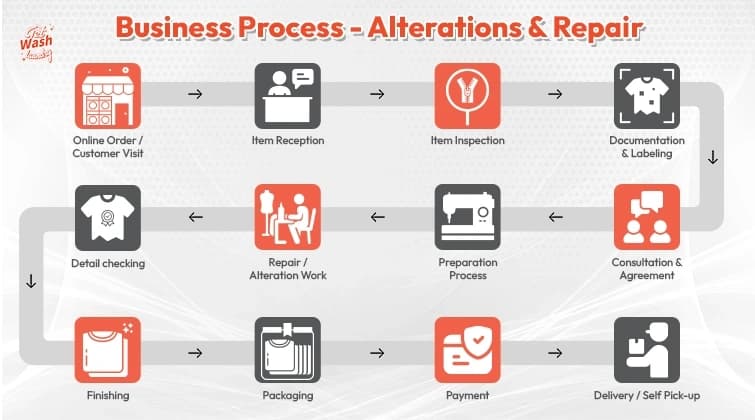
How to order

Figure 7. How to order backpack zipper replacement (cara-pesan-ganti-resleting-carrier-getwash-en.png)
- Empty the pack, including small pockets, the top lid, and hip belt pockets.
- Measure the broken zipper with a tailor's tape.
- Photograph the damage and send it via WhatsApp 0812-6610-0500 with the length.
- Share your hiking date and your zipper colour choice.
- Schedule a pickup via the order page, or drop it off at the outlet yourself.
- Track the status on the tracking page and receive your pack back.
Preparing your pack before handing it over
Empty everything out of the pack, shake out sand and rubbish from every pocket, and remove accessories such as water bottles, carabiners, or hanging tags. If the pack is still dirty and damp after a hike, mention it when you order so it can be assessed for cleaning at the same time. Do not leave a wet pack sealed in a bag while waiting for pickup.
When you get your pack back
When your pack comes back, take a few minutes to check it: open and close the new zipper several times along its full length, check the stitching at both ends, and try loading the pack as you would for a hike. If anything does not feel right, contact Customer Service promptly so it can be checked again. Checking early, well before departure day, leaves time for any adjustments.
First habits after a zipper replacement
A new zipper usually feels a little stiff the first few times. Open and close it several times before your trip so it moves more freely, and avoid stuffing the pack to the limit straight away. Treat the new zipper better than the old one, especially when pulling around corners, and it will last longer.
For outdoor clubs and gear rental businesses
Outdoor clubs, hiking groups, and gear rental businesses often have many packs to check before the hiking season. For needs like this, send Customer Service a list of the packs, the types of damage, and sample photos so they can be assessed and scheduled together.
Caring for Backpack Zippers and Seams So They Last
Most backpack zipper damage can be prevented or delayed with simple habits, both on the trail and after you get home.

Figure 8. How to care for backpack zippers (cara-merawat-resleting-carrier-agar-awet-getwash-en.png)
Do not overfill
A pack filled until the zipper has to be forced shut keeps the teeth and slider under tension the whole trip. Pack neatly, use the compression straps, and move items to outer pockets or another bag if the pack is too full.
Pull the zipper the right way
When pulling a zipper around a corner, hold both sides of the fabric near the slider so the teeth line up, then pull slowly. Never pull a zipper while fabric, cord, or contents are caught, because the teeth can bend and the slider can spread.
Clean it after every hike
After a hike, empty the pack, shake out sand and dust, and clean the zippers with a soft brush and clean water. Volcanic sand and mud left to dry between the teeth speed up wear. For a thorough pack clean, there is our outdoor gear cleaning service.
Dry it before storing
A pack stored damp can grow mould and smell, and metal parts on zippers or buckles can rust. Dry the pack in a shaded, breezy spot with all zippers and pockets open before putting it away.
Store it properly
Store your pack somewhere cool and dry, away from direct sunlight. Long UV exposure makes zipper tape and nylon fabric brittle. Do not stack heavy items on a stored pack, so its frame and shape stay intact.
In rain and river crossings
Backpack zippers are generally not watertight. In rain or when crossing a river, water can seep in along the zipper line. Use a rain cover, keep important items in dry bags or waterproof pouches, and once you reach somewhere dry, open all the zippers so the pack can dry from the inside. Zippers left wet with mud wear out faster, and their metal parts can rust.
When flying
A pack checked in as hold luggage often gets pulled and knocked on the baggage belt. Tighten all straps, tuck away dangling cords, and if possible wrap the pack in a cover or luggage protector. Zippers locked with a small padlock or tied with a cable tie are also less likely to open in transit. Check the zippers and seams after you land, before starting your hike.
Cleaning a zipper properly
To clean a zipper, open it fully, then brush between the teeth with a soft old toothbrush and a little clean water. For dried mud, soak the zipper area briefly in warm water before brushing. Run the slider back and forth a few times while rinsing so sand inside the slider is flushed out too. Wipe dry with a cloth, then let it dry completely in the shade before closing the zipper again.
Zipper lubricant
Zippers that are used often in dusty conditions can be treated with a dedicated zipper lubricant or zipper wax after cleaning. Use it sparingly and as directed on the product. Avoid sticky oils, which attract dust and sand.
Check the seams regularly
Besides the zippers, check the stitching on the shoulder straps, hip belt, haul handle, and top lid after every hike. Thread that has started to break or stitching that has started to open should be restitched promptly, before the tear spreads.
Other travel gear
Besides hiking packs, long trips often involve suitcases, hiking boots, and other bags that need care too. For suitcases there is suitcase cleaning, for footwear there is shoe cleaning, and for everyday bags there is our bag repair service. All of them can be combined in a single pickup.
A simple care routine
- After every hike: empty, shake out sand, clean the zippers, and dry.
- Every few hikes: clean the pack thoroughly and check all seams.
- Before the hiking season: test every zipper, buckle, and strap; repair anything starting to fail.
- For long storage: make sure it is dry, loosen the straps, and store it out of the sun.
This routine does not take long, but it catches damage early, while the repair is still simple and inexpensive.
Heirloom and well-travelled packs
Some customers bring packs that have been on dozens of hikes, or a parent's pack they want to keep using. For packs like these, we favour an approach that preserves as much of the original as possible: only the damaged parts are replaced, and the zipper colour is chosen to stay in harmony. Let us know if your pack has sentimental value, so the team can take extra care and discuss repair options with you.
Our experience
Main compartment zippers that open by themselves, sliders lost mid-trail, tapes torn at the end from being forced shut, and top lid stitching that has given way after years of use: these are the cases we see most. Almost all of those packs still had a good frame, straps, and fabric. With the right zipper replacement and restitching, packs like these can keep going on hikes for years to come.
Deciding whether a pack is still worth repairing
Before deciding to repair, it is worth assessing the pack as a whole. If the frame is still sturdy, the shoulder straps and hip belt are still padded and comfortable, and the main fabric is not brittle or holed in many places, the pack is usually worth repairing. On the other hand, if the fabric has become brittle, the inner lining is peeling in many places, and several components are broken at once, the repair cost can approach the price of a new pack. Send photos of the whole pack, not just the zipper, so the team can give you an honest picture.
Service hours and location
Customer Service hours: Monday–Friday 09:00–17:00, Saturday 09:00–15:00, closed Sunday. Our main outlet is at Jl. Ceger Raya No.42, Jurang Mangu Barat, Kec. Pd. Aren, Kota Tangerang Selatan, Banten 15222. We serve customers in Pondok Aren, Bintaro, BSD, Ciledug, South Jakarta, and surrounding areas. If you are searching for laundry near me that can also fix hiking backpack zippers, send us a photo and the zipper length first.
Is your pack's zipper giving you trouble? Contact WhatsApp 0812-6610-0500, order via the order page, or follow us on Instagram, TikTok, Facebook, and Threads.
FAQ: Backpack Zipper Replacement and Restitching
How much does backpack zipper replacement cost at Getwash?
YKK zipper replacement costs Rp100,000 for 50–60 cm, Rp110,000 for 70–80 cm, and Rp120,000 for 90–100 cm. The final cost is confirmed after the pack is inspected, and work only starts once you approve it.
What zipper is used as the replacement?
The price list specifies YKK zippers, available in gold and silver. Mention your colour choice when ordering, or send a photo of the old zipper if you want the closest match.
How do I measure zipper length?
Close the zipper fully, then measure the toothed section from the stop at one end to the end of the teeth at the other with a tailor's tape, following the curve if it is U-shaped. Photograph the zipper with the tape when you ask for a price.
My pack's zipper splits open by itself. Does it need replacing?
This usually means the slider is worn and has widened. Sometimes replacing the slider is enough; in other cases the teeth are worn too and the whole zipper needs replacing. The team will assess it during inspection and explain the options.
My zipper only sticks. Does it need replacing?
Not necessarily. A sticking zipper is often caused by sand, dust, or mud between the teeth and inside the slider. Clean it first with a soft brush and water; if it still sticks, the teeth may be bent or the slider worn, and the pack should be inspected.
What is inner top carrier restitching?
Restitching re-sews the inner top section of a hiking pack where the stitching has come loose, priced at Rp100,000. The page does not yet detail the scope of the job, so send a photo of the loose area for confirmation before handing it over.
How long does zipper replacement take?
The service page does not yet list a turnaround time. Mention your hiking date when you order, and ideally hand over your pack two to three weeks before departure so there is enough time.
Can zippers outside 50–100 cm be replaced?
Those are the ranges on the price list. For shorter or longer zippers, send a photo and the length to Customer Service to ask whether it can be handled and what it would cost.
Can you replace zippers on tents, sleeping bags, or jackets?
The current price list covers zippers by length and restitching for hiking packs. For other gear, send a photo and the zipper length to Customer Service to check suitability.
Does Getwash offer clothing alterations?
The Alterations & Repair page does not yet list prices for clothing alterations. Ask Customer Service about availability and pricing on WhatsApp before sending your garments.
Can my pack be cleaned at the same time?
Yes. Packs can be cleaned through the outdoor gear cleaning service, and repair and cleaning can be combined in one drop-off. Mention both needs when you order so they are scheduled together.
How much is pickup and delivery?
Since 20 June 2026, pickup and delivery is charged per trip based on distance from the nearest outlet: Zone 1 (0–3 km) Rp8,000, Zone 2 (3–7 km) Rp15,000, and Zone 3 (over 7 km) Rp22,000. You can also drop off at the outlet yourself.
What are Getwash Customer Service hours?
Monday–Friday 09:00–17:00 and Saturday 09:00–15:00. Closed Sunday. WhatsApp messages can be sent at any time and will be answered during the next service hours.
Sources
- Getwash Alterations & Repair service page (EN)
- Getwash Alterations & Repair page (ID)
- Getwash Laundry tracking page
- New Policy Notice: Pickup & Delivery Rates (effective 20 June 2026)