Leather Care

- Jacket — Genuine Leather
Jaket Kulit Asli
Rp 270.000 - Jacket — Synthetic Leather
Jaket Kulit Sintetis
Rp 170.000 - Jacket — Leather PremiumRp 400.000
- Macna Jacket Aviant Air Red/BlackRp 275.000
Contact us to schedule your order
09:00-20:00 (Weekday) & 09:00-17:00 (Weekend)
Ulasan Pelanggan
Belum ada ulasan untuk Leather Care
Sudah pernah pakai? Ceritakan pengalamanmu supaya pelanggan lain bisa memilih dengan yakin.
Professional Leather Jacket Care by Getwash: A Guide to Caring for Genuine, Synthetic, and Premium Leather Jackets, Knowing Your Leather, Dealing with Mould, Dryness, and Cracking, and Keeping a Leather Jacket Lasting in a Tropical Climate
By the Getwash Laundry Team | Updated 5 November 2026 | Reading time ±27 minutes
|
QUICK ANSWER Getwash cares for leather jackets at a price per type: Genuine Leather Jacket Rp270,000, Synthetic Leather Jacket Rp170,000, Premium Leather Jacket Rp400,000, and Macna Jacket Aviant Air Red/Black Rp275,000. According to the English page, the care covers inspecting the leather type, treating stains, low-moisture cleaning, conditioning, finishing with a water-protective coating, and a final quality check. The page does not yet list a turnaround, so ask when you order. Pickup is charged by zone (Rp8,000, Rp15,000, or Rp22,000 per trip). Order through the order page or WhatsApp 0812-6610-0500; service hours are Monday–Friday 09.00–17.00 and Saturday 09.00–15.00, closed on Sundays. |
A leather jacket is one of the few garments that can stay with someone for decades. It is worn riding, taken to cold countries, worn to evening events, or simply part of a personal style. A well-kept leather jacket actually looks better with age. A neglected one, especially in the tropics, can grow mould, dry out, crack, or peel within just a few years.
This article looks at leather jacket care service from that angle: leather as a material that lives on a balance of oil and moisture, and so is threatened from two directions at once: too damp in storage and too dry when worn in air-conditioned rooms. We explain leather types and how to tell genuine from synthetic, how to read the prices, the six care steps described on our page, typical leather jacket problems, and how to care for one day to day. If you are looking for a laundry near me for leather jackets, start with the table of contents below.
Table of Contents
1. The Leather Jacket: A Garment That Can Last Decades with Care
2. Leather Types and How to Tell Genuine from Synthetic
3. Leather Jacket Care Prices: Genuine, Synthetic, Premium, and Riding Jackets
4. Six Leather Care Steps and Why a Leather Jacket Must Not Be Washed Normally
5. Common Leather Jacket Problems: Mould, Dryness, Cracking, Peeling, Stains, and Odour
6. Caring for Leather Jackets in a Tropical Climate, and How to Order
7. FAQ: Questions About Getwash Leather Jacket Care
The Leather Jacket: A Garment That Can Last Decades with Care
Leather is a unique material. It is not a woven fabric, but animal hide that has been tanned so it does not rot and stays supple. Inside are interwoven collagen fibres and oils that keep it flexible. That is why leather is often said to need care like human skin: gentle cleaning and keeping it moisturised.
Why leather needs a balance of oil and moisture
Leather fibres stay supple because they are lubricated with oils added during tanning. Over time these oils decrease through heat, sunlight, dry air, and cleaning. Leather that loses its oils becomes stiff, dull, and eventually cracks where it bends most, such as the elbows and shoulders. Leather left damp for too long, on the other hand, becomes a place for mould to grow. Leather jacket care is essentially keeping the balance between these two extremes.
A threat from two directions in the tropics
In Greater Jakarta, a leather jacket faces two opposing threats. Stored in a closed wardrobe, humid air makes mould grow easily. Worn in cold, dry air-conditioned rooms or cars, the leather slowly loses moisture. Add sweat from journeys in hot air, sudden rain, and harsh sun for riders, and a leather jacket here works much harder than in its country of origin.
“Cared-for leather ages beautifully; neglected leather ages into damage.” — Working principle of the Getwash team
Myth: a leather jacket needs no care because it is tough
Many people think a leather jacket is almost indestructible because it feels thick and sturdy. In reality, leather's strength depends on its suppleness. Dry leather tears and cracks more easily than supple leather. Leather jackets left hanging for years without care, especially in the tropics, are often found mouldy inside and stiff outside when finally taken out.
Heirloom leather jackets
Many families keep a father's or grandfather's leather jacket that is decades old. Jackets like this often have high-quality leather hard to find today, but are also often very dry, mouldy, or musty from long storage. Caring for one needs extra care, because old leather that is too dry can tear if handled roughly. An initial assessment is essential before a jacket like this is cleaned.
Who wears leather jackets
Leather jacket owners in Indonesia are very varied. Motorcyclists wear them for protection and style. Travellers take them to Europe, Japan, or Korea in winter. Office workers wear them in air-conditioned rooms. Fashion lovers collect leather jackets from well-known houses. And many people keep leather jackets given by their parents that are decades old. Each pattern of use brings different dirt and different risks.
Signs your leather jacket needs care
- The surface feels dry, stiff, or dull compared with when it was new.
- Fine cracks appear at the elbows, sleeve folds, or shoulders.
- White, grey, or greenish spots, especially in folds and inside.
- The collar and cuffs look darker, oily, or sticky.
- A musty or sweaty smell when the jacket comes out of the wardrobe.
- Water marks, white sweat lines, or stains that do not wipe off.
How often does a leather jacket need professional care
Our service page gives no figure. A common guide: leather jackets do not need frequent full cleaning, because repeated cleaning also reduces their natural oils. Light care at home, wiping and airing, is enough day to day. Professional care is needed about once a year or once per wearing season, after heavy rain, before long storage, or when mould, cracks, and odours appear. A jacket worn for riding every day may need it more often.
Patina: the sign of a living jacket
A leather jacket that is worn and cared for well develops a patina, a subtle change in colour and sheen where it rubs most. Many owners seek this look because it makes the jacket personal and full of character. Good care does not erase the patina; it removes dirt and keeps the leather supple so the patina develops beautifully, not into cracks.
A leather jacket as an investment
A quality genuine leather jacket can cost millions to tens of millions of rupiah, and with care can be worn for decades. On the other hand, a single wrong wash at home, such as soaking it or putting it in a washing machine, can stiffen, shrink, discolour, and crack it. The cost of professional care once a year is far smaller than the jacket's value and the risk of that permanent damage.
Leather jackets of high-profile customers
Getwash is trusted as the go-to laundry for officials and high-profile customers, and is used to handling items from top fashion houses. Our English page mentions leather care for luxury items, including bags from well-known brands. Designer leather jackets, limited editions, or family heirlooms are handled in an orderly way and their owners' privacy is protected. To be open: Getwash is an independent care service, not an official service centre for any brand.
Leather Types and How to Tell Genuine from Synthetic
Our pricelist separates genuine, synthetic, and premium leather jackets with a significant price gap. Understanding leather types helps you order correctly and understand why their care differs.

Figure 1. Leather jacket types and care (leather-jacket-types-and-care-getwash-en.png)
Lambskin
Lambskin is thin, very soft, and drapes beautifully, so it is often used for fashion and designer jackets. Its softness also means it scratches more easily, absorbs stains faster, and is more sensitive to water and heat. Lambskin jackets deserve the most careful handling.
Cowhide
Cowhide is thicker, stiffer when new, and very resistant to abrasion. It is the leather widely used for riding jackets and classic-style jackets. It softens with wear and is relatively more forgiving than lambskin, but can still dry out and crack without care.
Goatskin and horsehide
Goatskin has a distinctive pebbled grain, strong yet supple. Horsehide, used on some classic jackets, is very thick and sturdy and known for developing a distinctive sheen with age. Both are less common but have their own fans, especially among collectors.
Aniline, semi-aniline, and pigmented leather
Besides the animal, how the leather surface is finished greatly decides its care. Aniline leather is dyed without a protective coating, so it feels natural but readily absorbs stains and water. Semi-aniline has a thin coating that gives some protection. Pigmented leather has a colour coating on the surface that resists stains and cleans easily, but the coating can crack if the leather underneath dries out. Knowing the finish helps the team choose the right cleaner and conditioner.
Oiled, waxed, and distressed leather
Some jackets use leather deliberately loaded with oil or wax to resist water and develop a patina quickly. There is also distressed leather made to look worn on purpose. Jackets like this must not be cared for in a way that removes that character. Mention it if your jacket is one of these.
Synthetic leather (PU and PVC)
Synthetic leather, often called faux leather or PU leather, is a fabric base coated with plastic textured to look like leather. It is much cheaper and can look very similar to genuine leather. The problem is that this plastic coating cannot absorb conditioner like real leather, and over time can harden, crack, and peel, especially in hot, humid climates. That is one reason the synthetic price on our list is lower: the work is different, and so are the limits of the result.
How to tell genuine from synthetic leather

Figure 2. How to tell genuine from synthetic leather (how-to-tell-genuine-from-synthetic-leather-getwash-en.png)
- Label: genuine leather jackets usually say genuine leather, full grain, lambskin, or cowhide; synthetic says PU, polyurethane, or faux leather.
- Pores: genuine leather has irregular pores and creases; synthetic tends to show a repeating pattern.
- Cut edge: genuine leather has a dense fibrous edge; synthetic often shows a fabric layer under the plastic.
- Smell: genuine leather has a distinctive scent; synthetic tends to smell of plastic or nothing.
- Feel: genuine leather feels warm and supple; synthetic feels cooler and slicker.
- Ageing: genuine leather develops a patina; synthetic tends to crack and peel.
If still unsure, send photos of the jacket and its label. Naming the leather type correctly ensures you pay the right price and the jacket gets the right care.
Riding jackets with armour
Riding jackets often have armour or protectors at the shoulders, elbows, and back, plus ventilation panels and reflectors. Our pricelist specifically lists the Macna Jacket Aviant Air Red/Black, showing that riding jackets are served. Remove any removable armour before handing over the jacket, and mention its material, because some modern riding jackets are actually textile, not leather.
Full grain, top grain, and corrected grain
Leather jacket labels often mention grain. Full grain is the intact top layer of the hide, with natural pores and creases; it is the strongest and develops the most beautiful patina. Top grain has been lightly sanded to even the surface, slightly more uniform but still quality leather. Corrected grain is sanded more deeply, then coated and embossed with texture, so it is more uniform and stain-resistant but has less character. In some products the term genuine leather can actually refer to a lower-quality layer. Knowing your jacket's grain helps you understand how it will age.
Non-leather parts of a leather jacket
Many leather jackets have a fabric lining, knitted collar or cuffs, a fur collar, metal zips, and buttons. Each of these reacts differently to cleaners. Fur can mat, knits can stretch, and metal can leave rust marks. Good care considers every material, not just the leather.
Leather Jacket Care Prices: Genuine, Synthetic, Premium, and Riding Jackets
Our service page lists four items on its leather jacket pricelist.

Figure 3. Leather jacket care prices (leather-jacket-care-prices-getwash-en.png)
- Synthetic Leather Jacket: Rp170,000.
- Genuine Leather Jacket: Rp270,000.
- Macna Jacket Aviant Air Red/Black: Rp275,000.
- Premium Leather Jacket: Rp400,000.
The page lists no turnaround, and there is a show-more button suggesting there may be other items not visible at first glance.
What separates genuine from premium
The service page does not explain what Premium Leather means compared with ordinary genuine leather. In leather care generally, a premium category usually covers finer, more sensitive leathers such as lambskin or aniline, high-value designer jackets, or jackets with more intricate details. Send photos, the label, and the brand of your jacket so Customer Service can choose the right category.
Why synthetic leather costs less
The Rp100,000 gap between synthetic and genuine leather makes sense. Genuine leather needs conditioning to restore oils and suppleness, while the plastic coating on synthetic leather does not absorb conditioner. But remember: synthetic leather that has already peeled or cracked cannot be restored by any care, because the damage is in the plastic coating itself.
Cost examples
Here is an illustration (not a real customer case). A motorcyclist with one genuine leather riding jacket and one synthetic jacket for everyday wear: Rp270,000 + Rp170,000 = Rp440,000. A collector with two designer jackets in the premium category: 2 × Rp400,000 = Rp800,000. The owner of one Macna Jacket Aviant Air: Rp275,000.

Figure 4. Leather jacket care cost examples (leather-jacket-care-cost-examples-getwash-en.png)
When a synthetic jacket is better replaced
A synthetic leather jacket that is still intact is worth cleaning to keep it fresh and odour-free. But if its coating has peeled in many places, the cost of care may not be worth the result, because peeled coating cannot come back. Weigh what the jacket means to you: a peeling synthetic jacket with sentimental value can still be cleaned, as long as expectations are realistic.
Cost compared with the jacket's value
If a genuine leather jacket is cared for once a year at Rp270,000, the cost is about Rp740 a day. For a jacket that can be worn for decades and is worth millions of rupiah, that is small. Letting a jacket go mouldy or crack from lack of care may force you to buy a new one far sooner.
Turnaround
The leather jacket service page lists no turnaround. For comparison, our suede jacket page lists 10 working days, but we do not assume that figure applies to leather jackets. Ask for the expected completion when ordering and follow it on the tracking page. Good leather care takes time for slow drying and for the conditioner to soak in, so avoid sending a jacket just before a trip or important event.
Planning before a trip or the rainy season
If you need a leather jacket for a trip to a cold country, schedule its care well in advance, or better still, after you return and before the jacket is stored. The run-up to the rainy season is also a good time, because a clean jacket with a protective coating is better prepared for splashes and wardrobe humidity.
Pickup and delivery rates
The page's title and description mention pickup and delivery. Since 20 June 2026, pickup and delivery is charged per trip by distance from the nearest outlet: Zone 1 (0–3 km) Rp8,000, Zone 2 (3–7 km) Rp15,000, and Zone 3 (over 7 km) Rp22,000. Customer Service confirms your zone when you order.
About the discount and the restoration claim
The English page's meta description mentions a 20% discount, and its title mentions restoration, but the page body does not explain the discount terms or describe restoration services such as recolouring or crack repair. The Indonesian page also mentions results like new. We do not use those claims as promises in this article. Ask Customer Service about current promotions and whether restoration is available for your jacket.
What to ask when you order
A few questions help avoid surprises: which category is my jacket, what is the expected completion, do heavy stains or mould cost extra, is the lining cleaned too, and what is my pickup zone. Ask for the answers in writing over WhatsApp so there is a shared record.
Six Leather Care Steps and Why a Leather Jacket Must Not Be Washed Normally
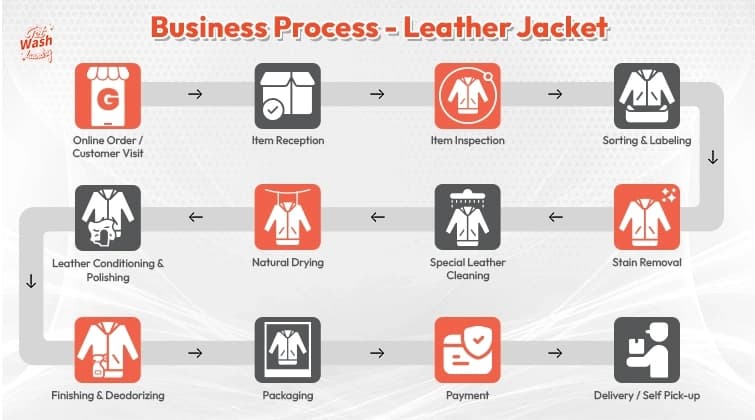
The process section on the Indonesian page is an image only, but the English page describes six leather care steps. Here is each step and why it matters.

Figure 5. Six-step leather jacket care process (six-step-leather-jacket-care-process-getwash-en.png)
Why a washing machine ruins a leather jacket
Soaking a leather jacket and spinning it in a washing machine dissolves the oils that keep the leather fibres supple. As it dries, those fibres shrink and harden. The result can be a jacket that has shrunk, is stiff as cardboard, blotchy in colour, and cracked at the folds. On synthetic leather, hot water and spinning speed up peeling of the plastic coating. Damage like this usually cannot be undone.
1. Inspection and diagnosis
The first step is identifying the leather type, its surface finish, and existing damage, such as fine cracks, faded colour, or loose seams. This diagnosis decides which cleaners and conditioners are safe, and also records the starting condition so it is not mistaken for new damage.
2. Manual stain pre-treatment
Stains are treated where they are before the full clean. Oil on the collar, white sweat lines, and ink each need a different approach. Cleaners are tested on a hidden area first, because every leather reacts slightly differently.
3. Gentle, low-moisture cleaning
The English page mentions cleaning with little water, using water-based, solvent-free products. Low moisture is the key: the leather is cleaned without soaking, so its natural oils are not dissolved and its fibres do not shrink as they dry.
4. Conditioning
Once clean, the leather is conditioned to restore oils and suppleness. The English page mentions balms containing beeswax and carnauba. Conditioning is the step that separates leather care from simple cleaning, and it is what prevents leather from drying and cracking. On synthetic leather, this step does not bring the same benefit because the plastic coating does not absorb it.
5. Finishing and a protective coating
The final step adjusts the leather's look, such as a high shine for smooth leather or a matte or satin result for suede and nubuck, then adds a water-protective coating. This coating helps resist splashes and stains for a while, but does not make the jacket rainproof.
6. Quality control and packing
The jacket is checked before packing. The English page mentions packing with dust bags and cedar inserts. Once received, take the jacket out of the packaging and hang it on a wide hanger.
Why testing on a hidden area matters
Every leather jacket is dyed and finished differently. A cleaner or conditioner safe for one jacket can darken or blotch another, especially uncoated aniline leather. That is why good care always tests products inside a hem or under the collar first.
Why leather drying must not be rushed
Leather that meets water, however little during cleaning, must be dried slowly at room temperature. Heat from a dryer, machine, or harsh sun shrinks the fibres too fast, leaving the leather stiff and cracked. Conditioner also needs time to soak into the leather. Both reasons mean good leather care cannot be finished in a matter of hours.
Zips, buttons, and metal hardware
Zips, metal buttons, and buckles on a leather jacket can leave dark marks or rust on the surrounding leather, especially when often exposed to sweat and rain. These areas are handled carefully during cleaning. If a zip is already stiff or broken, repairing it is a tailor's job, not leather care.
The lining inside
A leather jacket's lining absorbs sweat, especially at the armpits, back, and collar. A smelly lining makes the whole jacket feel stale even if the outside leather is clean. Ask whether the lining is included in your jacket's care.
Ordinary dry cleaning is not leather care
Some people take a leather jacket to ordinary dry cleaning. Solvents and processes designed for fabric can draw oils from leather and dry it out if not adapted. That is why a leather jacket needs dedicated leather care, including the conditioning step that ordinary dry cleaning lacks.
Common Leather Jacket Problems: Mould, Dryness, Cracking, Peeling, Stains, and Odour
These are the problems most often found on leather jackets, their causes, the treatment, and an honest line on what can be expected.

Figure 6. Leather jacket problems and treatments (leather-jacket-problems-and-treatments-getwash-en.png)
Mould
Mould is the most common problem on leather jackets in Indonesia. It shows as white, grey, or greenish spots with a musty smell, especially on jackets stored in plastic, closed wardrobes, or damp rooms. Light surface mould can usually be cleaned, but old mould can leave marks or discolouration, and in severe cases can weaken the leather. Send a photo of the affected area for assessment first.
Dry, stiff leather
Leather that has gone long without conditioner, is often in air conditioning, or was once dried with heat becomes dry, stiff, and dull. The right conditioning usually restores much of its suppleness and sheen, especially before it cracks.
Cracking
Cracks form when leather that has already dried out keeps being bent, such as at the elbows and shoulders. Fine surface cracks can be made less visible and kept from spreading with conditioning. Deep cracks that cut into the leather fibres cannot be restored by cleaning and conditioning, and our page does not describe a crack repair service.
Peeling synthetic leather
The plastic coating on synthetic leather hardens and peels over time, especially at the collar, armpits, and cuffs. This is damage to the material itself, not dirt. Cleaning can make the jacket clean and fresh, but cannot reattach coating that has peeled. We would rather say so up front than raise false hopes.
Oil on the collar and cuffs
The collar and cuffs absorb oil from the neck, hair, and hands, so they look darker and sticky. Oil stains are among the hardest because they soak into the leather fibres. Treatment works better when the stain is not too old.
Sweat and salt marks
Dried sweat leaves salt that forms white lines, especially across the back and under the arms. Motorcyclists wearing leather jackets in the daytime often see this. Salt also speeds up leather stiffening. These stains are treated differently from oil stains.
Water marks and rain spots
Rainwater that dries on leather, especially aniline leather, can leave rings or spots. Light marks can often be evened out with a full clean and conditioning.
Dye transfer from jeans and bags
Light-coloured leather can absorb dye from jeans, bag straps, or car seat belts that rub against it constantly. Dye transfer like this is hard to remove fully from leather. If your light jacket often rubs against a dark bag, watch for it early.
Scratches and fading
Fine scratches on leather often blend in after conditioning, especially on oiled leather. Deep scratches and sun-faded colour cannot be restored by cleaning. Our page does not mention recolouring; ask if you need it.
Musty, sweat, and cigarette odours
Leather and lining absorb odours easily. Light odours often fade with airing, but absorbed odours need a full clean including the lining. Odours years old may not disappear completely.
Sticky or tacky leather
Synthetic leather jackets stored for long in hot places sometimes turn sticky, and folded areas can stick together. This is a sign the plastic coating is breaking down. Genuine leather given too much conditioner or oil can also feel sticky. The first case is hard to recover; the second usually improves with the right cleaning.
Will the jacket look brand new?
The Indonesian page mentions results like new. We prefer to be more honest: a leather jacket worn for years has a patina, wear, and natural colour changes, and some of that is its character. What we can aim for is a jacket that is cleaner, more supple, odour-free, and better protected, together with an honest assessment at the start.
Torn or very fragile jackets
A jacket with tears, loose seams, or very brittle leather may need a leather tailor's repair before or after care. In that case we give advice before work.
Caring for Leather Jackets in a Tropical Climate, and How to Order
The simple habits below keep a leather jacket supple and mould-free far longer, and make professional care more effective.

Figure 7. Leather jacket care routine (leather-jacket-care-routine-getwash-en.png)
After wearing
- Wipe gently with a dry or slightly damp microfibre cloth to lift dust.
- Air it for a few hours so sweat evaporates before the jacket goes into the wardrobe.
- Check the collar and cuffs; wipe fresh marks before they soak in.
- Do not hang it on a chair back for long, as the shoulders can lose their shape.
If the jacket gets caught in the rain
- Blot gently with a clean, dry towel to absorb water; do not rub.
- Hang it on a wide hanger in a breezy room, away from direct sun and heat.
- Let it dry completely on its own, without a hair dryer.
- Once dry, apply a little leather conditioner if it feels stiff.
- If water marks or excessive stiffness appear, hand it to professional care.
Tools every leather jacket owner should have
- A soft microfibre cloth to lift dust and light marks.
- A leather-specific conditioner suited to your jacket.
- A wide wooden or thick plastic hanger to keep the shoulders' shape.
- A cloth garment bag for breathable storage.
- A moisture absorber for the wardrobe, especially in the rainy season.
These tools are cheap and last for years, and also work for leather bags, shoes, and belts.
Conditioning at home
A leather-specific conditioner applied thinly every few months helps keep the leather supple. Test it on a hidden area first, apply a thin layer with a soft cloth, let it soak in, then wipe off the excess. Do not overdo it, because too much conditioner can make the surface sticky and attract dust. Do not use cooking oil, body lotion, or household products as a substitute.
When the jacket meets a spill
If coffee, sauce, or a drink spills on a leather jacket, blot straight away with a clean, dry cloth to absorb the liquid, without rubbing. On coated leather, some spills can be wiped with a slightly damp cloth. On absorbent aniline leather, do not add water; let it dry and hand it to professional care if the stain still shows. Avoid dish soap, bleach, alcohol, or alcohol-based wet wipes.
Storing a leather jacket
Storage is the riskiest time in the tropics. Hang the jacket on a wide wooden or thick plastic hanger that follows the shoulders. Put it in a breathable cloth bag, not plastic that traps moisture. Store it in a dry, uncrowded wardrobe, away from damp walls, with a moisture absorber. Take it out to air now and then, especially in the rainy season.
For motorcyclists
A leather riding jacket faces road dust, exhaust fumes, sun, sweat, and rain every day. Wipe the jacket after long rides, do not store it sweaty, wear a rain cape over it in the rain, and condition it more often than a jacket only worn indoors. Riders can also look after their helmets with our helmet cleaning service.
After a winter trip
A leather jacket taken abroad often meets snow, rain, and very dry heated indoor air, then gets packed in a suitcase. When you get home, take it out at once, hang it in open air, and check for stains. This is the right moment for professional care before it is stored for months. Your suitcase can be cleaned at the same time through suitcase cleaning.
Other leather items in your wardrobe
The same principles apply to other leather items. The English page says leather care also covers bags, shoes, wallets, belts, and accessories. For bags there is Maison de Bag and bag cleaning, for shoes there is Signature Shoe Care and shoe cleaning, and for suede jackets there is professional suede care. Combining them in one pickup saves on the charge.
How to order
The English page describes the flow: order online or via WhatsApp, pickup and care, then delivery. The most dependable way: message WhatsApp 0812-6610-0500 or use the order page. You can also visit the outlet at Jl. Ceger Raya No.42, Jurang Mangu Barat, Kec. Pd. Aren, Kota Tangerang Selatan, Banten 15222.

Figure 8. Six steps to order leather jacket care (six-steps-to-order-leather-jacket-care-getwash-en.png)
- Empty every pocket, and remove pins, accessories, and riding armour if it comes out.
- Photograph the jacket front and back, the label, the brand, and any stains, mould, or cracks.
- Customer Service confirms the leather type, price category, estimate, and pickup zone.
- A courier collects the jacket from your address.
- The jacket goes through the six care steps; follow progress on the tracking page.
- The jacket is delivered back to your address or collected at the outlet.
Checklist before handing over a jacket
- Empty pockets and remove armour or accessories.
- Say whether the jacket is genuine, synthetic, or you are not sure.
- Note the stains, when they happened, and whether you tried cleaning them yourself.
- Photograph the starting condition, including cracks, peeling, or fading.
- Mention the brand and approximate value if the jacket is high-value.
- Keep your order number for tracking.
Choosing a leather jacket suited to the tropics
If you plan to buy a leather jacket, think about wearing it here. Cowhide or goatskin with a semi-aniline finish is more forgiving of rain and sweat than very fine aniline lambskin. Jackets with ventilation or an easy-to-clean lining are more comfortable in hot weather. And genuine leather, though more expensive, usually lasts longer in the tropics than synthetic leather, which tends to peel within a few years.
After the jacket returns
Take the jacket out of its packaging, hang it on a wide hanger, and leave it in a breezy room for a few hours. Store it in a cloth bag or the dust bag provided, not the delivery plastic, and follow the care routine above so the result lasts.
Second-hand and vintage leather jackets
Vintage leather jackets from flea markets often have interesting character and leather quality. But their storage history is unknown, and many carry hidden mould in the lining, musty smells, or very dry leather. Before wearing, a jacket like this deserves assessment and full care. Also check the leather's strength at the folds, because dry old leather can tear when bent.
Service hours and location
Service hours: Monday–Friday 09.00–17.00, Saturday 09.00–15.00, closed Sundays. Our main outlet is at Jl. Ceger Raya No.42, Jurang Mangu Barat, Kec. Pd. Aren, Kota Tangerang Selatan, Banten 15222. The English page lists service areas including South Jakarta, West Jakarta, Tangerang, South Tangerang, Bintaro, BSD, Pondok Aren, and Ciputat, plus other areas listed on the outlets page.
Why we write this plainly
A leather jacket is a high-value item whose care result depends heavily on the leather type and condition. We choose to state what is on the page, what has not yet been explained, and what care cannot achieve, so you hand over your jacket with the right expectations. We would rather answer many questions at the start than one complaint at the end.
Ready to care for your favourite leather jacket? Order through the order page, contact WhatsApp 0812-6610-0500, or follow us on Instagram, TikTok, Facebook, and Threads.
FAQ: Questions About Getwash Leather Jacket Care
How much does leather jacket care cost at Getwash?
Synthetic Leather Jacket Rp170,000, Genuine Leather Jacket Rp270,000, Macna Jacket Aviant Air Red/Black Rp275,000, and Premium Leather Jacket Rp400,000.
What is the difference between genuine and premium?
The page does not explain it yet. Generally, premium covers finer, more sensitive leathers or high-value designer jackets. Send photos and the label to decide the category.
How long does leather jacket care take?
The page does not yet list a turnaround. Ask for the expected completion when ordering and follow it on the tracking page.
What does the care process involve?
According to the English page: inspection, stain pre-treatment, low-moisture cleaning, conditioning, finishing with a water-protective coating, and quality control and packing.
Why must a leather jacket not go in a washing machine?
Water and spinning dissolve the leather's oils so the fibres shrink. The jacket can end up permanently shrunk, stiff, blotchy, and cracked.
How can I tell genuine from synthetic leather?
Check the label, irregular pores, the cut edge, the smell, the feel, and how it ages. Genuine leather develops a patina; synthetic tends to peel.
Can a peeling synthetic leather jacket be fixed?
Not by cleaning. Peeling is damage to the plastic coating itself. The jacket can be cleaned, but peeled coating does not come back.
Can a mouldy leather jacket be saved?
Light mould can usually be cleaned, but old mould can leave marks or discolouration. Send a photo for assessment first.
Can cracks in leather be removed?
Fine cracks can be made less visible and kept from spreading with conditioning. Deep cracks cannot be restored by cleaning.
Is pickup and delivery available?
Yes. Since 20 June 2026 the rate is Rp8,000 (Zone 1, 0–3 km), Rp15,000 (Zone 2, 3–7 km), or Rp22,000 (Zone 3, over 7 km) per trip.
How often does a leather jacket need professional care?
Usually once a year or once per wearing season, after heavy rain, before long storage, or when mould, cracks, or odours appear.
How do I order, and what are the service hours?
Contact us on WhatsApp or the order page with photos of the jacket and its label. Service hours are Monday–Friday 09.00–17.00 and Saturday 09.00–15.00, closed on Sundays.
Does Getwash care for designer leather jackets and high-profile customers?
Yes. Getwash is trusted as the go-to laundry for officials, public figures, business people, and celebrities, and is used to handling top-end items with privacy protected.
Sources
- Getwash Laundry leather care service page
- Getwash Laundry Jaket Kulit page (ID)
- Getwash Laundry tracking page
- New Policy Notice: Pickup & Delivery Rates (effective 20 June 2026)