Linen Laundry
Contact us to schedule your order
09:00-20:00 (Weekday) & 09:00-17:00 (Weekend)
Ulasan Pelanggan
- Okky5.0
Layanan Laundry Linen ini hasilnya bersih maksimal. Saya puas dan akan memakai lagi.
- AYYUB WIJAYA5.0
Layanan Laundry Linen ini hasilnya bersih maksimal. Terima kasih atas pelayanannya.
- Fauzan Agri Nugrogo5.0
Pencucian bahan linen yang sangat profesional. Kain linen yang rawan rusak justru tetap lembut dan serat kainnya terjaga aman. Hasil penyetrikaannya sangat rapi. Komunikasi sangat lancar dari awal pengajuan sampai pengerjaan selesai.
- Muhammad Syafiq5.0
Layanan Laundry Linen ini hasilnya bersih maksimal. Sangat direkomendasikan.
- Fauzan Agri Nugrogo5.0
Pencucian bahan linen yang sangat profesional. Kain linen yang rawan rusak justru tetap lembut dan serat kainnya terjaga aman. Hasil penyetrikaannya sangat rapi. Komunikasi sangat lancar dari awal pengajuan sampai pengerjaan selesai.
- Muhammad Syafiq5.0
Pencucian bahan linen yang sangat profesional. Kain linen yang rawan rusak justru tetap lembut dan serat kainnya terjaga aman. Hasil penyetrikaannya sangat rapi. Komunikasi sangat lancar dari awal pengajuan sampai pengerjaan selesai.
- Okky5.0
Pencucian bahan linen yang sangat profesional. Kain linen yang rawan rusak justru tetap lembut dan serat kainnya terjaga aman. Hasil penyetrikaannya sangat rapi. Komunikasi sangat lancar dari awal pengajuan sampai pengerjaan selesai.
- AYYUB WIJAYA5.0
Pencucian bahan linen yang sangat profesional. Kain linen yang rawan rusak justru tetap lembut dan serat kainnya terjaga aman. Hasil penyetrikaannya sangat rapi. Komunikasi sangat lancar dari awal pengajuan sampai pengerjaan selesai.
- UMAR SYAHID5.0
Pencucian bahan linen yang sangat profesional. Kain linen yang rawan rusak justru tetap lembut dan serat kainnya terjaga aman. Hasil penyetrikaannya sangat rapi. Komunikasi sangat lancar dari awal pengajuan sampai pengerjaan selesai.
- Asri Bahtiar5.0
Pencucian bahan linen yang sangat profesional. Kain linen yang rawan rusak justru tetap lembut dan serat kainnya terjaga aman. Hasil penyetrikaannya sangat rapi. Komunikasi sangat lancar dari awal pengajuan sampai pengerjaan selesai.
Getwash Linen Laundry for Spas, Hotels, Clinics, Sport Centres, and Homes: Understanding Linen Fabrics, Why White Linen Turns Grey, Yellow, and Musty, Clean-Linen Standards, and How to Care for Linen So It Lasts Longer
By the Getwash Laundry Team | Updated 6 November 2026 | Reading time ±27 minutes
|
QUICK ANSWER Getwash linen laundry handles sheets, pillowcases, towels, blankets, bathrobes, and covers for spas, hotels, clinics, sport centres, and households, with pricing by quotation based on item type, quantity, and schedule. White linen usually turns dull and grey because soil redeposits and detergent residue builds up, yellows because of body oils and care products, and smells because it is left damp too long before washing. Truly clean linen should have no smell, be completely dry, be free of visible stains, and be neatly folded. Contact WhatsApp 0812-6610-0500 for a consultation; service hours are Monday–Friday 09:00–17:00 and Saturday 09:00–15:00. |
Linen is the part of the experience closest to the body. Hotel guests judge a room by the sheets they sleep on. Spa guests feel the towel before they feel the massage. Clinic patients notice the cover on the examination couch. Gym members remember the smell of the towel they were handed. At home too, clean sheets and soft towels are the comfort we feel most often.
This article covers Getwash's linen laundry service from the angle of linen care itself: what linen means, the fabrics commonly used and how to read them, why white linen turns dull, yellow, stiff, and musty, the stains typical of each type of business, what truly clean linen looks like, the life cycle of linen, the washing process, and how to care for linen on site and at home. For business owners who want to discuss contracts, SLAs, and par levels, the full guide is in our B2B laundry article.
Table of Contents
1. Getwash Linen Laundry: For Businesses and Homes
2. Understanding Linen Fabrics and How to Read Them
3. Why White Linen Turns Dull, Yellow, and Musty
4. Clean-Linen Standards and the Life Cycle of Linen
5. The Linen Laundry Process and How to Order
6. Caring for Linen on Site and at Home
Getwash Linen Laundry: For Businesses and Homes
Getwash's Linen Laundry page names four main segments: spas, hotels, clinics, and sport centres. The English version also mentions linen for homes and businesses. The service covers washing, drying, stain treatment, and folding of linen in regular volumes.
The two meanings of linen
In everyday language, the word linen has two meanings. First, linen as a name for household and hospitality textiles, such as sheets, pillowcases, towels, tablecloths, and napkins, whatever they are made of. Second, linen as the name of a fibre and fabric made from the flax plant. Linen laundry focuses on the first meaning. For clothes made of linen fabric, such as linen shirts, trousers, or dresses, care is better handled through wet cleaning or dry cleaning, depending on the care label.
Why linen differs from clothes laundry
Linen is washed far more often than most clothing, in larger volumes, and to stricter presentation standards. Hotel sheets can be washed hundreds of times over their life, and every overly harsh wash shortens it. So linen laundry is not only about getting things clean, but also about keeping colour, softness, and fabric strength consistent from one wash to the next.
What counts as linen
- Bed linen: sheets, pillowcases, bolster covers, duvet covers, and mattress protectors.
- Towels: bath, hand, and face towels, bath mats, and pool towels.
- Spa and clinic linen: couch covers, treatment towels, bathrobes, and patient covers.
- Sport centre linen: gym towels, yoga mat towels, and equipment covers.
- Table linen: tablecloths and cloth napkins.
- Blankets: thin to medium blankets. For bedcovers and thick blankets, see bedcover cleaning.
Who uses this service
Our linen laundry customers include spas and beauty centres, boutique hotels and villas, dental and aesthetic clinics, gyms and studios, and households with large linen needs, such as homes with many guest rooms or private villas that often host guests. Many of them serve officials and high-profile guests, so neatness and confidentiality are part of the service, not extras.
Private villas and homes with staff
Large homes with several guest rooms, private villas that often host family and colleagues, or homes with household staff often have linen needs close to those of a small hotel. Linen used by guests in turn, pool towels, and tablecloths for dinners need consistent care. A linen service with regular pickups lets household staff focus on other work.
The working standards we hold ourselves to
Every linen consignment is counted at pickup and on return. Linen is sorted before washing, machines are not overloaded, detergent is dosed to the soil level, and linen is dried completely before folding. Linen still stained after treatment is separated and reported, not slipped back into the clean pile.
Confidentiality
Many of our clients host important guests, and linen sometimes carries guests' belongings tucked inside, such as small jewellery, cards, or notes. Anything found is recorded and returned to the client. We do not name clients in public materials, because a client list belongs to the clients.
Pricing by quotation
The service page does not yet list prices, units, or turnaround times. For linen in regular volumes, rates are usually set by item type, quantity, pickup frequency, and location. For households, send a list of the linen you want washed on WhatsApp and the team will give you a price. For businesses, the B2B team will prepare a written quotation.
Stain-removal expertise
Getwash is an official distributor of SEITZ (Germany) and A.L. Wilson (USA) professional spotting agents, and we use them in our own process. That experience matters for linen, because massage oil, make-up, blood, and rust on white linen are among the most common and hardest stains. We are honest about the chances of stain removal, because no stain treatment can be guaranteed one hundred percent.
One partner for linen and more
Besides routine linen, hospitality businesses also need curtains, carpets, bedcovers, and staff uniforms cleaned periodically. With one partner, scheduling and invoicing are simpler, and every item's care history is recorded in one place. Mention these other needs at the consultation so they can be scheduled together.
What we do not promise
We do not promise that old linen can be made new again, and we do not promise every stain will come out. Linen has a service life, and thinned fibres, permanent yellowing, or long-set stains cannot always be restored. Nor do we promise a particular savings figure. What we promise is a process explained openly and an honest assessment.
“Guests rarely praise clean sheets. But they almost always remember sheets that were not clean.” — Observation from the Getwash team
Understanding Linen Fabrics and How to Read Them
Understanding linen materials helps you choose the right linen for your business or home, and explains why each material needs slightly different care.

Figure 1. Linen fabric types and their character (jenis-kain-linen-dan-karakternya-getwash-en.png)
100% cotton
Cotton is the most common linen material, especially for premium sheets and towels. Cotton feels soft and cool and absorbs sweat well. Its downsides are that it creases more easily, takes longer to dry, and can shrink if dried on high heat. White cotton is also more prone to turning dull if the washing process is not right.
Cotton-polyester blends
Much hotel and clinic linen uses a cotton-polyester blend. The blend lasts longer, dries faster, and creases less, so it suits linen that is washed very often. Its downsides are that it feels slightly less cool than pure cotton, and polyester fibres tend to hold oily stains more stubbornly if not treated properly.
Microfibre
Microfibre is light, quick-drying, and widely used for gym and sports towels. It must not be washed with fabric softener, which clogs its fibres and reduces absorbency. Microfibre is also best kept apart from fabrics that shed lint, because stray fibres cling to it easily.
Linen fabric from flax
Linen fabric made from flax feels cool and strong and becomes softer the more it is washed. It creases easily, which is often seen as part of its character. Sheets and tablecloths in true linen are premium, and need gentle washing and drying that is not too hot.
Percale and sateen weaves
Besides material, the weave also shapes how a sheet feels. A percale weave produces fabric that feels crisp, cool, and matte, well suited to hot climates. A sateen weave produces smoother fabric with a slight sheen that feels warmer but snags more easily and shows creases. Many hotels in tropical climates choose percale because it feels cooler and stands up to repeated washing.
Thread count on sheets
Thread count is the number of threads per square inch of fabric. Higher numbers are often marketed as more luxurious, but sheet quality also depends on the type and length of fibre and the weave. A very high thread count from low-quality fibre can feel hotter and wear out sooner. For businesses, a good choice balances comfort with durability through repeated washing.
GSM on towels
GSM, grams per square metre, shows a towel's weight and density. Higher-GSM towels generally feel thicker, softer, and more absorbent but take longer to dry. Lower-GSM towels are thinner and dry faster. Hotels and spas usually choose towels thick enough to feel luxurious, while gyms often choose thinner towels that dry and turn around quickly. There is more detail in our towel laundry article.
The right size
A sheet too small for the mattress pulls at the corners and tears quickly, while one too large creases and bunches easily. The wrong size also speeds up damage to the elastic and seams of fitted sheets. Make sure sheets match the mattress size and depth, including any topper.
Logo and embroidered linen
Many hotels and spas use linen with an embroidered logo or decorative stitching. Embroidery can fade, fuzz, or pull if washed and dried too harshly. Let us know if your linen has embroidery or special trims so handling can be adjusted.
Mattress protectors and duvet covers
Mattress protectors shield the mattress from sweat, spills, and stains, and often have a waterproof layer on one side. That layer can be damaged by too much dryer heat, so it needs gentler handling. Duvet covers are large and often have buttons or zips that should be closed before washing so they do not snag and damage other linen.
White or coloured
White linen looks clean and makes it easier to wash with a consistent process, because stains and dullness show immediately. Coloured linen hides stains, but its colour can fade unevenly and it must be washed separately. Many salons and spas choose dark towels reserved for treatments involving hair dye or coloured products, while guest linen stays white.
Buying linen for heavy use
When buying linen for a business, consider not only how it feels new but how it holds up after dozens of washes. Check the weave density, edge stitching quality, colourfastness, and size. Ask for samples where possible, wash them several times, then compare shrinkage, softness, and colour before buying in bulk.
Standardise specifications
Linen with uniform specifications is easier to manage, easier to count, and ages the same way. When buying more stock, use the same size, material, and colour as your existing stock. Small differences in shade of white or thickness become more visible after a few washes.
Why White Linen Turns Dull, Yellow, and Musty
Almost everyone who manages linen has seen the same thing: white linen that started bright slowly turns dull, greyish, or yellowish, and towels that started soft become stiff and smelly. The causes can almost always be traced.

Figure 2. Why linen turns dull and smelly (penyebab-linen-putih-kusam-dan-bau-getwash-en.png)
Dull and greyish
White linen turns grey when soil lifted from one item settles back onto another during washing. This often happens when the machine is too full, detergent is too little for the soil level, or white linen is washed with coloured fabrics. Built-up detergent and softener residue also makes fibres attract dirt more easily.
Yellowing
A yellowish tint usually comes from body oils, sweat, lotion, sunscreen, massage oil, and hair products that were not fully removed. Oil left in the fibres changes colour over time, especially with dryer or iron heat. Linen stored for long periods when not truly clean can also yellow along the folds.
Brown tints and rust spots
Water with a high iron content, fairly common in some groundwater sources, can leave brownish tints or rust spots on white linen. Some bleaches actually make rust stains worse. Stains like these need special treatment, similar to rust stain removal.
Stiff and non-absorbent
Towels that are stiff and less absorbent are often caused by detergent and softener residue building up in the fibres, minerals from hard water, or drying too hot for too long. Ironically, adding more softener often makes absorbency worse.
An overloaded machine
A washing machine filled too full leaves no room for linen to move, so water and detergent do not reach all of the fabric, soil is not fully lifted, and rinsing is incomplete. The result is dull, smelly linen with faint stains. The right load size is one of the simplest yet most overlooked factors.
Bleach: when it helps and when it harms
Bleach can help keep white linen bright, but overuse or misuse does damage. Chlorine bleach that is too strong weakens cotton fibres so linen thins and tears quickly, can damage some fibres such as spandex, and can worsen rust stains. Bleach also does not solve oily residue; white forced over remaining oil will yellow again.
Hair and fibres that cling
Linen washed with fabrics that shed lint, or linen carrying lots of hair from salons and barbershops, can come back with fibres and hair stuck to it. Sorting by type and shaking linen out before bagging help prevent this.
Musty odour
A musty smell on linen almost always comes from moisture. Wet linen piled in closed bags for hours, linen folded before it is fully dry, or linen stored in a damp room is ideal for bacteria and mould. This smell does not go away with fragrance; its source has to be removed with thorough washing and complete drying.
Smells that appear after washing
Sometimes freshly washed linen actually smells musty. The most common causes are wet linen left too long in the machine before drying, incomplete drying, or a dirty, mouldy washing machine drum. A smell like this signals a process that needs fixing, not linen that needs fragrance.
Stains typical of each business

Figure 3. Linen stains by type of business (noda-linen-per-jenis-usaha-getwash-en.png)
Every type of business has its own typical stains. Spas face massage oil, body scrub, and masks. Hotels face make-up, sunscreen, coffee, and sometimes blood. Clinics face blood, body fluids, and medical products. Sport centres face large amounts of sweat and odour. Salons face hair dye. Restaurants face sauces, oil, and wine. A vendor who understands your business's typical stains can choose the right treatment from the start.
Massage oil and dryer heat
Spa linen carrying large amounts of oil residue needs a washing process designed to lift oil. Leftover oil not only makes linen smell rancid and turn yellow, but is also known as a risk in the dryer area, because some oils can react with heat. That is one reason spa linen should not go through an ordinary wash.
Blood and body fluids
Clinic linen with blood and body fluid stains needs to be separated on site and treated with cold water first, because hot water sets protein permanently. The segregation and bagging procedure for contaminated linen is best agreed in writing in line with the facility's policy.
Make-up and sunscreen on hotel linen
Foundation, mascara, lipstick, and sunscreen are very common stains on hotel pillowcases and towels. Make-up stains contain both oil and pigment, so they need treatment that lifts both. Many hotels provide dark make-up removal cloths in rooms so guests do not use white towels to remove make-up.
Mistakes that speed up linen damage
- Adding too much detergent or bleach in the hope of whiter linen.
- Using linen for other jobs, such as guest towels to wipe floors or chemical spills.
- Piling wet linen in closed bags for too long.
- Mixing white and coloured linen in one wash.
- Drying too hot for too long.
- Storing linen that is not completely dry.
Clean-Linen Standards and the Life Cycle of Linen
What does clean linen mean? For hospitality businesses, the answer has to be something you can check, not just an impression.

Figure 4. Clean-linen standards (standar-linen-bersih-getwash-en.png)
No smell
Clean linen does not smell musty, sour, rancid, or overpoweringly of soap. Strong fragrance can mask odour but does not prove cleanliness, and some guests are actually sensitive to strong scents. Many hotels and spas choose linen with a neutral scent and add their own signature scent to the room if they wish.
Completely dry
Linen must be completely dry, including at seams, folds, and thick areas. Slightly damp linen soon smells and can grow mould on the storage shelf.
Free of visible stains
Linen with visible stains is not fit for guests. Stains that do not come out after treatment should be recorded and the linen separated from guest stock.
Even colour
White linen should be evenly white, not grey in some places and yellow in others. Clear colour differences within one room set look poorly kept.
Neat, uniform folding
Neat, uniform folds make housekeeping easier, speed up preparing rooms or treatment areas, and look professional. Agree a folding standard with your vendor, especially for towels displayed in rooms.
Clean packing
Clean linen sent back should be packed closed so it is protected from dust and moisture in transit, and grouped by type so it is easy to put away.
Standards agreed together
Every business has its own standards, such as the level of whiteness, scent, folding style, or packing. Share your standards from the start, with example photos if you have them, and agree them together. Written standards make it easier for both sides to judge results objectively rather than by impression.
Measuring quality with numbers
For businesses, the impression of cleanliness should be backed by numbers you can record: how many items are returned for rewash, how many are withdrawn for damage or stains, how many count discrepancies occur, and how punctual deliveries are. Records like these help you and your vendor spot patterns early and fix them together.
Clean and hygienic
For healthcare facilities, linen that looks clean does not necessarily meet the facility's hygiene needs. Clinics and hospitals usually have their own infection-control policies on segregation, bagging, and handling of linen. We adapt our procedures to the agreed policy, and we do not claim linen becomes sterile unless the process and standard have been specifically agreed.
The life cycle of linen

Figure 5. The life cycle of linen (siklus-hidup-linen-getwash-en.png)
Every piece of linen goes through the same cycle again and again: used, sorted, washed, checked, stored, and used again. Linen life is determined by the quality of each stage in this cycle, not just by the quality of the fabric when bought.
- New linen is washed first to remove finishing residues before guests use it.
- It is used for its intended purpose, not for other jobs.
- It is sorted and bagged by type, with heavily stained items separated.
- It is washed and checked for cleanliness, smell, and condition.
- It is stored and rotated first in, first out.
- It is withdrawn from stock once thin, torn, or permanently stained.
Stock rotation
Linen always taken from the top of the pile wears out faster, while linen at the bottom is rarely used. Put newly delivered clean linen at the bottom or back of the shelf, and take the item that has been stored longest. With rotation, all stock ages evenly.
When to withdraw linen from stock
Withdraw linen from guest stock when its colour is uneven despite correct washing, its fibres are thin or holed, its edges are frayed, towels stay stiff and non-absorbent, or there are permanent stains in visible areas. Withdrawn linen can be reused as cleaning cloths or for internal use. Recording how many items you withdraw each month helps plan new linen purchases.
How much stock you need
How much linen stock you need depends on the pickup schedule, turnaround, and guest patterns. A common hospitality benchmark is about three sets per bed: one in use, one at the laundry, and one in reserve. A full guide to calculating it is in our B2B laundry article.
The Linen Laundry Process and How to Order
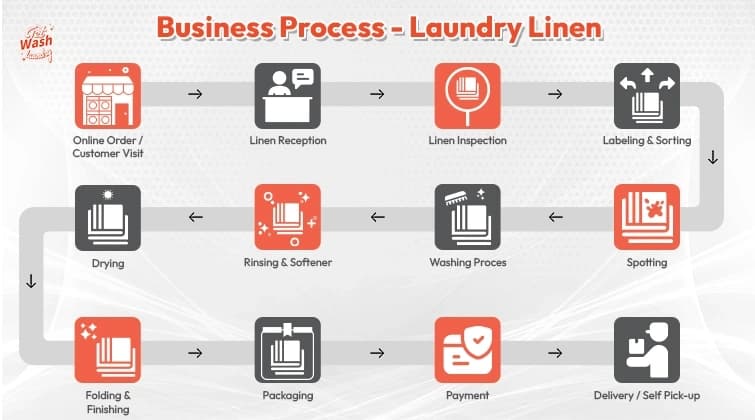
The Linen Laundry page does not yet set out its process steps in text. Here is the workflow we apply to linen.

Figure 6. Linen laundry process (proses-laundry-linen-getwash-en.png)
1. Pickup and counting
Linen is collected from your site and counted together. The count is recorded so it can be matched when the linen comes back.
2. Sorting
Linen is sorted by type, colour, fabric, and stain level. White linen is separated from coloured linen, and heavily stained or oily linen is set aside for special treatment.
3. Stain treatment
Visible stains are treated before the main wash, with products suited to the type of stain and the fabric.
4. Washing
Linen is washed with a programme, detergent dose, and temperature suited to the fabric and soil level, with machine loads that are not excessive so soil does not redeposit.
5. Drying
Linen is dried completely without excessive heat, so it is not damp, does not shrink, and its fibres do not become brittle quickly.
6. Checking, folding, and packing
Linen is checked for cleanliness, smell, and condition, folded to standard, packed by type, then recounted before delivery. Track your order on the tracking page.
Counting and discrepancies
Counting at handover is the foundation of trust. Linen is counted by type at pickup and on return, and both sides sign the record. If there is a discrepancy, this record is the starting point for tracing it. For businesses, how discrepancies are handled is best agreed at the start.
Communication
For regular needs, fast communication helps a great deal, for example to add pickups when occupancy rises or to report linen that needs rewashing. We usually agree one main communication channel with points of contact on both sides.
If results are not right
If any linen comes back with stains, odour, or folding that does not meet the standard, report it promptly with photos and quantities. It will be rewashed under the rewash procedure. Detailed reports also help us trace the cause, whether it lies in the washing process, the condition of old linen, or handling on site.
Turnaround
The page does not yet list a turnaround estimate. For businesses, turnaround and pickup schedules are agreed in the quotation. For households, ask for an estimate when you order.
How to order

Figure 7. How to order linen laundry (cara-pesan-laundry-linen-getwash-en.png)
- Note the types and quantities of linen, such as sheets, towels, robes, and covers.
- Mention special stains and fabrics in your linen.
- Contact [WhatsApp 0812-6610-0500](https://wa.me/6281266100500) for a consultation and quotation.
- Agree a pickup and delivery schedule that suits the rhythm of your business or home.
- Hand over pre-sorted linen, or drop it at the outlet via the order page.
- Track the status on the tracking page and receive clean linen.
Information worth sharing
When you contact us, share your type of business or household needs, roughly how much linen you have per week, the fabrics and colours, the stains that appear most, the schedule you need, and any problems with your current washing. This helps us give a more accurate quotation and better advice.
For businesses
For spas, hotels, clinics, and sport centres with regular needs, the B2B team will help set a schedule, calculate stock needs, and agree counting and complaint procedures. B2B team contact: WhatsApp 0812-6610-0500 or [email protected].
For households
For households, linen can be collected along with other laundry. Since 20 June 2026, pickup and delivery is charged per trip based on distance from the nearest outlet: Zone 1 (0–3 km) Rp8,000, Zone 2 (3–7 km) Rp15,000, and Zone 3 (over 7 km) Rp22,000. You can also drop off at our outlet at Jl. Ceger Raya No.42, Jurang Mangu Barat, Kec. Pd. Aren, Kota Tangerang Selatan, Banten 15222.
Caring for Linen on Site and at Home
Linen quality is not decided at the laundry alone. Habits on site, whether at a business or at home, have a big influence on linen life and cleanliness.

Figure 8. How to care for linen on site (cara-merawat-linen-di-lokasi-getwash-en.png)
Use linen for its purpose
Guest towels are not floor cloths, and sheets are not for moving things around. Linen used for other jobs often meets cleaning chemicals, paint, or heavy dirt that damage fibres and are hard to remove.
Sort from the start
Separate heavily stained linen, oily linen, and linen with blood or body fluids on site, and mark the bags. Early sorting makes treatment at the laundry more precise and stops stains spreading to other linen.
Do not pile up wet linen
Wet linen piled in closed bags for hours, let alone overnight, will smell musty and can grow mould. Use ventilated containers, and schedule pickups so soiled linen does not wait too long.
Shake it out before bagging
Hair, sand, food scraps, and small objects carried in linen make washing harder and can damage other linen. Shake linen out before bagging it, and check for any guest belongings tucked inside.
Store it properly
Store clean linen on dry shelves, covered from dust, away from damp walls or water pipes. Do not store clean linen near cleaning chemicals, and do not stack it so high that the bottom gets crushed.
The role of housekeeping
The housekeeping team is the front line of linen care. They judge whether linen is fit to put out, sort soiled linen, and store clean linen. Simple training, such as how to sort, signs linen should be withdrawn, and the habit of never using linen for other jobs, can extend linen life significantly.
Pool towels
Pool towels face chlorine, sunscreen, and sand. Chlorine can fade coloured towels, while sunscreen leaves yellowish marks. Keep pool towels separate from room towels, shake off the sand, and do not let wet towels pile up by the pool.
At home
At home, change sheets and pillowcases regularly, for example weekly, and more often if you sweat a lot or are unwell. Bath towels should be hung open after use so they dry quickly, and washed after a few uses. For sheets, see also bedsheet laundry, and for bedroom curtains, curtain cleaning.
In the rainy season
The rainy season is hard on linen: humid air makes it difficult for linen to stay dry on storage shelves, and wet linen smells faster. Make sure linen stores are ventilated, use moisture absorbers if needed, and do not keep clean linen in rooms near water sources or damp walls.
Linen for important guests
Hotels, villas, and homes that host important guests often set aside their best linen for particular rooms. Store this linen separately, check it before putting it out, and make sure there are no faint stains or smells. Small details such as neatly folded towels and crease-free sheets are very noticeable to guests used to high standards.
Long-term storage
Reserve linen that is rarely used, such as linen for peak season, should be stored completely clean and dry, in containers that keep out dust but still breathe. Check it periodically, and wash it again before use if it has been stored for a long time.
New linen
New linen from the factory usually still contains finishing agents that make it feel stiff and less absorbent. Wash new linen before it is used by guests or family. If you buy new stock in bulk, let us know so its first wash can be scheduled.
When occupancy spikes
Long holidays, year-end, and big events can multiply linen needs within days. Share known dates well in advance so capacity and extra pickups can be arranged, and check that your linen stock can cover the spike.
A simple routine
- Every day: sort soiled linen, separate heavy stains, never leave wet linen closed up.
- Every pickup: count the linen handed over and received back.
- Every week: check the condition of linen on the shelves and rotate stock.
- Every month: record withdrawn linen and plan new purchases.
Restaurant and dining linen
Tablecloths and cloth napkins face sauces, oil, coffee, red wine, and candle wax. Food stains left overnight are much harder to lift, so restaurant linen is best collected as often as possible. For dinners at home or family events, hand over tablecloths and napkins as soon as the event is over. Tell us the main stains, such as red wine or wax, so treatment can be prepared from the start.
Our experience
Spa towels smelling rancid from massage oil, boutique hotel sheets slowly turning grey, clinic couch covers with dried blood stains, and gym towels that smell despite being freshly washed: these are the linen cases we see most. Almost all of them can be fixed with the right process and better habits on site. For linen that has passed its service life, we say so honestly, so you can plan replacements before guests notice.
Service hours and location
Customer Service hours: Monday–Friday 09:00–17:00, Saturday 09:00–15:00, closed Sunday. Our head office is at Jl. Ceger Raya No.42, Jurang Mangu Barat, Kec. Pd. Aren, Kota Tangerang Selatan, Banten 15222, and we serve Greater Jakarta and Bali. If you are looking for laundry near me that can handle both business and household linen, contact us for a consultation.
Need a partner for your linen? Contact WhatsApp 0812-6610-0500, order via the order page, or follow us on Instagram, TikTok, Facebook, and Threads.
FAQ: Linen Laundry
How much does linen laundry cost at Getwash?
The service page does not yet list prices. Rates are set by item type, quantity, pickup frequency, and location. Send your linen list to WhatsApp 0812-6610-0500; for businesses, the B2B team will prepare a written quotation.
Which linen can be washed?
Sheets, pillowcases, bolster covers, duvet covers, mattress protectors, towels, bath mats, bathrobes, spa and clinic couch covers, gym towels, tablecloths, napkins, and thin to medium blankets.
Do you serve households or only businesses?
Both. The page names spas, hotels, clinics, and sport centres, and the English version also mentions linen for homes.
Why is my white linen turning grey?
Usually because soil redeposits during washing, the machine is too full, the detergent does not match the soil level, white linen is mixed with coloured fabrics, or detergent and softener residue has built up. More bleach is not a long-term fix.
Why does linen turn yellow?
Usually because body oils, sweat, lotion, sunscreen, or massage oil were not fully removed, then changed colour over time and with heat.
Why do towels go stiff?
Detergent and softener residue, minerals from hard water, or drying too hot for too long. Adding more softener often makes it worse.
Can massage oil stains be removed?
Spa linen with oil residue needs a special process to lift the oil. Oil stains that have long since yellowed cannot always be removed completely.
How is clinic linen handled?
Linen with blood and body fluids needs to be separated and marked on site, then treated with cold water first under a procedure agreed in writing in line with your facility's infection-control policy.
What is the difference between linen laundry and washing linen fabric?
Linen laundry handles household and hospitality textiles such as sheets and towels. Clothes made of flax linen fabric are better cared for through wet cleaning or dry cleaning according to their labels.
How long does linen laundry take?
The page does not yet list an estimate. For businesses, turnaround is agreed in the quotation; for households, ask when you order.
How much linen stock does a business need?
A common hospitality benchmark is about three sets per bed, adjusted to the pickup schedule and guest patterns.
How much is pickup and delivery for households?
Since 20 June 2026: Zone 1 (0–3 km) Rp8,000, Zone 2 (3–7 km) Rp15,000, and Zone 3 (over 7 km) Rp22,000 per trip. For businesses, it is agreed in the quotation.
What are Getwash Customer Service hours?
Monday–Friday 09:00–17:00 and Saturday 09:00–15:00. Closed Sunday. WhatsApp messages can be sent at any time and will be answered during the next service hours.
Sources
- Getwash Linen Laundry service page (EN)
- Getwash Laundry Linen page (ID)
- Getwash B2B Laundry page
- New Policy Notice: Pickup & Delivery Rates