Laundry B2B
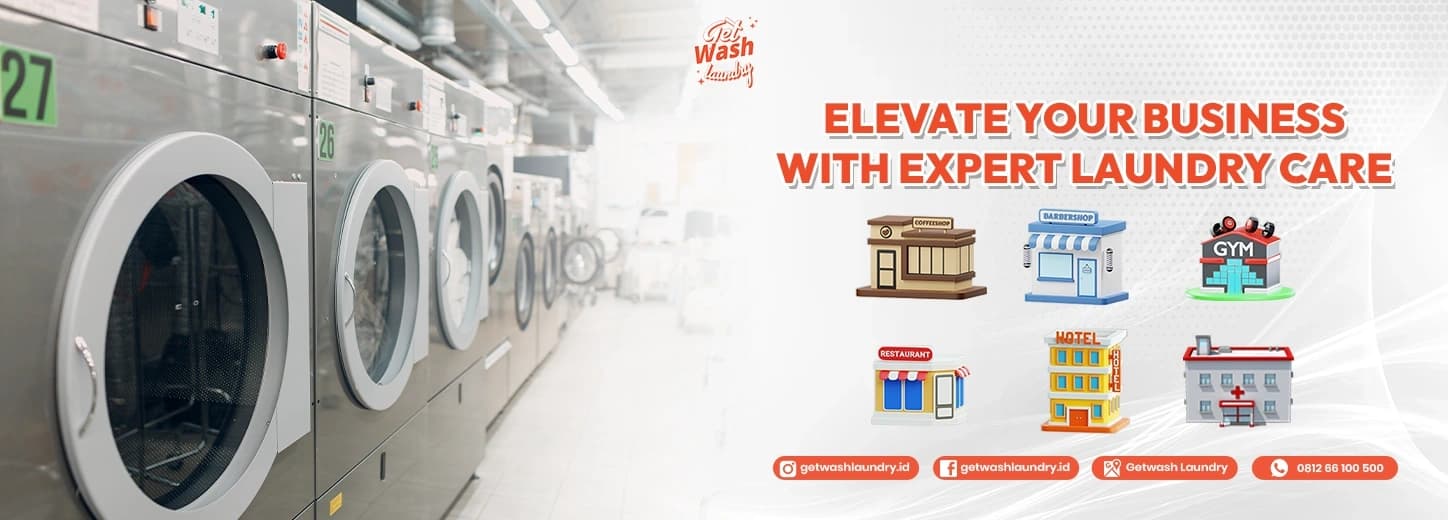
- Boutique hotelCall for a price
- Guest houseCall for a price
- HotelCall for a price
- Villa dan resortCall for a price
- Gym centerCall for a price
- Boxing & Martial arts gymCall for a price
- Yoga & pilates studioCall for a price
- BarbershopCall for a price
- SalonCall for a price
- SpaCall for a price
- Klinik GigiCall for a price
- Klinik KecantikanCall for a price
- Rumah SakitCall for a price
Contact us to schedule your order
09:00-20:00 (Weekday) & 09:00-17:00 (Weekend)
Ulasan Pelanggan
- Dani5.0
Layanan Laundry B2b ini hasilnya bersih maksimal. Saya puas dan akan memakai lagi.
- ARIFIN5.0
Layanan Laundry B2b ini hasilnya bersih maksimal. Terima kasih atas pelayanannya.
- Marwanto5.0
Layanan laundry B2B yang sangat profesional untuk kebutuhan operasional bisnis kami. Ketepatan waktu pengiriman, kapasitas besar, dan standar kebersihan selalu terjaga konsisten. Proses pengerjaan tepat waktu sesuai janji dan harganya sangat sepadan.
- yanuar erwan saputra5.0
Layanan Laundry B2b ini hasilnya bersih maksimal. Sangat direkomendasikan.
- Marwanto5.0
Layanan laundry B2B yang sangat profesional untuk kebutuhan operasional bisnis kami. Ketepatan waktu pengiriman, kapasitas besar, dan standar kebersihan selalu terjaga konsisten. Proses pengerjaan tepat waktu sesuai janji dan harganya sangat sepadan.
- yanuar erwan saputra5.0
Layanan laundry B2B yang sangat profesional untuk kebutuhan operasional bisnis kami. Ketepatan waktu pengiriman, kapasitas besar, dan standar kebersihan selalu terjaga konsisten. Proses pengerjaan tepat waktu sesuai janji dan harganya sangat sepadan.
- Dani5.0
Layanan laundry B2B yang sangat profesional untuk kebutuhan operasional bisnis kami. Ketepatan waktu pengiriman, kapasitas besar, dan standar kebersihan selalu terjaga konsisten. Proses pengerjaan tepat waktu sesuai janji dan harganya sangat sepadan.
- ARIFIN5.0
Layanan laundry B2B yang sangat profesional untuk kebutuhan operasional bisnis kami. Ketepatan waktu pengiriman, kapasitas besar, dan standar kebersihan selalu terjaga konsisten. Proses pengerjaan tepat waktu sesuai janji dan harganya sangat sepadan.
- TIPA RUSTIPAH5.0
Layanan laundry B2B yang sangat profesional untuk kebutuhan operasional bisnis kami. Ketepatan waktu pengiriman, kapasitas besar, dan standar kebersihan selalu terjaga konsisten. Proses pengerjaan tepat waktu sesuai janji dan harganya sangat sepadan.
- AHMAD RIZA PAHLEPI5.0
Layanan laundry B2B yang sangat profesional untuk kebutuhan operasional bisnis kami. Ketepatan waktu pengiriman, kapasitas besar, dan standar kebersihan selalu terjaga konsisten. Proses pengerjaan tepat waktu sesuai janji dan harganya sangat sepadan.
B2B Laundry for Hotels, Spas, Gyms, Clinics, and Restaurants: How to Choose a Laundry Vendor, Calculate Linen Par Levels, Set Contract and SLA Terms, and Start a Partnership with Getwash
By the Getwash Laundry Team | Updated 6 November 2026 | Reading time ±28 minutes
|
QUICK ANSWER Getwash B2B laundry handles linen, towels, and uniforms for hotels, villas, guest houses, spas, salons, barbershops, gyms, yoga and pilates studios, clinics, and hospitals, with pricing by quotation based on volume, item type, and schedule. Before choosing a laundry vendor, calculate how much linen stock you need (par level), then agree in writing on: the pickup and delivery schedule, turnaround times, quality standards and the rewash procedure, how lost or damaged items are handled, and the reporting format. A partnership runs from consultation to quotation, contract signing, service delivery, and periodic review. Contact WhatsApp 0812-6610-0500 or [email protected]; service hours are Monday–Friday 09:00–17:00 and Saturday 09:00–15:00. |
For anyone running a hotel, spa, or clinic, linen only feels important when something goes wrong. A guest checks in and the towels have not come back from the laundry. Sheets look dull in review photos. Spa therapists run short of towels at peak hours. Staff uniforms are not ready for an inspection. None of these are washing problems; they are problems of stock planning, scheduling, and agreements with the vendor.
This article is a practical guide, not a brochure. Inside you will find a comparison of in-house and outsourced laundry, the distinct needs of each industry, how to calculate linen par levels, the points every laundry contract and SLA should include, questions for assessing a prospective vendor, and how a Getwash [B2B laundry service](https://getwashlaundry.id/en/services/laundry-b2b) partnership runs from consultation to review. Use the table of contents below to jump to what you need.
Table of Contents
1. Getwash B2B Laundry: A Linen, Towel, and Uniform Partner for Business
2. In-House, Outsourced, or Both: Working Out the Right Choice
3. Different Laundry Needs in Every Industry
4. Par Levels: How to Calculate Your Linen Stock
5. Laundry Contracts and SLAs, and How to Assess a Vendor
6. The B2B Partnership Process and Day-to-Day Operations
Getwash B2B Laundry: A Linen, Towel, and Uniform Partner for Business
B2B laundry is different from household laundry. Volumes are larger and recurring, quality standards are set by the guest or patient experience, and a one-day delay can mean a room that cannot be sold or a treatment room that is not ready. That is why a relationship with a B2B laundry vendor is closer to an operational partnership than a one-off transaction.
Items we commonly handle
- Room linen: sheets, pillowcases, bolster covers, duvet covers, and bedcovers.
- Towels: bath, hand, and face towels, bath mats, and pool towels. For households and small businesses, see also towel laundry.
- Spa and salon linen: treatment towels, massage table covers, bathrobes, and shoulder capes.
- Restaurant linen: tablecloths, cloth napkins, aprons, and chef's uniforms.
- Staff uniforms: front office, housekeeping, therapist, and security uniforms, through to suits that need dry cleaning.
- Large and periodic items: curtains, carpets, and pillows cleaned on a set cycle.
One partner for many needs
Hospitality businesses rarely need only linen washing. There are curtains to clean every few months, corridor and lobby carpets, bedcovers and pillows, staff uniforms that need dry cleaning, and guest clothing. Managing many vendors means many schedules, many invoices, and many points of coordination. With one partner handling a range of items, coordination is simpler and every item's care history is recorded in one place.
Segments we serve
Getwash's B2B service page groups clients into four categories: Hotels (boutique hotels, guest houses, hotels, villas and resorts), Sport Centers (gyms, boxing and martial arts gyms, yoga and pilates studios), Beauty & Grooming (barbershops, salons, spas), and Clinics & Medical Facilities (dental clinics, aesthetic clinics, hospitals). Beyond these categories, restaurants, cafés, and offices with uniform needs are also welcome to consult with us so we can assess their needs.
A track record, without naming names
Getwash has served long-term linen and uniform contracts for international hotel chains, hospitals, airlines, airline caterers, boarding schools, and a range of hospitality businesses. From the start we have held to the principle that a client list belongs to the clients, so we do not put their names in public materials. For many operators, especially those hosting officials and high-profile guests, that discretion is one of the reasons they choose Getwash.
Why vendor distance matters
The distance between your business and the vendor's facility affects more than delivery cost. A nearby vendor can respond faster to urgent requests, add pickups more flexibly when volume spikes, and is easier to visit if you want to see the process. Getwash's head office is in Pondok Aren, South Tangerang, close to Bintaro, BSD, and South Jakarta. For locations further away, scheduling and cost are discussed in the quotation.
Stain-removal expertise
Business linen faces stains that are rare at home: massage oil and body scrub in spas, hair dye in salons, blood and body fluids in clinics, coffee, sauces, and wine in restaurants, and make-up on hotel towels. Getwash is an official distributor of SEITZ (Germany) and A.L. Wilson (USA) professional spotting agents, and we use these products in our own stain-removal process too. For specific stains such as colour bleed, ink, and rust, we are honest about the chances of success, because no stain treatment can be guaranteed one hundred percent.
Personal laundry for hotel guests
Besides operational linen, many hotels and villas also receive requests to launder guests' personal clothing: a shirt that needs pressing before a meeting, a suit to be cleaned before an event, or clothes that must be ready before check-out. Requests like these need item-by-item handling, care, and often a short turnaround. Hotels can hand guest laundry to Getwash under a scheme separate from linen, including dry cleaning and express laundry. For officials and high-profile guests travelling with designer clothing and formal wear, careful and discreet handling is the standard, not an add-on.
What we do not promise
We do not promise a specific savings figure, we do not promise that every stain will come out, and we do not promise that old linen can be made new again. Linen has a service life, and some stains are genuinely permanent. What we do promise is a process explained openly, agreements in writing, and honest communication when something goes wrong.
“A good laundry vendor is not measured by how white the linen is on day one, but by how consistently it comes back on time in month twelve.” — Working principle of the Getwash B2B team
In-House, Outsourced, or Both: Working Out the Right Choice
The first question is usually whether to wash in-house or hand it to a vendor. The answer depends on volume, space, capital, and how much your team wants to manage outside your core business.

Figure 1. In-house vs outsourced laundry costs (biaya-laundry-in-house-vs-outsourcing-getwash-en.png)
Costs often forgotten with in-house laundry
When comparing, many operators only count detergent and electricity. In fact the cost of in-house laundry covers much more:
- Machine investment: industrial-capacity washers and dryers, ironers, and work tables.
- Space and installation: a dedicated room, water supply, drainage, power, and ventilation.
- Labour: wages, overtime, training, and cover when staff are on leave or sick.
- Chemicals: detergent, bleach, softener, and the right stain-removal products.
- Machine maintenance: regular servicing, spare parts, and the cost of breakdowns in peak season.
- Hidden costs: linen that wears out quickly from the wrong process, and managers' time.
Linen life is part of the cost
Laundry cost is not only the cost of washing, but also the cost of replacing linen. A process that is too harsh, such as excess bleach, the wrong temperatures, or overly hot drying, makes fibres brittle so linen has to be replaced more often. The right process, on the other hand, extends linen life. When comparing options, look at the condition of the linen after a few months, not just the first week's results.
When outsourcing makes sense
Outsourcing is generally the better choice for businesses with medium volumes, limited space, or no wish to invest capital in machines. Boutique hotels, villas, spas, salons, gyms, and clinics fall into this group. Costs become variable with volume, and your team can focus on serving guests.
When in-house is still needed
Businesses that need very fast turnaround within hours, such as gym towels that cycle several times a day, sometimes still need a small machine on site. Many end up with a combination: small, urgent items are washed on site, while large linen, uniforms, and items needing stain treatment go to the vendor.
Risks that rarely get counted
In-house laundry also carries risks that often stay out of the calculation. A machine breaking down in peak season can cut off linen supply for days. Industrial dryers need their lint filters cleaned regularly; lint build-up is a known fire risk in laundry rooms. Skilled laundry staff are also hard to replace. These risks do not always materialise, but when they do, the cost is far greater than the difference in price per kilogram.
The combined model in practice
A common combined model: a gym keeps one small washer on site for hand towels that cycle several times a day, while bath towels, staff uniforms, and equipment covers go to the vendor twice a week. A boutique hotel washes bath mats on site, while sheets, pillowcases, and bath towels go to the vendor. With a model like this, urgent needs are still met without building a full laundry.
Questions to ask yourself before outsourcing
- How much space could be freed up if laundry were no longer done on site?
- How many staff hours currently go into washing, drying, and folding?
- How often have machines failed in the past year?
- Does your current linen quality meet the standard you want?
- Is your linen stock large enough to cover the time linen spends at the vendor?
How to compare fairly
- Record actual volumes for one to two months, separated by item type.
- Count all in-house costs, including machine depreciation and staff time.
- Ask vendors for quotes based on the same volumes.
- Include risk costs, such as breakdowns in peak season or laundry staff leaving.
- Compare quality, not just price, with a limited trial where possible.
We do not promise any particular savings figure, because results depend heavily on each business. What we can do is help you work it out together, based on real volume data.
Different Laundry Needs in Every Industry
Every industry has its own linen, stains, and working rhythm. A vendor who understands these differences will deliver far better results.

Figure 2. Laundry needs by industry (kebutuhan-laundry-b2b-per-industri-getwash-en.png)
Hotels, villas, and guest houses
A hotel's main need is consistency: white linen that stays white, towels that are soft and absorbent, and supply that follows occupancy. Volume rises sharply at weekends, in holiday seasons, and around big events. The vendor needs to be able to adjust pickups and capacity. For villas and guest houses, the challenge is scheduling around guest changeovers that are not always regular. Sheets and pillowcases are covered in more detail in our bedsheet laundry article.
Star-rated hotels and boutique hotels
Star-rated hotels with many rooms usually have established linen standards and housekeeping procedures, so their main needs are capacity and consistency. Boutique hotels and guest houses often have linen with a distinctive character, such as colours, patterns, or premium materials that form part of their identity, so it needs more careful handling. These two types of hotel need different approaches, and this is best discussed at the consultation stage.
Spas, salons, and barbershops
Massage oil, body scrub, creams, and hair dye leave residues that make towels smell rancid and feel stiff if not removed properly. Oil residue can also build up in fibres and, under certain conditions, poses a risk with dryer heat, so spa linen washing needs a process designed specifically to lift oil. Salons and barbershops face hair dye and chemical stains that often cannot be removed fully; many salons choose dark towels reserved for colouring.
Gyms, martial arts gyms, and yoga or pilates studios
Gym towels absorb large amounts of sweat and are often piled up wet before washing, ideal conditions for odour-causing bacteria. The main needs are fast turnaround and towels that are genuinely odour-free. Yoga and pilates studios also have mat towels and covers that need regular washing. The key is not leaving dirty towels damp for too long before pickup.
Barbershops and men's grooming
Barbershops use capes, small towels, and hot towels in large numbers every day. Fine hair clippings stuck to fabric should be shaken off before items go to the laundry, because large amounts of hair make washing harder and can cling to other items. Towels used with shaving cream and hair oils also need a residue-lifting process similar to spa towels.
Clinics and hospitals
Healthcare facilities have the strictest needs. Ordinary soiled linen and linen contaminated with body fluids need to be separated on site, bagged and clearly marked, and handled by a different procedure. Blood and protein stains must be treated with cold water first, because hot water sets protein permanently. Segregation, bagging, and handling procedures like these should be agreed in writing and aligned with your facility's infection-control policy.
Pools and beach facilities
Pool and beach towels face chlorine, sunscreen, and sand. Chlorine can fade coloured towels, while sunscreen and body oils cling to fibres and can leave yellowish stains. Pool towels should be kept separate from room towels and washed with a suitable process, and shaken free of sand before they are sent.
Restaurants and cafés
Tablecloths and cloth napkins face oil, sauces, coffee, wine, and candle wax. Food stains left to dry overnight are much harder to lift. Chef's uniforms also absorb oil and kitchen odours. Restaurants that use cloth linen usually need frequent pickups and enough reserve stock.
Offices, schools, and institutions
The main need for offices and institutions is uniforms that are neat and visually uniform: colours that do not fade unevenly, and consistent folds and pressing. For suits and formal wear, dry cleaning is the better fit, while for fabrics that cannot tolerate solvent, wet cleaning can be an alternative.
Uniforms in large numbers
Companies with hundreds of uniforms, such as airlines, caterers, boarding schools, or security firms, need a different system from hotel linen. Each uniform has to go back to the right owner, so name or number tagging becomes important. Schedules also often follow work rotations or particular seasons. Discuss tagging, packing per person or per unit, and peak periods at the consultation.
Bali and tourist areas
Getwash also operates in Bali. Villas and resorts in tourist areas face sharp seasonal swings, high humidity, and linen often exposed to sand, sunscreen, and pool water. Sunscreen and body oils are known to leave yellowish marks on white towels if not treated properly. Discuss seasonal patterns and the most common stains at the consultation, so capacity and processes can be prepared from the start.
Sustainability
Getwash's B2B service page sets out a commitment to sustainability, including biodegradable detergents, efforts to reduce water and energy use, reusable delivery packaging, and employing a local workforce. If your business has sustainability targets or needs to report on them to owners or a chain, raise your data needs at the consultation so we can discuss what can be reported.
Par Levels: How to Calculate Your Linen Stock
Many business laundry problems are really stock problems. If linen stock is too low, no vendor, however good, can prevent shortages at high occupancy. The concept the hospitality industry uses to manage this is called the par level.

Figure 3. How to calculate linen par levels (cara-menghitung-par-level-linen-getwash-en.png)
What a par level is
A par level is the number of linen sets held for each unit of use, such as per bed or per treatment room. A common industry benchmark is around three sets: one in use, one being washed, and one in reserve in the store. Many hotels add one or two more sets to cover damaged or lost linen and peak seasons. This is a general benchmark, not a fixed rule; the right number depends on your pickup schedule, turnaround time, and occupancy pattern.
A simple worked example
Suppose a boutique hotel has 20 rooms, each with one double bed and needing two bath towels. At a par level of three, the hotel needs about 60 sheet sets and 120 bath towels. If the vendor collects twice a week and weekend occupancy is often full, a par level of four, meaning 80 sheet sets and 160 towels, gives a safer margin. These figures are only an illustration of the thinking.
An example for spas and gyms
For a spa, calculate from the number of treatment rooms and the average number of guests per room per day. If one room serves six guests a day and each guest uses two large towels and one table cover, that room needs twelve towels and six covers a day. Multiply by the number of days between pickups, then add a reserve. For a gym, calculate from daily visits and your towel policy, whether each member gets one towel or two. The principle is the same: stock must cover the time linen spends off site, plus a buffer.
Factors that affect par levels
- Pickup frequency: the less often items are collected, the more stock you need.
- Vendor turnaround: linen that spends longer at the laundry needs more reserve.
- Occupancy pattern: businesses with weekend or holiday spikes need a buffer.
- Linen change policy: hotels that change linen daily need more stock than those changing between guests.
- Damage rate: permanent stains and tears reduce usable stock.
Keeping stock healthy
Count stock regularly, for example monthly, and record linen withdrawn for damage or permanent stains. Separate linen no longer fit for guests, and reuse it as cleaning cloths or for internal use where possible. This data also helps you plan new linen purchases before stock runs too low.
Standardise linen specifications
Linen with uniform specifications is easier to manage. If a hotel uses towels from several suppliers with different weights and shades of white, the differences become more visible after a few washes. Choose a standard specification for each linen type, including size, material, and colour, and use the same specification when buying more stock. White makes it easier to wash with a consistent process, while coloured linen needs separate processing so it does not fade or bleed.
Mark your linen
Marking linen with the business name, a code, or a particular stitch colour helps counting and prevents mix-ups. This is especially important for businesses with several branches or several similar linen types. Marking also helps you track linen age if you record purchase periods.
Rotate your stock
Linen always taken from the top of the pile wears out faster, while linen at the bottom is rarely used. Rotate it: newly delivered clean linen goes at the bottom or back, and what is taken for use is whatever has been on the shelf longest. With rotation, all stock wears evenly and average service life is longer.
New linen needs washing first
Linen and towels fresh from the factory usually still carry finishing residues that reduce absorbency and make them feel stiff. Wash new linen before it goes to guests. If you buy new stock in large quantities, let the vendor know so its first wash can be scheduled.

Figure 4. Signs hotel linen needs replacing (tanda-linen-hotel-harus-diganti-getwash-en.png)
When linen needs replacing
Hotel linen does not last forever. Signs that linen needs replacing include white turning yellow or grey despite correct washing, thinning or holed fibres, frayed edges, and towels that stay stiff and non-absorbent. Recording the age and condition of linen helps you plan a replacement budget in stages, rather than all at once.
Laundry Contracts and SLAs, and How to Assess a Vendor
A good laundry contract protects both parties and prevents disputes. Here are the points worth agreeing in writing before a partnership begins.

Figure 5. What a laundry contract and SLA should cover (isi-kontrak-dan-sla-laundry-b2b-getwash-en.png)
Pickup and delivery schedule
Set fixed days and times for pickup and delivery, and a procedure for extra requests when volume spikes. Decide too who receives and signs for handovers at your site. Pickup and delivery charges for B2B clients are agreed in the quotation according to schedule and location.
Turnaround
Agree turnaround times for each item type, because room linen, uniforms, and dry-cleaning items follow different processes. Agree too what happens if there is a delay, and how urgent requests are handled.
Pricing basis
B2B laundry can be priced per kilogram, per piece, or a combination. Getwash's B2B page says "contact for price" because rates are built around volume, item type, frequency, and location. Make sure the quotation explains what is included, such as pressing, folding, packaging, and standard stain treatment, and what is charged separately.
Quality standards and rewash
Set standards that can be checked: cleanliness, odour, neatness of folding, and packaging condition. Agree a procedure for items that fall short, such as a reporting deadline and the rewash process. Getwash has a rewash form for this purpose.
Lost and damaged items
Counting items at handover is the foundation of everything. Agree how counting is done, who signs, how discrepancies are handled, and how responsibility for damage caused by processing is distinguished from wear due to linen age. Permanent stains that existed before handover are best recorded from the start.
Reports and reviews
Regular reports on item numbers, types, and special notes help you control cost and stock. Getwash provides monthly digital reports, and the frequency and format can be set in the contract. Schedule periodic reviews too, to discuss quality, complaints, and changing needs.
Contract length and trial period
B2B laundry contracts usually run for a year or more. For a new partnership, consider a trial period or a review clause in the first months, so both parties can adjust processes before full operation. Agree too on renewal, price adjustment, and termination terms.
Confidentiality and security of items
For hotels hosting important guests, clinics treating patients, and companies with branded uniforms, confidentiality and the security of items matter as much as cleanliness. Agree how items are packed and transported, who may receive them, and how logoed items or official uniforms are treated so they do not fall into the wrong hands.
Invoicing and payment
Agree the billing period, for example monthly, an invoice format with item-count detail, and payment terms. Clear detail makes it easier for your finance team to match invoices against handover records on site.
Example points for a written agreement
- Schedule: pickup every Monday, Wednesday, and Friday morning; delivery at the next pickup.
- Counting: counted jointly at pickup and delivery, signed on a handover form.
- Complaints: reported within a set time after items are received, with photos.
- Rewash: items that fall short are rewashed under the rewash procedure.
- Permanently stained items: recorded and reported, not returned to guest stock without approval.
- Reporting: a monthly summary of item counts by type, with special notes.
The examples above are only an outline. The actual agreement is drawn up together to suit your business.
Questions for assessing a prospective vendor

Figure 6. Checklist for choosing a laundry vendor (checklist-memilih-vendor-laundry-b2b-getwash-en.png)
- What is your capacity in peak season, and what happens if our volume suddenly spikes?
- How do you handle the stains typical of our industry, such as massage oil, hair dye, or blood?
- What is your counting and handover procedure, and how are discrepancies handled?
- What is included in the price, and what costs extra?
- What is the complaint and rewash procedure, and how long does resolution take?
- Can we run a limited trial before signing a long-term contract?
- Can we see your process or speak to the team who will handle our account?
Why the cheapest price often costs the most
A difference of a few thousand rupiah per kilogram looks attractive on paper. But if the cheapest vendor wears linen out faster, is often late so rooms cannot be sold, or frequently loses items, the total cost can be far higher. Compare vendors on total cost over a year, including linen replacement, delays, and your team's time spent dealing with problems.
Warning signs in a vendor
- Very low prices with no breakdown of what is included.
- No clear item-counting procedure.
- Promising every stain will come out, which technically cannot be guaranteed.
- Reluctance to put turnaround and lost items in writing.
- No backup plan for machine breakdowns or volume spikes.
The B2B Partnership Process and Day-to-Day Operations
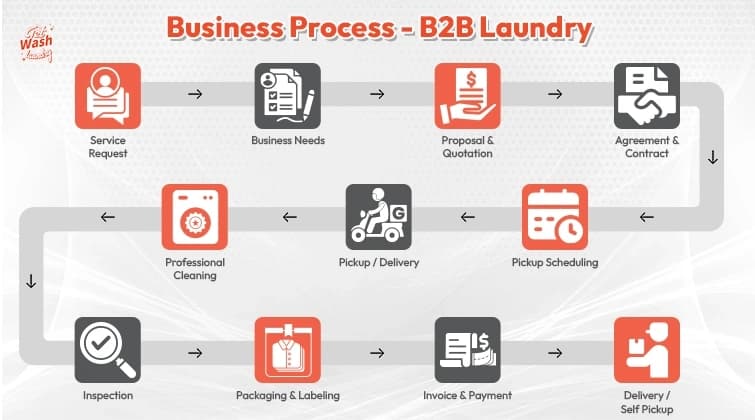
A B2B laundry partnership with Getwash runs in five stages, as set out on our service page.

Figure 7. B2B laundry partnership process (proses-kerja-sama-laundry-b2b-getwash-en.png)
1. Initial consultation
The B2B team learns about your type of business, the types and quantities of items, volume patterns, required schedule, location, and the problems you have with your current setup. Bring volume data if you have it, because it makes the quotation far more accurate.
2. Quotation and agreement
Based on the consultation, we prepare a quotation covering the pricing basis, schedule, turnaround, and relevant additional services. The quotation is discussed together until it fits your needs.
3. Contract signing
The agreement is set out in a written contract, including the SLA points discussed in the previous section. A clear contract means both sides know what to expect from day one.
4. Service delivery
The service runs to the agreed schedule. In the first weeks we usually monitor more closely to make sure handover, counting, and quality procedures are working as expected.
5. Review and adjustment
Periodically, we review reports, complaints, and changing needs with you, then adjust schedules, capacity, or processes where needed.
Day-to-day operational flow

Figure 8. Daily B2B laundry flow (alur-harian-laundry-b2b-getwash-en.png)
- Sort on site: soiled linen is separated by type, and heavily stained or contaminated linen is separated and marked.
- Count at pickup: item numbers are recorded and signed by both parties.
- Process by type: each item type is washed with the right programme and stain treatment.
- Check and fold: items are checked for cleanliness, odour, and neatness.
- Pack and label: items are packed by type so they are easy to store.
- Deliver and recount: quantities are matched at handover and any discrepancy recorded.
The first weeks of a partnership
The first weeks are a period of adjustment. Counting procedures are tested, pickup times are tuned to your operating rhythm, and quality standards are matched to your team's expectations. During this period we recommend one point of contact on your side and one on ours, so every question and piece of feedback is handled directly without changing hands.
Measuring whether the partnership works
To judge whether the partnership is going well, use simple measures that can be recorded: the percentage of on-time deliveries, the number of items returned for rewash, the number of count discrepancies, and the number of linen items withdrawn for damage. Discuss these figures in periodic reviews, not just general impressions.
When there is a complaint
Complaints are best raised as soon as possible, with photos and the number of items affected. That way the cause can be traced, whether it lies in the washing process, in the condition of old linen, or in handling on site. Complaints traced together often lead to better procedures on both sides.
Peak seasons and volume spikes
Long holidays, year-end, wedding season, and big events near your site can multiply linen volume. Share known dates well in advance, such as major events or group bookings, so capacity and extra pickups can be arranged. It is also the right time to check that your par level is sufficient.
Your team's role on site
Laundry quality is not determined by the vendor alone. Your housekeeping or operations team plays a large part: not using towels to clean floors or chemical spills, not leaving wet linen piled in sealed bags for too long, and separating heavily stained linen from the start. These habits make linen last longer and washing results better.
Information to prepare before a consultation
- Type of business and location, including the number of branches if any.
- A list of item types, such as sheets, towels, uniforms, tablecloths.
- Estimated volume per week or per month, by item type.
- Seasonal patterns, such as weekends, long holidays, or regular events.
- The schedule you need for pickup and delivery.
- Current problems, such as stains, odour, or delays.
On-site habits that make linen last
- Do not use guest towels to clean floors, shoes, or chemical spills.
- Separate heavily stained linen and mark it before pickup.
- Do not leave wet linen sealed in bags for too long.
- Shake off hair, sand, and food scraps before bagging linen.
- Store clean linen on closed shelves that are dry and away from damp walls.
- Use first-in, first-out so all linen is used in rotation.
Day-to-day communication
For daily operations, fast and recorded communication helps a great deal. We usually agree one main channel, such as a WhatsApp group with points of contact from both sides, for schedule confirmations, extra requests, and short updates. Contractual matters are still recorded formally by email.
Starting with a trial
If you want to assess quality before committing, ask the B2B team about a trial with limited volume. The terms are discussed at the consultation. A good trial should include the hardest item types in your business, not just the easiest.
Contacting the B2B team
For a consultation, contact WhatsApp 0812-6610-0500 or email [email protected]. Service hours: Monday–Friday 09:00–17:00, Saturday 09:00–15:00, closed Sunday. Our head office is at Jl. Ceger Raya No.42, Jurang Mangu Barat, Kec. Pd. Aren, Kota Tangerang Selatan, Banten 15222, and we serve Greater Jakarta and Bali. If you are a business owner looking for laundry near me for commercial needs, tell us your location at the consultation.
Follow our news and tips on Instagram, TikTok, Facebook, and Threads.
FAQ: B2B Laundry
How much does B2B laundry cost at Getwash?
Pricing is by quotation, based on volume, item type, pickup frequency, and location. That is why the service page says "contact for price". Contact the B2B team for a consultation, and you will receive a written quotation explaining what is included.
Which businesses do you serve?
Hotels, villas, guest houses, spas, salons, barbershops, gyms, martial arts gyms, yoga and pilates studios, dental clinics, aesthetic clinics, and hospitals. Restaurants, cafés, and offices are also welcome to consult.
Is pricing per kilogram or per piece?
It can be per kilogram, per piece, or a combination, depending on item type and needs. The pricing basis is set out in the quotation.
Is there a minimum volume?
The service page does not list a minimum volume. Your needs are assessed at the consultation based on item type, frequency, and location, including for small businesses such as barbershops or studios.
Is pickup and delivery free for B2B clients?
Pickup and delivery charges and schedules for B2B clients are agreed in the quotation according to location and frequency.
What is a par level and what is ideal?
A par level is the number of linen sets per unit of use. A common industry benchmark is around three sets, often increased for peak season and damaged linen, depending on your pickup schedule and occupancy.
What happens if items go missing?
Items are counted and signed for by both parties at handover. How discrepancies are handled, the reporting deadline, and responsibility for lost items are agreed in writing in the contract from the start.
What if results do not meet the standard?
Report it under the agreed procedure. Getwash has a rewash form for rewashing items that fall short of the standard.
Can every stain be removed?
No stain treatment can be guaranteed one hundred percent. Getwash uses SEITZ and A.L. Wilson professional spotting agents, which we also distribute, and will be honest about the chances of success. Permanent stains are recorded and reported.
How is clinic and hospital linen handled?
Contaminated linen needs to be separated and marked on site. Segregation, bagging, and handling procedures are agreed in writing in line with your facility's policies.
Do you provide reports?
Yes, Getwash provides monthly digital reports. Frequency and format can be adjusted in the contract.
Does Getwash serve areas outside Greater Jakarta?
Getwash operates in Greater Jakarta and Bali. For other locations, raise it at the consultation.
How do we start a partnership?
Contact the B2B team on WhatsApp 0812-6610-0500 or email [email protected] for an initial consultation. Prepare item types and estimated volumes so the quotation is more accurate. Service hours are Monday–Friday 09:00–17:00 and Saturday 09:00–15:00.