Golf Equipment Care
- Golf Bag
(Stand/Cart Bag) | Estimasi 5 Hari Kerja
Rp 150.000 - Travel Bag Golf
Estimasi 5 Hari Kerja
Rp 180.000 - Golf Glove Leather
Estimasi 3 Hari Kerja
Rp 50.000 - Golf Glove Sintetis
Estimasi 3 Hari Kerja
Rp 30.000 - Topi / Visor Golf
Estimasi 3 Hari Kerja
Rp 30.000 - Sepatu Golf
(Spikeless/Softspike) | Estimasi 5 Hari Kerja
Rp 125.000 - Rain Cover Golf Bag
Estimasi 5 Hari Kerja
Rp 50.000 - Towel Golf / Handuk Golf
Estimasi 3 Hari Kerja
Rp 18.000 - Sling Bag / Shoe Bag Golf
Estimasi 5 Hari Kerja
Rp 70.000 - Golf Apparel
Kaos, Polo, Celana, Jaket ( Dry / Wet Cleaning ) Tergantung bahan dan instruksi label care
Rp 35.000 - Headcover Set
(1–10 pcs) | Estimasi 5 Hari Kerja
Rp 100.000
- Par Package
1 Golf Bag + 1 Sepatu + 1 Towel + 1 Topi | Estimasi 7 Hari Kerja
Rp 270.000 - Birdie Package
1 Golf Bag + 1 Sepatu + Headcover Set | Estimasi 7 Hari Kerja
Rp 300.000 - Eagle Package
Full Set ( 1 Golf Bag + 1 Sepatu + 1 Towel + 1 Topi + Headcover Set ) | Estimasi 7 Hari Kerja
Rp 599.000
Contact us to schedule your order
09:00-20:00 (Weekday) & 09:00-17:00 (Weekend)
Ulasan Pelanggan
- Thomas Triyatmoko5.0
Layanan Laundry Peralatan Golf ini hasilnya bersih maksimal. Saya puas dan akan memakai lagi.
- ANWAR5.0
Layanan Laundry Peralatan Golf ini hasilnya bersih maksimal. Terima kasih atas pelayanannya.
- Wegig Sutopo5.0
Tas golf, sarung tangan, dan tas stik golf saya dicuci hingga bersih bebas noda rumput dan tanah. Pengerjaannya sangat hati-hati pada bahan kulit sintetis maupun kain canvas-nya. Pelayanan admin dan teknisinya juga sangat ramah dan responsif.
- Dimas Wahyu Febrianto5.0
Layanan Laundry Peralatan Golf ini hasilnya bersih maksimal. Sangat direkomendasikan.
- Wegig Sutopo5.0
Tas golf, sarung tangan, dan tas stik golf saya dicuci hingga bersih bebas noda rumput dan tanah. Pengerjaannya sangat hati-hati pada bahan kulit sintetis maupun kain canvas-nya. Pelayanan admin dan teknisinya juga sangat ramah dan responsif.
- Dimas Wahyu Febrianto5.0
Tas golf, sarung tangan, dan tas stik golf saya dicuci hingga bersih bebas noda rumput dan tanah. Pengerjaannya sangat hati-hati pada bahan kulit sintetis maupun kain canvas-nya. Pelayanan admin dan teknisinya juga sangat ramah dan responsif.
- Thomas Triyatmoko5.0
Tas golf, sarung tangan, dan tas stik golf saya dicuci hingga bersih bebas noda rumput dan tanah. Pengerjaannya sangat hati-hati pada bahan kulit sintetis maupun kain canvas-nya. Pelayanan admin dan teknisinya juga sangat ramah dan responsif.
- ANWAR5.0
Tas golf, sarung tangan, dan tas stik golf saya dicuci hingga bersih bebas noda rumput dan tanah. Pengerjaannya sangat hati-hati pada bahan kulit sintetis maupun kain canvas-nya. Pelayanan admin dan teknisinya juga sangat ramah dan responsif.
- SUTRIMAN5.0
Tas golf, sarung tangan, dan tas stik golf saya dicuci hingga bersih bebas noda rumput dan tanah. Pengerjaannya sangat hati-hati pada bahan kulit sintetis maupun kain canvas-nya. Pelayanan admin dan teknisinya juga sangat ramah dan responsif.
- Adul Azis5.0
Tas golf, sarung tangan, dan tas stik golf saya dicuci hingga bersih bebas noda rumput dan tanah. Pengerjaannya sangat hati-hati pada bahan kulit sintetis maupun kain canvas-nya. Pelayanan admin dan teknisinya juga sangat ramah dan responsif.
Golf Equipment Care by Getwash: A Guide to Caring for Golf Bags, Shoes, Gloves, Headcovers, and Apparel in a Tropical Climate, Understanding Materials and Prices per Item, Choosing a Club Member Package, and Storing Your Kit So It Is Always Ready for the Course
By the Getwash Laundry Team | Updated 5 November 2026 | Reading time ±27 minutes
|
QUICK ANSWER Getwash cleans golf equipment per item: golf bag Rp150,000, travel bag Rp180,000, golf shoes Rp125,000, leather glove Rp50,000, synthetic glove Rp30,000, cap or visor Rp30,000, headcover set (1–10 pcs) Rp100,000, rain cover Rp50,000, sling or shoe bag Rp70,000, golf towel Rp18,000, and golf apparel Rp35,000. The listed estimate is 3 working days for gloves, caps, and towels, and 5 working days for bags, shoes, rain covers, sling bags, and headcovers; apparel has no estimate yet. Golf club member packages are available: Par Rp270,000, Birdie Rp300,000, and Eagle Rp599,000 (7 working days). Pickup is charged by zone (Rp8,000, Rp15,000, or Rp22,000 per trip). Order through the order page or WhatsApp 0812-6610-0500; service hours are Monday–Friday 09.00–17.00 and Saturday 09.00–15.00, closed on Sundays. |
Golf is a sport that values neatness. A player who arrives at the tee box with a clean bag, mud-free shoes, a supple glove, and a crisp polo shows that they take the game seriously, and their playing partners too. But a tropical climate is not kind to golf equipment. Morning dew, afternoon rain, sweat, wet grass, and bunker sand cling to everything each round, and then the kit is stored in a hot car boot or a damp storeroom until the next round.
This article covers the Getwash golf equipment care service in full: why golf equipment goes mouldy and smelly so quickly in Indonesia, what materials make up bags, shoes, and gloves, what each item and package costs, how the process works, which problems can and cannot be fixed, and how to look after your kit between rounds. If you are looking for laundry near me that understands golf equipment, start with the table of contents below.
Table of Contents
1. Why Golf Equipment Needs Special Care in a Tropical Climate
2. Understanding Golf Equipment Materials: Glove Leather, Bags, Shoes, Headcovers, and Apparel
3. Golf Equipment Cleaning Prices per Item and Golf Club Member Packages
4. The Cleaning Process for Each Type of Equipment, and Turnaround
5. Common Problems: Mould, Odour, Mud, Grass Stains, Stiff Gloves, and Misshapen Caps
6. Caring for Your Kit Between Rounds, for Golf Clubs, and How to Order
7. FAQ: Questions About Getwash Golf Equipment Care
Why Golf Equipment Needs Special Care in a Tropical Climate
In countries with four seasons, many golfers put their kit away for the winter and clean it once a year. In Indonesia, golf is played all year round, often early in the morning when the grass is still wet with dew, or in the afternoon when rain can arrive without warning. That means golf equipment here is constantly exposed to water, sweat, and humidity, with little time to dry out properly.
Morning dew, afternoon rain, and wet grass
Early tee times are a favourite for many golfers because the air is cooler. But at that hour the fairway and rough are still wet. Shoes soak up water through the uppers and seams, the base of a bag set down on the grass gets damp, and grass clippings stick to soles and stand bag legs. Afternoon rain adds mud around the greens and along buggy paths. All this moisture is invisible, but it stays inside the materials.
Sweat and damp hands
The golf glove wears out faster than anything else because it constantly absorbs sweat from the hand. In hot, humid air, an 18-hole round can leave a glove soaked with sweat, which then dries stiff once it is stuffed into a bag pocket. The same happens to bag handles, shoulder straps, the inside of caps, and polo collars. Sweat contains salt and oil that gradually stiffen leather, dull colours, and leave odours that are hard to remove.
Car boots and storerooms: where mould grows
After a round, most golf bags go straight into the car boot and stay there until the next one. A closed boot that is hot during the day and cool at night creates condensation. A bag that still holds wet shoes, a damp towel, and a sweaty glove becomes an ideal home for mould. A bag stored for a long time in a storeroom or club locker without air circulation goes the same way, showing white or green spots and a musty smell when it is opened again.
“Golf equipment rarely gets ruined on the course; it gets ruined in the car boot and the storeroom, left damp and forgotten.” — Observation from the Getwash team
Image on the golf course
The golf course is where many business decisions and relationships are made. Clean, well-kept equipment is part of the first impression. Getwash is trusted as the go-to laundry for government officials and high-profile clients, and golf equipment is one of the things they most often hand to us, because few laundries are willing to handle golf bags, golf shoes, and headcovers one by one with a method that suits the material.
Why not just use the washing machine
Many golfers try washing shoes or gloves in their home washing machine. The results are often disappointing: leather gloves shrink and harden, golf shoes lose their shape and their glue weakens, knitted headcovers stretch or pill, and golf bags do not fit or have their frames bent. Golf equipment combines leather, synthetics, foam, plastic, metal, and rubber, so it needs part-by-part handling, not the same machine cycle for everything.
The often underestimated value of golf equipment
A full set of golf kit, from the bag, shoes, several gloves, and headcovers to the travel bag, is no small investment. Some of it was bought on golf trips abroad, some was a gift, and some is limited edition and hard to replace. Ironically, these are exactly the items most often left in the car boot without care. Regular cleaning costs far less than replacing a bag whose foam has gone mouldy or shoes whose soles have come away.
Who needs this service most
- Regular golfers who play every week and have no time to look after their kit.
- Golfers just back from a golf trip, with a travel bag and shoes still damp from travelling.
- Owners of bags stored for a long time in a storeroom or locker that are starting to grow mould.
- Executives and officials who need their kit always tidy for meetings on the course.
- Golf clubs and communities that want members' equipment cared for on a schedule.
- Golfers about to sell or gift their equipment in the best possible condition.
Understanding Golf Equipment Materials: Glove Leather, Bags, Shoes, Headcovers, and Apparel
Understanding materials is the foundation of correct care. A set of golf kit can contain more than ten different materials, and each reacts differently to water, detergent, and heat.

Figure 1. Golf equipment materials and care (golf-equipment-materials-and-care-getwash-en.png)
Leather gloves: soft, sensitive, and quick to stiffen
Premium leather golf gloves are usually made from a thin sheepskin known as cabretta. Golfers love it because it is soft, thin, and gives an excellent feel for the grip. Its weakness is that thin leather hardens easily after being soaked with sweat and drying in hot air, and it shrinks easily if washed in hot water or dried with direct heat. Leather gloves need gentle cleaning and slow drying in shape.
Synthetic and hybrid gloves
Synthetic gloves are more resistant to water and sweat, easier to clean, and longer lasting in humid weather. Many golfers in the tropics choose synthetic or hybrid gloves (leather on the palm and synthetic on the back of the hand) for this reason. Even though they are tougher, synthetic gloves can still stretch or lose grip if washed the wrong way.
Golf bags: technical fabric, frames, and foam
Stand bags and cart bags are usually made of nylon or polyester with a water-resistant coating, a plastic or metal frame, foam in the shoulder straps and back panel, and many zipped pockets. Some premium bags use leather or synthetic leather (PU) panels. This mix means a golf bag cannot be soaked or spun in a machine; each part needs cleaning according to its material, and the foam inside must be dried completely so it does not grow mould.
Stand bags and cart bags: a difference that affects care
A stand bag is light, has support legs, and is designed to be carried, so its shoulder straps and back panel absorb a lot of sweat. Its legs are also often planted in wet grass and soil. A cart bag is larger and designed to sit on a buggy, with more pockets and a wider base; the base is often exposed to water and mud on the buggy floor. Both are covered by the golf bag price, but the dirtiest areas differ, and our inspection takes that into account.
Travel golf bags
A travel bag or travel cover protects the bag and clubs during flights. It is usually made of heavy padded fabric with wheels, a frame, and large zips. Because it moves from aircraft hold to car to storeroom, a travel bag tends to get dirty underneath and mouldy inside if it is stored before it is completely dry.
Golf shoes: spikeless, softspike, and waterproofing
Modern golf shoes usually use leather, synthetic leather, or mesh with a waterproof membrane, and either spikeless soles (rubber studs moulded into the sole) or softspike soles (removable plastic cleats). The waterproofing keeps the outside from getting wet easily, but the inside still absorbs sweat. Cleats and sole grooves trap grass, soil, and bunker sand. Our page lists both spikeless and softspike golf shoes.
Headcovers: knit, synthetic leather, and plush
Headcovers protect the heads of drivers, fairway woods, hybrids, and putters. They come in many materials: wool or acrylic knit, synthetic leather with embroidery, and even plush fabrics. Knitted headcovers stretch and pill when spun hard, while synthetic leather can crack or peel with heat. Many headcovers are also collectible or limited edition, so they need very careful handling.
Sunscreen: the forgotten enemy
Playing golf for four to five hours under the tropical sun makes sunscreen essential. But sunscreen on your hands transfers to gloves, grips, cap sweatbands, and polo collars. Some sunscreen ingredients leave yellow or orange marks on white fabric, especially when they react with iron in water. Let sunscreen soak in for a few minutes before putting on a glove, and wash your hands before handling light-coloured items.
Caps, visors, and golf towels
Golf caps absorb sweat in the inner sweatband and often lose their shape in a washing machine, especially the brim, which contains plastic or card. Golf towels pick up soil, grass, and sand every time they wipe a ball or a club, so they need regular washing so they do not smell and do not leave sand on club faces.
Golf apparel: polos, trousers, and technical jackets
Modern golf clothing uses a lot of technical fabrics that wick sweat quickly, UV-protective fabrics, and stretch materials. Fabrics like these are sensitive to fabric softener, which can clog their pores, and to high heat, which can damage elastic fibres. Our page says golf apparel is cleaned by dry or wet cleaning according to the material and care label.
Golf Equipment Cleaning Prices per Item and Golf Club Member Packages
Below are the prices listed on the Getwash Golf Equipment Care service page. Prices are per item, except the headcover set, which is priced per set (1–10 pcs). Pickup and delivery are charged separately by zone.
Golf bag and shoe prices

Figure 2. Golf bag and shoe prices (golf-bag-and-shoe-cleaning-prices-getwash-en.png)
Golf bags and travel bags carry the highest prices because they are large, made of many materials, and take the longest to dry. Golf shoes sit in the middle because the sole, upper, and inside each need separate cleaning. Headcovers are priced per set, so a set covering the driver, fairway wood, hybrid, and putter counts as one price as long as there are no more than ten pieces.
Glove, cap, towel, and apparel prices

Figure 3. Golf glove, cap, towel, and apparel prices (golf-glove-cap-towel-and-apparel-prices-getwash-en.png)
Golf apparel is cleaned by dry or wet cleaning according to the material and care label. The page does not yet list a turnaround for apparel, nor does it say whether the price is per piece; confirm with Customer Service when you order. For shirts and suits you wear to the clubhouse or to events after a round, dry cleaning and wet cleaning are also available.
Gloves, caps, and towels are small items that get dirty fastest, so they carry low prices and short turnaround. Many golfers send several gloves at once because they rotate two or three gloves over a season. Rotating gloves gives each one time to dry completely between rounds, and cleaning them regularly keeps the grip feeling right.
Golf club member packages

Figure 4. Golf club member packages (golf-club-member-packages-getwash-en.png)
Our page describes these as special packages for golf club members. The contents of the Eagle Package are listed only as a full set, so it is best to ask Customer Service which items are included and what the membership requirements are before choosing a package. For some needs, combining per-item prices may suit you better than a package.
Cost examples

Figure 5. Golf equipment cleaning cost examples (golf-equipment-cleaning-cost-examples-getwash-en.png)
- After the rainy season: 1 golf bag + 1 pair of shoes + 2 leather gloves = Rp150,000 + Rp125,000 + Rp100,000 = Rp375,000.
- Back from a golf trip: 1 travel bag + 1 golf bag + 1 headcover set = Rp180,000 + Rp150,000 + Rp100,000 = Rp430,000.
- Monthly care for a regular player: 1 pair of shoes + 1 cap + 1 towel + 3 polos = Rp125,000 + Rp30,000 + Rp18,000 + Rp105,000 = Rp278,000 (assuming apparel is priced per piece).
- Accessories only: 2 synthetic gloves + 1 cap + 1 towel = Rp60,000 + Rp30,000 + Rp18,000 = Rp108,000.
None of these examples include pickup and delivery. Prices can change, so confirm the final total when you order.
Pickup and delivery fees
Since 20 June 2026, pickup and delivery have been charged per trip based on distance from the nearest outlet: Zone 1 (0–3 km) Rp8,000, Zone 2 (3–7 km) Rp15,000, and Zone 3 (over 7 km) Rp22,000. You can also drop items off yourself at our outlet at Jl. Ceger Raya No.42, Jurang Mangu Barat, Kec. Pd. Aren, Kota Tangerang Selatan, Banten 15222.
Prices to confirm
A few things are not yet explained on the page: whether there is an extra charge for heavy mould or extra deodorising, whether apparel is priced per piece, and the exact contents of the Eagle Package. We prefer not to guess. Send photos of your items via WhatsApp 0812-6610-0500 to get confirmation before pickup.
The Cleaning Process for Each Type of Equipment, and Turnaround
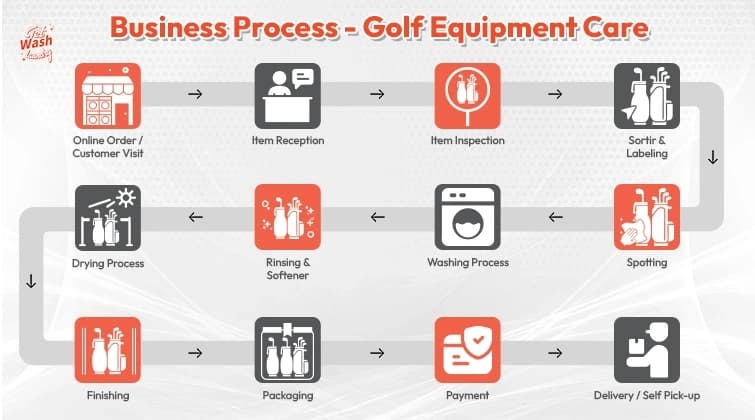
Each piece of golf equipment is handled according to its material and condition. The process starts with inspection, because the most important decisions are made before water and soap ever touch the item.
Why a set is not all cleaned the same way
One FAQ on our page asks whether a set, meaning the bag, headcovers, shoes, and apparel, needs to be separated when sent. Within our process, every item is handled separately because the materials differ. You can simply hand them over together; what matters is that you state the number and type of each item when ordering so everything is recorded, and flag anything of special value.
Inspection and condition notes
When items arrive, our team inspects and records their initial condition: mould, stains, peeling areas, stuck zips, loose stitching, or worn soles. Conditions that cleaning cannot fix, such as cracked leather or peeling coatings, are reported before we start so expectations are clear. Make sure every bag pocket is empty, including balls, tees, rangefinders, and valuables.
Golf bags and travel bags
Golf bags are cleared of dust and sand in every pocket and divider, and the fabric surface is cleaned section by section with a suitable solution. Leather or PU panels are cleaned separately using leather care methods. For mould, our page describes a deep cleaning method that combines vacuuming, enzymatic cleaning, and slow drying at low heat. The foam in shoulder straps and back panels is dried completely, because foam that is still damp is where the next mould starts. Turnaround is 5 working days.
Golf shoes
Laces and insoles are removed, and grass and soil are cleaned out of every sole groove and around the cleats. The upper is cleaned according to its material, leather, synthetic leather, or mesh, and the inside is cleaned to reduce odour. Shoes are dried in shape without direct heat so the glue and waterproofing are not damaged. For non-golf shoes, there is shoe cleaning and Signature Shoe Care. Turnaround is 5 working days.
Leather and synthetic gloves
Gloves are cleaned gently to lift sweat, oil, and dirt without harming the leather. Leather gloves are dried slowly in shape so they do not shrink and harden. It is worth knowing that gloves are consumables: a glove that is torn, worn thin on the palm, or has very stiff leather cannot be made new again, but regular cleaning extends its life. Turnaround is 3 working days.
Headcovers
Headcovers are cleaned according to their material. Knits are handled gently without hard spinning so they do not stretch or pill, synthetic leather and embroidery are cleaned carefully, and their shape is preserved while drying. A headcover set is priced at 1–10 pieces per set. For limited edition or collectible headcovers, tell us at the start so they are noted specially. Turnaround is 5 working days.
Caps, visors, towels, rain covers, and sling bags
Caps and visors are cleaned while protecting the shape of the brim, and the inner sweatband is cleaned of sweat marks. Golf towels are washed to remove soil, grass, and sand. Rain covers are cleaned while protecting their waterproof coating, and sling bags or shoe bags are cleaned like small bags. Turnaround is 3 working days for caps, visors, and towels, and 5 working days for rain covers and sling bags.
Golf apparel
Golf polos, shirts, trousers, and jackets are cleaned by dry or wet cleaning according to the material and care label. Technical fabrics are washed without softener that would clog their pores and dried without high heat so elastic fibres and UV protection are preserved. The page does not yet list a turnaround for apparel; ask when you order.
Slow drying and final inspection
The key to caring for golf equipment in a tropical climate is thorough drying without excessive heat. Items are dried until the inside, foam, and linings are completely dry, then inspected again before packing. Anything packed while still damp will go mouldy again, so we do not rush this stage.
Turnaround
- 3 working days: leather gloves, synthetic gloves, caps/visors, golf towels.
- 5 working days: golf bags, travel bags, golf shoes, rain covers, sling/shoe bags, headcover sets.
- 7 working days: Par, Birdie, and Eagle packages.
- Not yet listed: golf apparel.
Turnaround is counted in working days. If you have a tournament or golf trip coming up, give us the date when you order so we can confirm whether the timing works. Follow your order status on the tracking page.
Common Problems: Mould, Odour, Mud, Grass Stains, Stiff Gloves, and Misshapen Caps
Most of the golf equipment that reaches us has one of the following problems. We explain what can usually be restored and what cannot, so you can decide with honest information.

Figure 6. Golf equipment problems and treatments (golf-equipment-problems-and-treatments-getwash-en.png)
Mould on bags stored for a long time
This is the most common problem. A bag stored for a long time in a storeroom, locker, or car boot with damp items inside can grow mould on the fabric, inner lining, and foam. Surface mould can usually be cleaned with deep cleaning. Mould that has been there a long time and has penetrated light-coloured material can leave marks even after the mould itself is removed. The sooner it is treated, the better the result.
Odour that will not go away
Odour in shoes, bags, and gloves comes from sweat and bacteria that grow in damp materials. Cleaning the surface is not enough; the inside and the foam need cleaning and complete drying. The FAQ on our page includes a question about extra deodorising for bags and shoes; tell us if you would like it and ask whether there is an extra charge.
Mud and grass after rain
Golf shoes muddied after playing in the rain can be cleaned, including soil that has dried in the sole grooves and around the cleats. The key is not to leave muddy shoes stored wet in a shoe bag for days. Knock off and brush away mud after the round, then leave the shoes open until we collect them.
Grass stains and course fertiliser
Grass leaves green stains on white shoes, light trousers, and the base of bags. Golf courses are also maintained with fertilisers and turf treatments that can leave yellowish marks on white shoes. Fresh stains are easier to lift than old ones that have been exposed to heat.
Stiff, hardened leather gloves
A leather glove left to dry after being soaked with sweat or rain will harden. Gentle cleaning and slow drying can help, but leather that is cracked, worn thin, or has holes cannot be restored. Once a glove reaches that stage, replacing it makes more sense than cleaning it.
Caps that have lost their shape
A cap that has lost its shape from machine washing, being crushed in a bag, or heat drying is hard to restore fully, especially if the material inside the brim has broken or buckled. We will clean it and protect its shape as well as we can, but we do not promise it will look new again.
Drink stains on polos
Energy drinks, coffee, tea, and soft drinks are often spilled on the course or in the clubhouse. These stains contain sugar and dyes that bond more strongly when heated. Do not tumble dry or iron a stained polo before it has been cleaned. For older stains, our stain removal service can also help.
Bunker sand in every corner
Bunker sand gets into shoes, lodges in seams, piles up at the bottom of bag pockets, and sticks to towels. Sand carried into the bag can scratch grips and club heads, and sand left in zips makes them jam quickly. Clearing sand from every pocket and corner is an important part of cleaning a golf bag, not just cleaning its outer surface.
Sweat stains on cap sweatbands and polo collars
Sweat building up on cap sweatbands and polo collars leaves yellowish or brownish lines. These stains form slowly from skin oil, salt from sweat, and sunscreen. Regular cleaning stops them from building up; very old stains can fade but do not always disappear completely, especially on white caps.
Stuck zips and physical damage
A stuck zip on a bag or travel bag is often caused by sand, soil, and light corrosion. Cleaning can make the zip run smoothly again if dirt is the cause. But a zip with damaged teeth, loose stitching, or a broken frame needs repair, not cleaning. Our page does not list a repair service for golf equipment; ask Customer Service if you need one.
Musty golf towels
A golf towel left hanging on the bag after wiping wet balls and muddy clubs will smell musty within days, and the smell can spread to the parts of the bag around it. Take the towel off the bag after a round, dry it, and wash it regularly. With its low price, the golf towel is the most sensible item to include every time you send something else.
Peeling coatings
Older bags, headcovers, or shoes made of synthetic leather can start to peel because the PU breaks down with heat and humidity. This cannot be fixed by cleaning, and cleaning can even cause already fragile areas to come away. We will tell you if we find this during inspection.
Caring for Your Kit Between Rounds, for Golf Clubs, and How to Order
Professional cleaning lasts much longer when it is followed by a few simple habits after every round. These habits take no more than ten minutes.

Figure 7. Golf equipment care after a round (golf-equipment-care-after-a-round-getwash-en.png)
Rotating gloves and shoes
Golfers who play more than once a week should have at least two gloves and, if possible, two pairs of golf shoes. Rotation gives each item time to dry fully before it is used again. A glove that is always worn half damp hardens and tears faster, while shoes that never get to dry become a source of stubborn odour. This simple rotation extends the life of your equipment far more than any care product.
Habits after every round
- Take shoes, gloves, and towel out of the bag and shoe bag as soon as you get home.
- Knock and brush mud off the soles while still wet, before it dries hard.
- Air gloves in shape in the shade; do not dry them in direct sun or leave them on the car dashboard.
- Open every bag pocket to let air in, and remove rubbish, broken tees, and sand.
- Hang up your cap and wash your golf towel regularly.
- Put headcovers back on only once dry, so moisture is not trapped around the club heads.
Do not use your car boot as a locker
Keeping a golf bag in the car boot is convenient, but the boot is the worst place to store golf equipment. Daytime heat can weaken shoe glue and dry out glove leather, while night-time humidity encourages mould. Where possible, keep the bag indoors in a dry, ventilated room.
Storing equipment for a long time
If you will not play for a few weeks, clean your equipment first, make sure everything is dry, then store it in a ventilated room. Take shoes out of the shoe bag and fill them with paper or shoe trees. Keep gloves in their original packaging or flat so they do not crease. A moisture absorber in the cupboard or storeroom helps, but it does not replace cleaning before storage.
Before and after a golf trip
A golf trip out of town or abroad means your equipment moves from the aircraft hold, to the car, to the hotel room, and back again, often while damp. Before you leave, make sure the travel bag is clean and dry. When you get back, do not put the travel bag and shoes straight into storage; schedule cleaning first. For the suitcases that come along, there is also suitcase cleaning.
Before tournaments and important events
Corporate tournaments, community golf days, or business meetings on the course are moments when the look of your equipment is noticed too. Plan cleaning at least a week before the event so there is enough time for the turnaround. Give Customer Service the event date from the start, so if any condition needs more time, such as heavy mould, you know well in advance.
Choosing gloves for a tropical climate
If you often play in hot, humid weather, consider having a combination of leather gloves for dry days and synthetic or rain gloves for wet days. Leather gloves give the best feel, but synthetic gloves cope better with heavy sweat and rain. With this combination, your leather gloves are not forced to work in conditions that speed up their wear, and all of them can be cleaned together regularly.
Driving range and regular practice
Many golfers practise at the driving range several times a week. Practice does not bring much mud, but it works the glove hardest: hundreds of shots in one session mean far more friction and sweat than a single round. Keep practice gloves separate from the gloves you use on the course, and clean practice gloves more often. Towels used at the range also collect dust and sweat quickly.
Caring for new equipment
New golf equipment also needs attention from day one. New gloves should go straight into rotation, new shoes should be cleaned after their first round on a wet course, and a new bag should not go straight into the car boot. Habits started while equipment is new are far more effective than trying to rescue equipment that is already mouldy and stiff.
How often to clean professionally
As a general guide, golfers who play every week can consider cleaning shoes and gloves every one to two months, and cleaning the bag a few times a year or after the rainy season. Items that start to smell, grow mould, or get very dirty should be dealt with straight away without waiting for the schedule.
For golf clubs, communities, and companies
Our page offers special packages for golf club members. For golf clubs, golf communities, or companies that regularly host tournaments, scheduled pickup for several sets at once can be more efficient than ordering one by one. Tell Customer Service the number of sets, the types of items, and the schedule you need so the arrangement can be discussed.
Related items you can send at the same time
Golfers often have other items that need care too: a leather jacket for an evening event at the clubhouse, a leather work bag, or a designer bag. For items like these, there is leather care, bag cleaning, and Maison de Bag for luxury bags. Orders can be combined in one pickup.
Preparing items before pickup
A few small preparations make the process faster and the result better. Take the headcovers off the clubs; golf clubs are not listed in this service, so keep them yourself unless Customer Service has confirmed otherwise. Empty the bag completely, including umbrellas, water bottles, and rangefinders. Leave wet shoes and gloves open in the shade until pickup rather than sealing them in a plastic bag. Note any items of special value, such as limited edition headcovers or leather bags, and mention them at pickup.
How to order golf equipment cleaning

Figure 8. How to order golf equipment cleaning (how-to-order-golf-equipment-cleaning-getwash-en.png)
- Empty every pocket of the golf bag, travel bag, and shoe bag, including balls, tees, and valuables.
- Photograph the items and note their type: bag, shoes, leather or synthetic gloves, headcovers, apparel.
- Confirm prices, turnaround, the right package, and your pickup zone via WhatsApp 0812-6610-0500.
- Schedule pickup through the order page, or drop items off at the outlet yourself.
- Track the status of your order on the tracking page.
- Receive your equipment back clean, dry, and ready for the next round.
If you are sending several items at once, pack each group separately, for example gloves and caps in one pouch, shoes in the shoe bag, and headcovers inside the golf bag. This simple packing makes recording easier at pickup and reduces the risk of small items going astray in transit.
Service hours and location
Customer Service hours: Monday–Friday 09.00–17.00, Saturday 09.00–15.00, closed on Sundays. Our main outlet is at Jl. Ceger Raya No.42, Jurang Mangu Barat, Kec. Pd. Aren, Kota Tangerang Selatan, Banten 15222. We serve customers in Pondok Aren, Bintaro, BSD, South Jakarta, and the surrounding area.
About golf equipment brands
We handle golf equipment from many brands. Getwash is an independent care service, not an official service centre for any brand, so we do not handle warranty claims or manufacturer repairs. If your equipment is still under warranty and has a manufacturing defect, contact the seller or the brand's official distributor first.
Our experience
Golf bags with mould in the shoulder strap foam, golf shoes whose glue is coming away from being kept in the car boot, leather gloves gone as stiff as paper, knitted headcovers stretched after a home machine wash: these are the stories we see most often. Most of that damage can be prevented with simple habits and cleaning at the right time. We have written that experience down here so you can look after your golf kit with more peace of mind.
Ready to hand over your golf equipment? Contact WhatsApp 0812-6610-0500, order through the order page, or follow us on Instagram, TikTok, Facebook, and Threads.
FAQ: Questions About Getwash Golf Equipment Care
How much does Getwash charge to clean a golf bag?
A golf bag (stand or cart bag) is Rp150,000 and a travel golf bag is Rp180,000, with a turnaround of 5 working days.
How much does golf shoe cleaning cost?
Spikeless or softspike golf shoes are Rp125,000, with a turnaround of 5 working days.
Can leather golf gloves be cleaned?
Yes. Leather gloves are Rp50,000 and synthetic gloves Rp30,000, with a turnaround of 3 working days. Leather that is cracked or has holes cannot be restored.
Can a golf bag that went mouldy in storage be cleaned?
Yes, with deep cleaning that combines vacuuming, enzymatic cleaning, and slow drying at low heat. Old mould on light-coloured material can leave marks.
Is a limited edition knitted headcover safe to clean?
Knitted headcovers are handled gently without hard spinning. Tell us at the start if your headcover is limited edition so it is noted and handled specially.
How much are headcovers?
A headcover set (1–10 pcs) is Rp100,000, with a turnaround of 5 working days.
What golf club member packages are there?
Par Package Rp270,000 (bag, shoes, towel, cap), Birdie Package Rp300,000 (bag, shoes, headcover set), and Eagle Package Rp599,000 (full set), with a turnaround of 7 working days. Ask Customer Service for the exact contents and membership requirements.
Can a golf cap be cleaned without losing its shape?
Caps and visors are Rp30,000 and are cleaned while protecting the shape of the brim. A cap that has already lost its shape is hard to restore fully.
Is UV-protective golf apparel safe to clean?
Golf apparel is Rp35,000 and is cleaned by dry or wet cleaning according to the material and label, without softener or high heat. The apparel turnaround is not yet listed.
Can I ask for extra deodorising?
Mention it when you order, and ask whether there is an extra charge for that treatment.
Can a stuck travel bag zip be fixed?
A zip that is stuck because of dirt can run smoothly again after cleaning. Repair of a damaged zip is not listed on the page; ask Customer Service.
How much is pickup and delivery?
Since 20 June 2026: Zone 1 (0–3 km) Rp8,000, Zone 2 (3–7 km) Rp15,000, Zone 3 (over 7 km) Rp22,000 per trip.
What are Getwash Customer Service hours?
Monday–Friday 09.00–17.00 and Saturday 09.00–15.00. Closed on Sundays. Messages can be sent at any time and are answered during the next service hours.
Sources
- Getwash Laundry golf equipment care service page
- Getwash Laundry Peralatan Golf page (ID)
- Getwash Laundry tracking page
- New Policy Notice: Pickup & Delivery Rates (effective 20 June 2026)