Shoe Repair Service
- Birkenstock - NaplesRp 80.000
- Penggantian Sol CustomRp 600.000
- Penggantian Sol LokalRp 500.000
- Penggantian Sol PremiumRp 950.000
- Penggantuan Tutup Hak KecilRp 200.000
- Penggantian Tutup Hak BesarRp 250.000
- Penggantian Bungkus HakRp 450.000
- Penyesuaian Ukuran Sepatu / BesarkanRp 150.000
- Lem + PressRp 100.000
- Retouch SuedeRp 125.000
Contact us to schedule your order
09:00-20:00 (Weekday) & 09:00-17:00 (Weekend)
Ulasan Pelanggan
- Tri haryono5.0
Layanan Reparasi Sepatu ini hasilnya bersih maksimal. Saya puas dan akan memakai lagi.
- AGUS JUMARNO5.0
Layanan Reparasi Sepatu ini hasilnya bersih maksimal. Terima kasih atas pelayanannya.
- Suhardi handoyo5.0
Sol sepatu formal saya yang lepas dijahit dan dilem ulang dengan sangat rapi dan kokoh. Sekarang sepatunya enak lagi dipakai jalan jauh tanpa takut lepas. Pelayanan mantap! Proses pengerjaan tepat waktu sesuai janji dan harganya sangat sepadan.
- Tri Yulianto5.0
Layanan Reparasi Sepatu ini hasilnya bersih maksimal. Sangat direkomendasikan.
- Erlyana5.0
Layanan Reparasi Sepatu ini pengerjaannya rapi dan cepat. Layanan seperti ini yang saya cari.
- Suhardi handoyo5.0
Sol sepatu formal saya yang lepas dijahit dan dilem ulang dengan sangat rapi dan kokoh. Sekarang sepatunya enak lagi dipakai jalan jauh tanpa takut lepas. Pelayanan mantap! Proses pengerjaan tepat waktu sesuai janji dan harganya sangat sepadan.
- Tri Yulianto5.0
Sol sepatu formal saya yang lepas dijahit dan dilem ulang dengan sangat rapi dan kokoh. Sekarang sepatunya enak lagi dipakai jalan jauh tanpa takut lepas. Pelayanan mantap! Proses pengerjaan tepat waktu sesuai janji dan harganya sangat sepadan.
- Tri haryono5.0
Sol sepatu formal saya yang lepas dijahit dan dilem ulang dengan sangat rapi dan kokoh. Sekarang sepatunya enak lagi dipakai jalan jauh tanpa takut lepas. Pelayanan mantap! Proses pengerjaan tepat waktu sesuai janji dan harganya sangat sepadan.
- AGUS JUMARNO5.0
Sol sepatu formal saya yang lepas dijahit dan dilem ulang dengan sangat rapi dan kokoh. Sekarang sepatunya enak lagi dipakai jalan jauh tanpa takut lepas. Pelayanan mantap! Proses pengerjaan tepat waktu sesuai janji dan harganya sangat sepadan.
- SUPIYA JAKA BASUKI5.0
Sol sepatu formal saya yang lepas dijahit dan dilem ulang dengan sangat rapi dan kokoh. Sekarang sepatunya enak lagi dipakai jalan jauh tanpa takut lepas. Pelayanan mantap! Proses pengerjaan tepat waktu sesuai janji dan harganya sangat sepadan.
Shoe Repair at Getwash: Peeling Soles, Worn Heels, and Tight Shoes — Recognising the Damage, Choosing Between a New Sole and New Heel Tips, Full Pricing, and How to Care for Your Shoes So the Repair Lasts
By the Getwash Laundry Team | Updated 6 November 2026 | Reading time ±27 minutes
|
QUICK ANSWER Getwash repairs shoes with peeling soles, worn heels, and a tight fit: reglue + press Rp100,000, suede retouch Rp125,000, size adjustment (stretching) Rp150,000, small heel tip Rp200,000, large heel tip Rp250,000, heel recovering Rp450,000, and sole replacement at Rp500,000 (local), Rp600,000 (custom), and Rp950,000 (premium). A sole that has only started to lift at the edge can often just be reglued and pressed; a sole that is thin, cracked, or holed needs replacing. The page does not yet list turnaround times, so tell us when you need to wear the shoes when you order. Contact WhatsApp 0812-6610-0500; service hours are Monday–Friday 09:00–17:00 and Saturday 09:00–15:00, closed Sunday. |
The shoes that wear out first are usually the ones you love most. The dress shoes you wear to the office every day, the heels for formal occasions, loafers that fit perfectly, or sneakers that have been with you for years. The uppers are still good, but the sole is starting to gape at the toe, the heel tip has worn down until you hear metal on every step, or the shoes pinch after months in the cupboard.
Throwing shoes like that away is a waste. This article covers Getwash's shoe repair service in full: the parts of a shoe that fail most often and why, signs that your shoes need repair, choosing between regluing and a new sole, the difference between heel tips and heel recovering, full pricing with worked examples, the process and how to order, and how to care for your shoes so the repair lasts. Start from the table of contents below.
Table of Contents
1. Getwash Shoe Repair: Extending the Life of Your Favourite Shoes
2. The Parts of a Shoe That Fail Most Often, and Why
3. Signs Your Shoes Need Repair, and the Right Fix
4. Sole Replacement, Heel Tip Options, and Shoe Repair Prices
5. The Repair Process and How to Order
6. Caring for Your Shoes So the Repair Lasts
Getwash Shoe Repair: Extending the Life of Your Favourite Shoes
Getwash's shoe repair service covers the jobs shoe owners need most: regluing soles that have come loose, replacing worn heel tips, recovering scuffed heels, stretching shoes that are too tight, restoring suede colour, and full sole replacement with three sole tiers to choose from. Every job is listed with a clear price on the service page.
The shoes we see most often
- Leather dress and work shoes worn almost daily, with heels and forefoot soles that wear quickly.
- High heels for formal events, with worn-out heel tips or scuffed heel covers.
- Loafers, oxfords, and derbies whose uppers are still good but whose soles have started to peel.
- Sneakers with soles coming away at the toe or along the side.
- Suede shoes and sandals whose colour has faded or gone patchy.
- New shoes that feel tight and need a little stretching to be comfortable.
Who this service is for
Our shoe repair customers range from office workers who wear one pair of dress shoes every day to officials and high-profile professionals who must look immaculate at formal events on a packed schedule. For them, taking shoes to a roadside cobbler and waiting on the spot is not practical. At Getwash, shoes can be picked up, repaired, and delivered back, with all communication on WhatsApp.
Shoes for formal occasions
Formal occasions demand a polished look from head to toe. A worn heel tip is clearly audible on the marble floor of a function hall, and a gaping sole shows when you are seated in the front row. Event shoes are also often worn only a few times a year, so damage is only discovered when you are about to put them on. If you have a formal engagement in the next few weeks, check your shoes now and send us photos so the repair is done in time.
Repair, cleaning, or both
Repair restores a shoe's function and structure, while cleaning restores its appearance. A shoe with a brand-new sole looks odd if the upper is still dull and dirty. That is why many customers combine repair with shoe cleaning, or, for leather and designer shoes, with Signature Shoe Care. Both can be handed over in a single pickup.
Why repair instead of buying new
Good shoes, especially leather shoes, often become more comfortable over time because they have moulded to the owner's foot. A well-kept leather upper can outlast its sole many times over. Replacing a sole or heel tips for a few hundred thousand rupiah makes far more sense than buying a new pair of leather shoes that need breaking in again, and it also reduces shoe waste, which is hard to break down.
“Good shoes rarely fail at the upper. What wears out first is almost always the sole and the heel tips, and both can be replaced.” — Observation from the Getwash team
The working standards we hold ourselves to
Every pair that comes in is handled with the same habits: its condition is recorded on arrival, the repair options and cost are confirmed before work begins, and the shoes are checked again before they are returned. If inspection shows a pair is not worth repairing, for example because the upper is badly torn or the leather has become brittle, we will tell you honestly so you do not pay for a repair that is not worthwhile.
What we do not promise
We do not promise that every pair can be made to look new. Repair restores a shoe's function and neatness, but signs of wear on the upper, creases in the leather, and colour changes from age remain. With stretching, the result depends on the material. With a replacement sole, the look and feel may differ slightly from the original. We explain these points at the confirmation stage, so your expectations and the result line up.
About shoe brands
Getwash is an independent service provider, not an authorised service centre for any shoe brand. Our price list does include an item called "Birkenstock – Naples", but that does not make Getwash a partner or official service centre for that brand. If your shoes are still under the manufacturer's warranty, consider a warranty claim first, because third-party repairs may affect that warranty.
The Parts of a Shoe That Fail Most Often, and Why
Understanding the parts of a shoe helps you describe the damage accurately when you order, and helps explain why one repair differs from another.

Figure 1. Parts of a shoe that fail most often (bagian-sepatu-yang-sering-rusak-getwash-en.png)
The upper
The upper is the body of the shoe that wraps the foot, made of leather, suede, canvas, or synthetic material. On well-kept shoes, the upper usually lasts longest. Common damage includes scuffs, fading, and cracked creases in leather that has dried out.
The outsole
The outsole is the part in direct contact with the ground. It takes friction with every step, so it thins over time, especially at the heel and at the front near the toes. Outsoles can be rubber, leather, or other synthetics, each with different grip and durability.
Midsole and the sole join
Many shoes, especially sneakers, have a midsole layer between the upper and outsole for cushioning. The join between upper and sole may be glued, stitched, or both. On shoes with glued-only soles, the join can weaken with heat, humidity, and age, and the sole starts to gape from the edge.
Insole
The insole is the layer inside the shoe that the sole of your foot rests on. It can come unstuck, tear, or smell from sweat. On some shoes the insole is removable; on others it is glued in permanently. If your shoes' insoles are a problem, include them in your photos when you order so they can be assessed at the same time.
Heel and heel tip
The heel supports the back of the foot. At the bottom of the heel is the heel tip, a small layer that touches the floor and protects the heel from wear. Heel tips are designed to be replaced periodically. If they are left to wear out, the heel itself starts to erode, and on high heels the metal pin inside can show through and click as you walk.
Heel cover
On many women's shoes, the heel is wrapped in leather or another material that matches the upper. This cover scuffs easily on stair edges, pavement gaps, or when stepped on. When it is scuffed or torn, the heel cover can be replaced so the heel looks neat again.
Glued soles and stitched soles
Broadly, there are two ways a sole is attached to the upper. With cemented construction, the sole is glued directly to the upper. This is common on sneakers, casual shoes, and many women's shoes because it is light and flexible. With stitched construction, the sole is also sewn to the upper or to an intermediate layer, making the join stronger and allowing the sole to be replaced several times. Knowing how your shoes are built helps explain why a sole comes loose and which repairs are possible. If you are unsure, just photograph the side of the sole; stitching along the edge is usually easy to see.
Wear patterns on men's and women's shoes
On men's shoes, especially dress shoes, the fastest wear is on the outer edge of the heel and on the front of the sole where the foot flexes. On high heels, wear concentrates on the heel tip, whose small surface wears out much faster, and on the front of the sole, which carries most of the body's weight. This pattern explains why women's heel tips need replacing more often than men's heels.
What causes shoes to wear out

Figure 2. What causes shoes to wear out (penyebab-sepatu-cepat-rusak-getwash-en.png)
Shoe damage rarely has a single cause. Shoes worn every day never get the chance to dry out from sweat, so adhesive and leather weaken faster. A gait that presses on one side wears heels unevenly. Rain and puddles soak into soles. Heat from a car boot or drying in direct sun makes adhesive lose its grip. And heel tips left to wear right down let the damage spread to the heel itself.
Tropical climate conditions
In a hot, humid climate like Greater Jakarta's, shoes face a tough combination: high daytime temperatures, heavy rain in the wet season, and humidity that makes it hard for shoes to dry completely. Shoes stored for a long time in closed cupboards can also suffer: some rubber soles become brittle or sticky, and adhesive weakens even when the shoes are rarely worn. That is why even shoes that are seldom worn can suddenly lose a sole.
Rarely worn shoes can fail too
Many customers are surprised that event shoes worn only a few times a year are the ones that fail. The cause is the age of the materials, not use. Adhesive and some foam or rubber soles age even when not worn, especially in hot or humid storage. So event shoes should be taken out and checked a few weeks before they are needed, not on the morning of the event.
Signs Your Shoes Need Repair, and the Right Fix
Spotting symptoms early keeps repairs simpler and cheaper. Here are the most common signs and the repair that usually fits.

Figure 3. Signs your shoes need repair (tanda-sepatu-perlu-direparasi-getwash-en.png)
Sole starting to gape at the edge
If the sole is slightly open at the toe or along the side but the sole itself is still thick and intact, it can usually just be reglued and pressed. Do not wait for the gap to widen, because dirt and water getting into the gap make it harder for the adhesive surfaces to bond again.
Sole thin, cracked, or holed
A sole worn so thin you can feel gravel, cracked across, or holed cannot be saved with glue. Shoes like these need a new sole. Press the middle of the sole with your thumb; if it feels very soft or you can see the layer beneath, it is time for a new sole.
Worn heel tip
Look at the bottom of the heel from the side. If the heel tip is flush with the heel or worn at an angle, replace it promptly. On high heels, a clear sign is a metallic click as you walk. Replacing a heel tip before the heel itself is worn down is far easier and cheaper than repairing a damaged heel.
Scuffed or peeling heel cover
Small scratches on a heel cover can sometimes be disguised with colour care, but if the cover is torn, peeling, or showing the material beneath, it needs replacing for the shoe to look neat again.
Shoes that feel tight
Shoes that pinch across the width of the foot or at the toes can be stretched slightly. Note that this adjustment only enlarges, it does not shrink, and the result depends on the material. Genuine leather generally adapts better than synthetics. Shoes that are a full size or more too small usually cannot be fixed by stretching.
Faded or patchy suede
Suede that has faded from sunlight, abrasion, or stains can be restored with a suede retouch. If the suede is dirty, it is best cleaned first so the new colour goes on evenly.
Check your shoes in two minutes
- Turn the shoe over and look at the sole: are any areas thin, cracked, or holed?
- Look at the sole edge from the side: is there a gap between sole and upper?
- Check the heel from the side: is the heel tip still intact and level?
- Flex the shoe gently: is there a cracking sound or a broken leather crease?
- Check inside: is the insole still stuck down and untorn?
- Put them on and walk: is there a noise, a wobble, or anywhere that pinches?
This quick check is worth doing regularly for everyday shoes, and a few weeks before an important event for shoes that are rarely worn.
Sounds and sensations while walking
Shoes often warn you through sound and feel. A metallic click on high heels means the heel tip has worn through. A squeak or a slap on every step can mean the front of the sole is coming loose. Feeling unstable or tilted when standing can mean the heels are unevenly worn. If you notice changes like these, check your shoes more closely before the damage grows.
Mistakes that make damage worse
- Gluing it yourself with all-purpose glue that hardens and cracks, making the next repair harder.
- Continuing to wear shoes with worn-out heel tips until the heel itself erodes.
- Wearing shoes with a gaping sole on rainy days, letting water in and damaging the inside.
- Drying wet shoes in hot sun, which weakens adhesive and stiffens leather.
- Forcing tight shoes on until the stitching on the upper pulls.
- Putting off repair until the day before an event, leaving no time for proper work.
If you have already tried a home repair, mention it when you order, including the type of glue used. Old adhesive needs to be cleaned off before new adhesive is applied, and this information helps the team assess the job.
Emergency fixes until you can bring them in
If a sole comes off while you are out, avoid instant glue that dries hard and brittle. As a stopgap, wrap a rubber band or tape around the outside of the shoe so the sole does not fold under as you walk, then bring it in for repair as soon as possible. Keep any piece of sole or heel tip that has come off and bring it with the shoes.
Sole Replacement, Heel Tip Options, and Shoe Repair Prices
Below are the prices listed on Getwash's Shoe Repair service page, grouped by type of job.

Figure 4. Sole and heel repair prices (tarif-ganti-sol-dan-hak-sepatu-getwash-en.png)
- Local sole replacement: Rp500,000
- Custom sole replacement: Rp600,000
- Premium sole replacement: Rp950,000
- Small heel tip replacement: Rp200,000
- Large heel tip replacement: Rp250,000
- Heel recovering (heel cover replacement): Rp450,000

Figure 5. Regluing, suede retouch, and stretching prices (tarif-lem-sepatu-retouch-suede-melebarkan-sepatu-getwash-en.png)
- Reglue + press: Rp100,000
- Suede retouch: Rp125,000
- Shoe size adjustment / stretching: Rp150,000
- Birkenstock – Naples: Rp80,000
The page does not yet say whether prices are per pair or per shoe, and does not list turnaround times. Send photos of your shoes via WhatsApp 0812-6610-0500 for confirmation before handing them over.
Local, custom, or premium sole?
The price list includes three sole replacement tiers but does not yet detail the materials or character of each. So we will not guess at their specifications here. What we can suggest is how to choose: tell us the type of shoe, how often you wear it, where you usually wear it, and what matters most to you, such as grip on slippery floors, durability for daily wear, or a look that suits formal shoes. The team will recommend the most suitable tier and explain why.
Things to consider when choosing a sole
- How often you wear them: daily work shoes need a hard-wearing sole.
- Surfaces you walk on: marble office and hotel floors call for a non-slip sole.
- Type of shoe: formal, casual, and sneakers have different sole needs.
- Appearance: sole thickness and colour affect the shoe's silhouette.
- The shoe's value: quality leather shoes deserve a sole to match.
Small and large heel tips
Heel tips come in two sizes, small and large. The right size depends on the surface area at the bottom of your heel. A stiletto or slim heel is clearly different from a block heel or a men's heel. Send a photo of the bottom of the heel, and the team will confirm the right size and price.
Heel recovering
Replacing a heel cover is more involved than replacing a heel tip, because the old cover has to be removed carefully and the new one fitted tightly to the curve of the heel. If you want a particular colour or texture to match the upper, mention it at the start and send photos of the shoe from several angles.
Reglue + press
Reglue + press is the option for a sole that is still good but whose join has started to come apart. The join surfaces are cleaned, adhesive is applied, and the sole is pressed so the adhesive bonds evenly across the whole surface. It is most effective when done early, before the sole has opened too far.
Size adjustment and suede retouch
Size adjustment, listed as "besarkan" (enlarge) on the price list, is for shoes that are a little tight. Suede retouch restores faded suede colour. For suede that is also dirty, it is best combined with cleaning through our shoe cleaning service.
The Birkenstock – Naples item
The price list includes an item called "Birkenstock – Naples" at Rp80,000 with no description of the work involved. If you have Birkenstock sandals or shoes that need repair, ask Customer Service what this item covers and whether it suits the damage on your pair.
Why a new sole costs more than regluing
Reglue + press simply re-bonds the existing join. Sole replacement means removing the old sole entirely, cleaning and preparing the upper's surface, then fitting the new sole and shaping it to the shoe. It takes far more material, time, and precision. So fixing a sole early, while regluing is still enough, is the most economical way to look after your shoes.
Working out whether a repair is worth it
A simple way to judge whether a repair is worthwhile is to compare its cost with the price of an equivalent replacement and with how much longer the shoes can be worn after repair. Quality leather shoes with a new sole can often be worn for years more, while cheap shoes with an already brittle upper may not justify a new sole. Our team will give you an honest opinion if you ask.
Worked examples
- Work dress shoes with a sole starting to gape: reglue + press Rp100,000.
- High heels with worn heel tips and a scuffed heel cover: small heel tip Rp200,000 + heel recovering Rp450,000 = Rp650,000.
- Leather shoes with a thin sole, replaced with a custom sole: Rp600,000.
- Tight, faded suede shoes: stretching Rp150,000 + suede retouch Rp125,000 = Rp275,000.
The examples above do not include cleaning or pickup and delivery. The final cost is confirmed after the shoes are inspected, and no additional work is done without your approval.
When left and right are damaged differently
Left and right shoes often wear differently, because most people press harder on one foot. Sometimes only one sole has come loose, or only one heel tip is worn through. Describe the condition of each side when you order. For appearance and balance, the team may suggest repairing both sides, for example replacing heel tips as a pair, and the decision is yours.
When the cost may differ from the estimate
If inspection reveals other damage, such as a heel already eroded beneath the heel tip, loose stitching on the upper, or a crumbling midsole, the team will tell you, along with the options and cost. You can decide whether to fix it at the same time or stick to the original job.
Pickup and delivery fees
Since 20 June 2026, pickup and delivery is charged per trip based on distance from the nearest outlet: Zone 1 (0–3 km) Rp8,000, Zone 2 (3–7 km) Rp15,000, and Zone 3 (over 7 km) Rp22,000. You can also drop off at our outlet at Jl. Ceger Raya No.42, Jurang Mangu Barat, Kec. Pd. Aren, Kota Tangerang Selatan, Banten 15222.
The Repair Process and How to Order
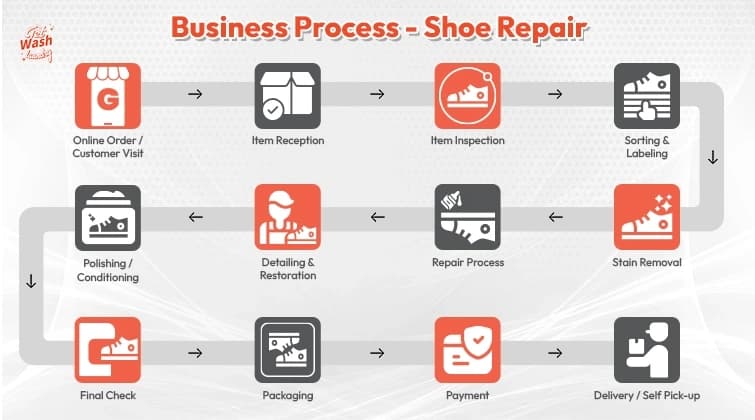
Shoe repair is handwork that demands precision. Here is the workflow we follow for every pair.

Figure 6. Shoe repair process (proses-reparasi-sepatu-getwash-en.png)
1. Inspection
The shoes are inspected thoroughly: the sole, heel, heel tips, the join between sole and upper, the stitching, and the condition of the leather or upper material. The team assesses whether the damage can be handled with a light repair or needs replacement parts.
2. Confirmation
The team explains the repair options, for example regluing or a new sole, along with the cost and estimated timing. Work begins only once you approve.
3. Surface preparation
Before adhesive or new parts go on, surfaces are cleaned of dirt, old adhesive, and crumbling material. This stage decides how strong the result will be, because adhesive does not bond well to dirty or dusty surfaces.
4. The repair
The work follows the type of repair: the join is reglued and pressed, the old heel tip is removed and replaced, the heel cover is replaced, the old sole is removed and a new one fitted, or the shoe is stretched in stages.
5. Finishing
The edges of the sole and heel are trimmed to blend with the shape of the shoe, excess adhesive is cleaned off, and the shoe is checked from every angle.
6. Final inspection
Before return, the shoes are checked again: joins are pressed to make sure nothing is still open, heel tips are checked for level, and neatness is reviewed. Track your order on the tracking page.
Why repairs take time
Many people picture shoe repair as something you wait for in minutes. Work done properly takes time: adhesive needs time to cure fully after pressing, a new sole needs careful finishing, and stretching is done in stages so the material does not tear. Allowing enough time is part of getting a repair that lasts.
Communication during the work
If something turns up during the work that was not visible at the first inspection, for example the inside of a heel turns out to be cracked once the old heel tip is removed, the team will contact you on WhatsApp before continuing, with an explanation and photos where needed.
Turnaround and your event schedule
The service page does not yet list a turnaround time. If you need the shoes for a particular event, such as an inauguration, a wedding, a graduation, or an important meeting, tell us the date at the start and hand the shoes over well ahead. If time is tight, ask Customer Service whether the schedule allows it.
What is recorded when your shoes arrive
When shoes are received, the team records their condition: the damage to be repaired, other visible damage, existing scuffs or stains, and items handed over with them such as shoe trees or dust bags. This record protects both sides and makes communication easier if anything new is found during the work.
How to order

Figure 7. How to order shoe repair (cara-pesan-reparasi-sepatu-getwash-en.png)
- Clean the shoes of soil, gravel, and dirt on the sole.
- Photograph the damage from the side, underneath, and the front.
- Send it via [WhatsApp 0812-6610-0500](https://wa.me/6281266100500) and describe the problem.
- Tell us when you need to wear them and any preferences.
- Schedule a pickup via the order page, or drop them at the outlet yourself.
- Track the status on the tracking page and receive your shoes back.
Information worth sharing
Besides photos, tell us the brand and type of shoe if you know it, roughly how long you have had them, how often you wear them, and whether they have been repaired before. This helps the team choose the most suitable materials and method, and estimate the result more accurately.
Photos that help the assessment
Good photos speed up the assessment. Take them in bright light from the left and right sides, from underneath to show the sole and heel, and close up on the damaged area. For tight shoes, say where they pinch. For heel tips, a side view shows how far the wear has gone.
Preparing your shoes before handing them over
Remove anything inside the shoes, such as socks or shoe trees that do not need to come along. If the shoes are still wet, let them dry naturally in the shade before handing them over. If you kept any piece of sole or heel tip that came off, include it with the shoes.
When you get your shoes back
Try the shoes on at home first and walk a few steps. Notice whether anything feels different, such as heel height or comfort after stretching. If anything does not feel right, contact Customer Service promptly so it can be checked again.
For offices, hotels, and uniform footwear
Companies, hotels, and institutions with many pairs of uniform shoes, such as for officers, front office staff, or security, can ask about scheduling repairs collectively. Send Customer Service a list of the shoes, the types of damage, and sample photos so they can be assessed together.
Caring for Your Shoes So the Repair Lasts
A good repair lasts longer when shoes are looked after with the right habits.

Figure 8. How to care for your shoes (cara-merawat-sepatu-agar-awet-getwash-en.png)
Rotate your shoes
Shoes worn every day never get the chance to dry out from sweat. If you can, rotate two or three pairs of work shoes so each gets a day's rest. This simple habit makes adhesive, leather, and soles last longer.
Dry them properly
Shoes wet from rain should be stuffed with newspaper or tissue paper to absorb water, then dried in a shaded, breezy spot. Avoid drying them in hot sun, with a hot hair dryer, or near a heat source, because excess heat weakens adhesive and makes leather stiff and cracked.
Use shoe trees
For leather shoes, shoe trees help keep the shape, reduce creasing at the front, and absorb moisture, especially wooden ones. Put them in after taking the shoes off, once they are no longer very damp.
Replace heel tips before they wear through
Check heel tips every few weeks, especially on shoes worn daily. Replacing a heel tip as it starts to thin is far cheaper than repairing a heel that has worn down with it.
Store them in the right place
Store shoes somewhere cool, dry, and ventilated. A sealed shoebox in a damp cupboard can make shoes go mouldy, while a hot spot speeds up the ageing of adhesive and soles. For shoes you rarely wear, take them out and check them now and then.
Look after the uppers
Dry leather cracks more easily, especially at the creases. Brush off dust regularly and use care products suited to the type of leather. For suede, use a dedicated suede brush and avoid too much water. For a full care treatment, there is shoe cleaning and Signature Shoe Care.
In the rainy season
The rainy season is the toughest test for adhesive and soles. If possible, keep a pair specifically for rainy days and save your best leather shoes for dry ones. Shoes that get caught in puddles should be dried properly straight away, and the sole join checked once they are completely dry. A sole that starts to gape after the rainy season should be reglued promptly.
When travelling
When travelling, put shoes in cloth bags so they do not rub against each other or soil the clothes in your suitcase. Avoid piling heavy items on top of them, and take them out of the suitcase as soon as you arrive so they do not stay damp. For event shoes taken out of town, check the heel tips and soles before you leave.
Event shoes and collector's pairs
Shoes worn only for particular occasions, or valuable collector's pairs, need different attention. Even when rarely worn, materials still age. Store them in cloth bags with shoe trees, somewhere cool and dry, and take them out occasionally to check. For shoes with sentimental value or designer labels, mention this when you order so the team can discuss repair options with extra care.
Things to avoid
- Polish or care products that do not suit the leather, such as smooth-leather products on suede.
- Soaking leather shoes or putting them in a washing machine.
- Wearing shoes like slippers by treading down the heel, which ruins the heel counter.
- Storing shoes in sealed plastic that traps moisture.
First habits after a repair
After a sole has been replaced or reglued, give the shoes time to settle. Avoid long walks in the rain straight away, and pay attention to comfort over the first few wears. Shoes that have just been stretched will also keep adapting to the shape of your foot as you wear them.
A simple care routine
- After every wear: untie the laces to take them off, brush off dust, and insert shoe trees.
- Every week: check the soles and heel tips, clean the uppers.
- Every few months: condition the leather with a suitable product.
- Before an important event: take the shoes out a few weeks ahead and check them.
Other items we can handle at the same time
Besides shoes, bags and other gear can also be repaired or cleaned in the same pickup. For hiking backpack zippers and restitching there is our Alterations & Repair service, and for everyday bags there is our bag repair service.
Our experience
Dress shoes with heels worn at an angle from daily use, high heels with heel tips worn through until the metal pin shows, sneakers whose soles came off after long storage, and suede shoes with patchy colour: these are the cases we see most. Most of those shoes still had good uppers, and after repair they could be worn comfortably again.
Deciding whether shoes are still worth repairing
Shoes are generally worth repairing if the upper is still intact, the leather is not brittle, and the shape is still good. On the other hand, if the upper is torn in many places, the leather has become brittle, or the inside is badly damaged, the repair cost may not be worth the value of the shoes. Send photos from several angles so the team can give you an honest picture.
Service hours and location
Customer Service hours: Monday–Friday 09:00–17:00, Saturday 09:00–15:00, closed Sunday. Our main outlet is at Jl. Ceger Raya No.42, Jurang Mangu Barat, Kec. Pd. Aren, Kota Tangerang Selatan, Banten 15222. We serve customers in Pondok Aren, Bintaro, BSD, Ciledug, South Jakarta, and surrounding areas. If you are searching for laundry near me that also repairs shoes, send us photos of your shoes first.
Are your favourite shoes starting to fail? Contact WhatsApp 0812-6610-0500, order via the order page, or follow us on Instagram, TikTok, Facebook, and Threads.
FAQ: Shoe Repair
How much does shoe repair cost at Getwash?
Listed prices: reglue + press Rp100,000, suede retouch Rp125,000, size adjustment (stretching) Rp150,000, small heel tip Rp200,000, large heel tip Rp250,000, heel recovering Rp450,000, local sole Rp500,000, custom sole Rp600,000, and premium sole Rp950,000. The final cost is confirmed after inspection.
My shoe sole is peeling. Does it need replacing?
Not necessarily. If the sole is still thick and intact but the join has started to open, reglue + press is usually enough. If the sole is thin, cracked, or holed, it needs replacing.
What is the difference between local, custom, and premium soles?
The page does not yet detail the materials of each tier. Tell Customer Service the type of shoe, how often you wear it, and your priorities, and the team will recommend the most suitable tier.
What is the difference between a heel tip and heel recovering?
A heel tip is the small layer at the bottom of the heel that touches the floor and is designed to be replaced periodically. Heel recovering replaces the cover wrapped around the heel itself, usually on women's shoes, when it is scuffed or peeling.
How do I know when a heel tip needs replacing?
Look at the heel from the side. If the heel tip is flush with the heel, worn at an angle, or on high heels you hear a metallic click when walking, replace it promptly before the heel itself wears down.
Can shoes be made smaller?
The listed item is a size adjustment that enlarges or stretches shoes. For shoes that are too big, ask Customer Service about other options.
How much can shoes be stretched?
It depends on the material and construction. Genuine leather generally adapts better than synthetics, and shoes a full size or more too small usually cannot be fixed by stretching.
What is the Birkenstock – Naples item?
The price list includes this item at Rp80,000 with no description of the work. Ask Customer Service what it covers. Getwash is an independent service, not an official Birkenstock service centre.
How long does shoe repair take?
The page does not yet list a turnaround time. Tell us when you need to wear the shoes when you order and hand them over well ahead, especially for important events.
Can my shoes be cleaned at the same time?
Yes. Repair can be combined with shoe cleaning or Signature Shoe Care in a single drop-off. Mention both when you order.
Are prices per pair?
The page does not yet say whether prices are per pair or per shoe. Confirm with Customer Service before handing your shoes over.
How much is pickup and delivery?
Since 20 June 2026: Zone 1 (0–3 km) Rp8,000, Zone 2 (3–7 km) Rp15,000, and Zone 3 (over 7 km) Rp22,000 per trip. You can also drop off at the outlet yourself.
What are Getwash Customer Service hours?
Monday–Friday 09:00–17:00 and Saturday 09:00–15:00. Closed Sunday. WhatsApp messages can be sent at any time and will be answered during the next service hours.
Sources
- Getwash Shoe Repair Service page (EN)
- Getwash Reparasi Sepatu page (ID)
- Getwash Laundry tracking page
- New Policy Notice: Pickup & Delivery Rates