Rust Stain Removal
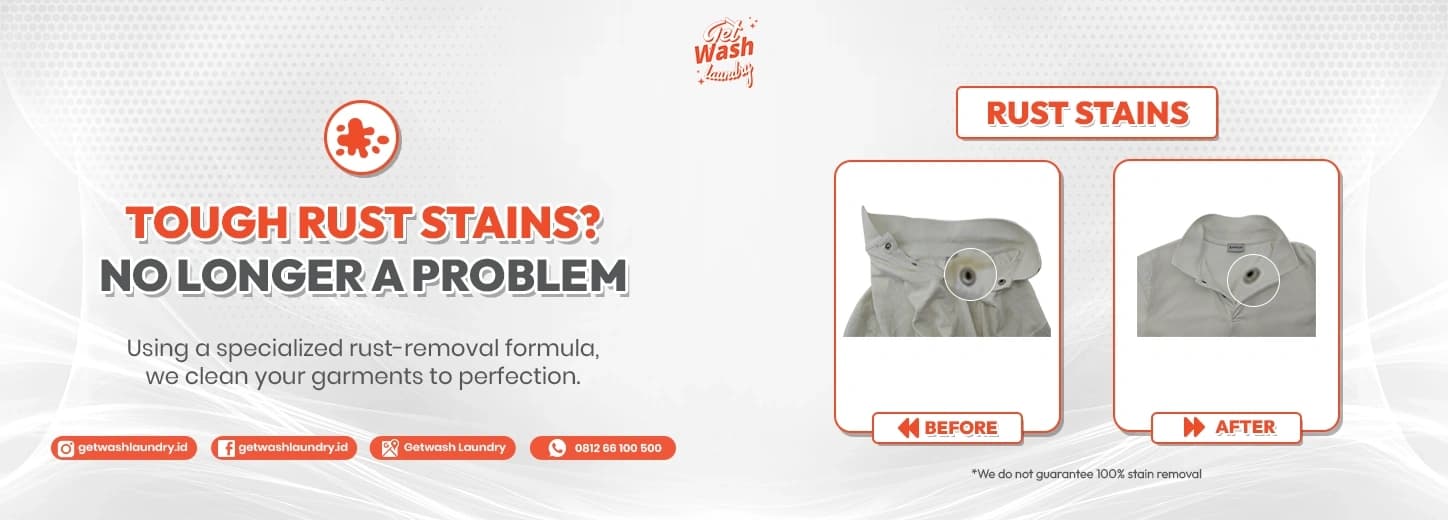
- Karat - Major
Layanan ini bersifat add on | Harap membaca FAQ di bawah
Rp 70.000 - Karat - Minor
Layanan ini bersifat add on | Harap membaca FAQ di bawah
Rp 50.000 - Stain Removal - Minor ( General Stain )Rp 50.000
- Stain Removal - Major ( General Stain )Rp 70.000
Contact us to schedule your order
09:00-20:00 (Weekday) & 09:00-17:00 (Weekend)
Ulasan Pelanggan
- Indrawan5.0
Sangat efektif merontokkan noda karat yang sudah membandel di pakaian. Pengerjaannya rapi, tidak meninggalkan bau kimia menyengat, dan kain tetap aman. Hasil akhirnya betul-betul memuaskan! Komunikasi sangat lancar dari awal pengajuan sampai pengerjaan selesai.
- Indrawan5.0
Sangat efektif merontokkan noda karat yang sudah membandel di pakaian. Pengerjaannya rapi, tidak meninggalkan bau kimia menyengat, dan kain tetap aman. Hasil akhirnya betul-betul memuaskan! Komunikasi sangat lancar dari awal pengajuan sampai pengerjaan selesai.
- Indrawan5.0
Jasa Noda Karat di sini pengerjaannya rapi dan cepat. Terima kasih atas pelayanannya.
- Partono5.0
Layanan Noda Karat ini hasilnya bersih maksimal. Sangat direkomendasikan.
- Muhammad Dinar Fadzar Abadi5.0
Layanan Noda Karat ini pengerjaannya rapi dan cepat. Layanan seperti ini yang saya cari.
- Partono5.0
Sangat efektif merontokkan noda karat yang sudah membandel di pakaian. Pengerjaannya rapi, tidak meninggalkan bau kimia menyengat, dan kain tetap aman. Hasil akhirnya betul-betul memuaskan! Komunikasi sangat lancar dari awal pengajuan sampai pengerjaan selesai.
- ROM SBM5.0
Sangat efektif merontokkan noda karat yang sudah membandel di pakaian. Pengerjaannya rapi, tidak meninggalkan bau kimia menyengat, dan kain tetap aman. Hasil akhirnya betul-betul memuaskan! Komunikasi sangat lancar dari awal pengajuan sampai pengerjaan selesai.
- Gio5.0
Sangat efektif merontokkan noda karat yang sudah membandel di pakaian. Pengerjaannya rapi, tidak meninggalkan bau kimia menyengat, dan kain tetap aman. Hasil akhirnya betul-betul memuaskan! Komunikasi sangat lancar dari awal pengajuan sampai pengerjaan selesai.
- ODING ROHADI5.0
Sangat efektif merontokkan noda karat yang sudah membandel di pakaian. Pengerjaannya rapi, tidak meninggalkan bau kimia menyengat, dan kain tetap aman. Hasil akhirnya betul-betul memuaskan! Komunikasi sangat lancar dari awal pengajuan sampai pengerjaan selesai.
- Gde Akmal Irawan5.0
Sangat efektif merontokkan noda karat yang sudah membandel di pakaian. Pengerjaannya rapi, tidak meninggalkan bau kimia menyengat, dan kain tetap aman. Hasil akhirnya betul-betul memuaskan! Komunikasi sangat lancar dari awal pengajuan sampai pengerjaan selesai.
Rust Stains on Clothes: Where They Come From, Why Bleach Makes Them Worse, When the Water at Home Turns Whites Yellow, and How Getwash Removes Rust Stains Professionally
By the Getwash Laundry Team | Updated 6 November 2026 | Reading time ±27 minutes
|
QUICK ANSWER If rust gets on your clothes, do not use chlorine bleach, because bleach can make rust stains darker and more permanent. Separate the garment from metal objects, do not rub it, and get it treated as soon as possible. Rust stains come from iron oxide, usually from wire hangers, iron clotheslines, metal buttons or zips, washing machine drums, or well water with a high iron content. At Getwash, rust stains are treated as an add-on service: Rust Minor Rp50,000 and Rust Major Rp70,000 per item, with the cost confirmed before processing. There is no 100% guarantee: fresh stains (under 5 days) usually succeed 70–90%, old stains 25–60%. Treatment adds about 5–7 days. Contact WhatsApp 0812-6610-0500; service hours are Monday–Friday 09.00–17.00 and Saturday 09.00–15.00, closed on Sundays. |
Rust stains often appear quietly. A white shirt hung for weeks on a wire hanger suddenly has brown lines on the shoulders. A uniform dried on an iron clothesline comes back with orange patches. A white T-shirt that is always washed at home slowly turns yellowish for no obvious reason, while the bathtub at home also picks up orange marks. Unlike food or ink stains that are visible when they happen, rust stains are often only noticed once they have bonded firmly.
This article covers rust stains from our team's experience treating them: where rust stains come from, why bleach and home remedies often make them worse, how iron-rich water turns white clothes yellow, how likely the stain is to come out, the price and process of the Getwash [rust stain removal service](https://getwashlaundry.id/en/services/rust-stain-removal), and how to stop rust stains from coming back. If you are holding a garment with orange-brown marks, go straight to the first aid section, especially the part about bleach. One wrong step at the start, above all using chlorine bleach, can turn a stain that is still easy to lift into one that is almost permanent, so read that section before doing anything to your garment.
Table of Contents
1. Understanding Rust Stains: Where They Come From
2. First Aid: Why Bleach Makes It Worse
3. Rust From Water: When White Clothes Turn Yellow for No Reason
4. Success Rates and Risks: Being Honest About Results
5. Getwash Rust Stain Removal Prices and How to Order
6. The Professional Treatment Process and How to Prevent Rust Stains
7. FAQ: Questions About Rust Stains and the Getwash Service
Understanding Rust Stains: Where They Come From
A rust stain is a brown, orange, or yellowish mark caused by iron oxide, which forms when iron or steel reacts with water and air. When rust particles transfer to wet fabric, they cling to the fibres and resist ordinary washing. Rust stains differ from ordinary dirt because they are chemical in nature: they do not dissolve in detergent and need special products to release them.

Figure 1. Sources of rust stains on clothes (sources-of-rust-stains-on-clothes-getwash-en.png)
Wire hangers and iron clotheslines
The most common sources of rust stains at home are wire hangers with peeling paint, wire clotheslines, iron drying poles, and pegs with metal springs. Wet clothes hung or pegged on rusty metal absorb rust at the point of contact. The pattern is distinctive: lines on the shoulders from hangers, long straight lines from clotheslines, or small paired marks from pegs.
Buttons, zips, and metal trims
Metal buttons, zips, rivets on jeans, buckles, bra hooks, and metal appliqués can rust if clothes are often left damp. The rust then stains the fabric around them, usually as small rings around buttons or lines along zips. Plated trims whose coating has worn away are more prone to rust.
Metal objects forgotten in pockets
Nails, paper clips, coins, keys, hairpins, or staples forgotten in a pocket and put through the wash can rust inside the machine and stain both that garment and others in the same load. Stains like these often take the exact shape of the object.
Washing machines, pipes, and water tanks
A washing machine drum that is starting to rust, screws or metal parts inside the machine, old iron water pipes, and rusty water tanks can release rust particles into the wash water. Stains from these sources are often small specks spread across many garments at once, or an even yellowish tint.
Well water and iron-rich groundwater
In many parts of Greater Jakarta, homes still use well water or groundwater. Some groundwater contains high levels of dissolved iron. When it is used for washing, this iron can settle on fabric fibres, especially when it reacts with chlorine bleach, gradually turning white clothes yellow or brownish. We cover this in its own section below, because many homeowners do not realise that the water is the source of the problem.
Damp wardrobes and long storage
Clothes stored for a long time in a damp wardrobe with metal objects, such as wire hangers, iron racks, or metal hooks, can pick up rust stains without ever getting wet. The humidity of a tropical climate is enough to trigger rust on metal touching the fabric.
Field work clothing
Work clothing from workshops, construction sites, warehouses, or factories often comes into contact with iron, steel, and rusty metal tools. Uniforms like these can carry rust along with oil and other dirt. If work clothes are washed with household laundry, rust particles can also transfer to other items. Keep field work clothes separate from everyday laundry.
Why a tropical climate speeds up rust
Rust forms faster with water and humidity, and the Greater Jakarta climate supplies both almost all year round. Rain soaking the washing line, humid air in wardrobes, and clothes that take a long time to dry in the rainy season give metal more time to rust and rust more time to transfer to fabric. That is why rust stain cases tend to rise in the rainy season.
“Rust stains rarely appear out of nowhere. They form slowly from metal objects and water that we treat as perfectly ordinary every day.” — Observation from the Getwash team
Why rust stains are hard to remove
Iron oxide attaches to fibres through a chemical bond, not just by sitting on the surface. Detergent is designed to lift oil and dirt, not to dissolve iron oxide. That is why rust stains do not come out even after many washes, and can actually get darker, because every wash with iron-rich water adds new deposits.
Reading the stain pattern to guess the source
The shape and spread of a stain often reveal its source. A curved line on the shoulder usually comes from a hanger. A long straight line from a clothesline. Small paired marks from pegs. Small rings around buttons or rivets from metal trims. Small specks across many garments from the washing machine. An even yellowish tint across all white clothes from the water. Recognising these patterns helps you stop the source, not just treat the stain.
The items we receive most often
- White shirts with brown lines on the shoulders from wire hangers.
- School and work uniforms with orange patches from iron clotheslines.
- White T-shirts and underwear turned evenly yellow by iron-rich water.
- Jeans and trousers with brown rings around buttons and rivets.
- White bedsheets, pillowcases, and towels gone dull and brownish.
- White prayer garments yellowed along the folds after long storage.
First Aid: Why Bleach Makes It Worse
The most common mistake with rust stains is reaching for bleach. The logic makes sense: the stain is coloured, bleach whitens. Unfortunately, with rust this logic works in reverse.

Figure 2. First aid for rust on clothes (first-aid-for-rust-on-clothes-getwash-en.png)
1. Do not use chlorine bleach
Chlorine bleach reacts with iron and can make rust stains darker, more widespread, and harder to remove. On clothes washed with iron-rich water, bleach can even be the main reason white clothes turn yellow. If you see orange-brown marks, keep chlorine bleach away from that garment.
2. Separate it from the metal source
Take the garment off the wire hanger, peg, or clothesline that caused the stain. Also check pockets for any metal object left behind. If the garment is still wet, let it dry away from metal, for example on a plastic hanger.
3. Do not scrub hard
Scrubbing a rust stain does not release iron oxide from the fibres, but it can damage the fabric surface, especially on delicate fabrics. Scrubbing can also spread loose rust particles to the surrounding area.
4. Be careful with acidic home remedies
Many home remedies for rust use acidic ingredients such as lime, lemon, or vinegar, sometimes with salt and then dried in the sun. Acid can indeed dissolve rust, and in some cases these remedies help. But acid can also fade coloured fabric, weaken delicate fibres such as silk and wool, and leave new marks if not rinsed out thoroughly. Piling up several remedies one after another makes the result even harder to predict.
5. Do not iron the stained area
Iron heat can speed up the reaction between rust and fibres, and on synthetics it can lock the stain in deeper. Hold off ironing the stained area until it has been treated.
6. Bring it in quickly and tell us the source
The sooner it is treated, the better the chances. Tell us the likely source of the stain, for example a wire hanger, clothesline, buttons, or the water at home, and what has already been tried. If the stain has appeared on many garments at once, mention that too, because it often means the source is the water or the washing machine rather than a particular metal object.
Emergency first aid while travelling
Rust stains also often happen while travelling, for example when clothes are dried on an iron line at a guesthouse or hung on a hotel wire hanger. If this happens, take the garment off the source, let it dry without rewashing it with bleach or harsh soap, and keep it separate from other clothes. As soon as you get home, hand it over for treatment.
If the stain is found after long storage
Rust stains that appear on stored clothing, such as a kebaya, suit, or prayer garment that is rarely worn, are often weeks old by the time they are found. The chances are lower, but they are still worth assessing. Do not try washing them repeatedly at home; bring them in as they are.
Do not mix it with other laundry
Garments with an active rust stain, especially from a metal object that went through the wash, should not be washed with other clothes until the source is clear. Loose rust particles in the water can stain other white garments in the same load. Separate them and keep them dry until treated.
What to bring when you hand over the garment
- The stained garment, ideally not yet treated with bleach or acidic remedies.
- The likely source of the stain and when it was first noticed.
- Whether the stain appears on one garment or many.
- The care label still attached.
- A note if the garment is needed by a certain date.
Rust From Water: When White Clothes Turn Yellow for No Reason
Many customers come in with the same complaint: white clothes that are always washed at home slowly turn yellow or brownish, even though they have never touched rusty metal. In many cases, the cause is the water used for washing.

Figure 3. Signs of iron-rich water in your laundry (signs-of-iron-rich-water-in-your-laundry-getwash-en.png)
How iron in water stains clothes
Groundwater can contain dissolved iron that is invisible when the water first comes out of the tap. When the water meets air, detergent, or bleach, the iron oxidises into orange-brown particles that settle on fabric fibres. One wash may show nothing, but after dozens of washes, white clothes turn evenly yellowish. Chlorine bleach speeds up this process.
Signs that your home water is high in iron
- White clothes turn evenly yellow after a few months, rather than a mark in one spot.
- The bathtub, toilet, or bathroom floor has orange-brown stains.
- Water looks cloudy and yellowish after standing in a bucket for a few hours.
- Water smells or tastes metallic.
- Laundry gets yellower every time bleach is used.
- White towels and sheets look dull and brownish despite regular washing.
Tackling the problem at its source
If these signs match your home, treating the stains on your clothes only deals with the effect. The problem will return as long as the same water is used for washing. Consider having your water tested, installing an iron filter, or using mains water to wash white clothes where available. In the meantime, stop using chlorine bleach on white clothes.
Sending white clothes to a laundry
For homes with iron-rich water, sending important white clothes such as work shirts, uniforms, and prayer garments to a laundry is often a practical solution. For everyday clothes there is laundry by the kilo, and for sheets and bedding there is bedsheet laundry. Clothes that have already yellowed can be assessed separately for rust stain treatment.
Yellowing from rust or from something else
Not every yellowed white garment is caused by rust. Sweat and deodorant at the armpits, built-up detergent and fabric softener, oxidation from long storage, and iron heat can also yellow white fabric. The cause affects the treatment. Our team assesses the pattern and colour of the stain to estimate its cause before choosing the right product.
A rusty washing machine
If small brown specks appear on clothes after washing in the same machine, check the drum, the drum lid, and the metal parts inside the machine. A scratched drum that has started to rust can stain every load. On top loaders, also check the underside of the lid and the shaft. A machine that has rusted should be repaired or replaced, because the stains will keep coming back.
Mains water can carry rust too
It is not only well water. Mains water can carry rust particles from old distribution pipes or old household pipes, especially after a supply interruption when the first water out of the tap looks cloudy and brownish. If you see cloudy water after the supply returns, run the tap for a while before using it to wash white clothes.
Water tanks that are rarely cleaned
Water tanks that are rarely drained can collect rust and silt at the bottom. This sediment is carried to the taps and the washing machine, especially when the tank is nearly empty. Draining and cleaning the tank regularly helps reduce yellowish marks on your laundry.
Success Rates and Risks: Being Honest About Results
No laundry can guarantee that every rust stain will come out 100%. The result depends on the age of the stain, the fabric, the intensity of the stain, and what has already been done to the garment before it reaches us.

Figure 4. Rust stain removal success rates (rust-stain-removal-success-rates-getwash-en.png)
Fresh stains versus old stains
Based on our treatment experience, fresh rust stains under 5 days old can usually be lifted 70–90%, while old stains fall in the 25–60% range. These figures are a general guide, not a promise for every garment. Rust that has just settled is not yet firmly bonded and has not gone deep into the fibres. Rust that is weeks old, especially if it has been washed many times in iron-rich water or exposed to bleach, is much harder.
Factors that raise the chances
- The stain is fresh and has not been exposed to chlorine bleach.
- The stain comes from one clear source, such as a hanger or peg.
- The fabric is white or light cotton, linen, or polyester.
- No acidic remedies or other chemicals have been tried at home.
- The stained area is not too large.
Factors that lower the chances or raise the risk
- The stain is old or has built up from iron-rich water over months.
- It has already been exposed to chlorine bleach.
- Acidic remedies have been tried repeatedly.
- The fabric is coloured or patterned, so rust removers risk fading the original colour.
- Delicate fabrics such as silk and wool that need a very careful procedure.
- The fibres in the stained area are already thin or holed because of the rust.
Why the 5-day mark
In the first few days, rust sits mostly on the surface of the fibres and is not yet firmly bonded. Every time the fabric is washed, dried, ironed, or gets damp again, the rust goes deeper and its reaction with the fibres continues. On very old stains, rust can even start to weaken the fibres themselves. That is why the first five days are an important benchmark for estimating the chances.
Delicate fabrics: possible, with the right procedure
Rust stains on silk, linen, and wool can be treated with the right procedure, but these materials need extra care. Professional rust removers are strong and must be used with measured doses, contact times, and neutralisation. Delicate fabrics are tested first, and if the risk is too great, we will say so.
Risks you need to understand
A product strong enough to dissolve iron oxide can also affect fabric if not handled correctly. On coloured fabric, the original colour in the treated area may fade slightly. On very old stains, rust has sometimes already damaged the fibres, leaving a thinner area or small holes once the rust is gone. Sometimes a stain is greatly reduced but a yellowish shadow remains. We explain risks like these after inspection, before treatment begins.
How we judge the result
The result is judged by comparing the condition before and after under good lighting. There are three possible outcomes: the stain is gone or barely visible, the stain is greatly reduced but a faint mark remains, or the stain is only slightly reduced because the rust has bonded too strongly. We tell you the result as it is when the garment is returned.
Why one stain can need more than one treatment
A dense rust stain rarely comes out in a single round of spotting. Rust is usually released in stages, with neutralisation and rinsing between each stage so the fabric is not exposed to strong products for too long. This staged approach is slower, but far safer for fibres and colour.
Three example cases
Case one: a white cotton shirt with brown lines on the shoulders from a wire hanger, found two days after drying. Cases like this are among the most responsive, and the stain can usually be lifted until it is no longer visible.
Case two: several white T-shirts and underwear yellowed evenly over a year by iron-rich well water and routinely washed with bleach. The white can usually improve, but rarely returns fully, and will yellow again if the same water is still used.
Case three: a cream silk kebaya with rust marks from a metal hook, found after months in storage and already treated with lime juice. This case is risky because of the material, colour, age of the stain, and the earlier attempt. The team will explain the risks in detail before deciding with you.
When rust has already damaged the fibres
On stains that are months or years old, rust has sometimes already weakened the fibres underneath. The fabric in that area feels thinner or stiffer. In this situation, removing the rust can reveal damage that the stain was hiding, such as a thin area or small holes. The team will check the condition of the fibres first and explain it before treatment.
When it is better not to treat
There are cases where rust has damaged the fibres so badly that treatment could leave holes, or where a coloured fabric fades very easily. In cases like these, we will advise against going ahead. We would rather be straightforward than take a risk with a garment you value.
Getwash Rust Stain Removal Prices and How to Order
Rust stain treatment at Getwash is an add-on service. This means it is added to the garments you send and is not automatically included in regular washing, so it needs to be requested when you order or mentioned to Customer Service so the garment gets an extra inspection.

Figure 5. Rust stain removal prices (rust-stain-removal-prices-getwash-en.png)
- Rust Minor: Rp50,000 per item.
- Rust Major: Rp70,000 per item.
- Type of service: add-on, not automatically included in regular washing.
- Cost: confirmed before processing, after the garment has been inspected.
- Extra time: treatment adds about 5–7 days to turnaround.
The service page does not yet explain the difference between Minor and Major in detail. The category for your garment is confirmed by the team after inspection, so you know the cost before treatment begins. The same price list also includes Stain Removal for general stains at Minor Rp50,000 and Major Rp70,000, if your garment has stains other than rust.
The add-on price plus the washing service
Because it is an add-on, the rust stain price is added to the washing service that suits the garment, for example laundry by the kilo for everyday clothes, wet cleaning for materials that need gentle handling, or dry cleaning for suits, kebaya, and dry-clean-only garments. Customer Service will confirm the right combination.
Example calculations
- One shirt with a small rust line on the shoulder (Minor): shirt washing price + Rp50,000.
- One uniform with a wide rust patch from a clothesline (Major): washing price + Rp70,000.
- Several white garments yellowed by water: washing price + the add-on price per item for each one's category.
Send photos of the stain via WhatsApp 0812-6610-0500 for an initial assessment: one close up showing the stain and one from further away showing the whole garment. If many garments are affected, the team will help you prioritise the ones most worth treating.
When it is worth treating
For work shirts, uniforms, kebaya, suits, prayer garments, and garments of special value, professional treatment is almost always worth trying, especially when the stain is fresh. For old T-shirts yellowed evenly by water, replacing them while fixing the water source may make more sense. Ask the team's opinion; we will not push a treatment that is not worthwhile.
Baby and children's clothes
White or pastel baby and children's clothes often show rust stains from pegs or metal buttons. Because professional rust removers are strong, children's clothes get special attention at the neutralisation and rinsing stages so no residue is left and they are safe for sensitive skin.
Other stains that often come with it
Clothes with rust stains sometimes have other stains too. For pen and marker there is ink stain removal, and for dye transferred from other clothes there is color bleed removal. Both are also add-on services with their own assessment.
For hotels, hospitals, and institutions
Rust stains on hotel linen, hospital linen, and institutional uniforms often come from the same source, such as metal trolleys, storage racks, or the water at the facility. For needs like these, send Customer Service the number of items, the fabric type, and sample photos of the stains. Getwash also handles regular laundry for institutions.
Why the cost is confirmed first
The Minor or Major category can only be decided once the stain has been seen in person, because the size, intensity, and fabric affect the level of treatment. That is why the cost is confirmed after inspection and before processing, so you can decide with full information and no surprise charges.
Pickup and delivery fees
Since 20 June 2026, pickup and delivery have been charged per trip based on distance from the nearest outlet: Zone 1 (0–3 km) Rp8,000, Zone 2 (3–7 km) Rp15,000, and Zone 3 (over 7 km) Rp22,000. You can also drop items off yourself at our outlet at Jl. Ceger Raya No.42, Jurang Mangu Barat, Kec. Pd. Aren, Kota Tangerang Selatan, Banten 15222.
How to order rust stain removal

Figure 6. How to order rust stain removal (how-to-order-rust-stain-removal-getwash-en.png)
- Protect the garment: do not use bleach, separate it from metal, do not scrub.
- Photograph the stain close up and from a distance, and note the likely source.
- Contact [WhatsApp 0812-6610-0500](https://wa.me/6281266100500) and say you need the rust stain add-on.
- Schedule pickup through the order page, or drop it off at the outlet yourself.
- Inspection and cost confirmation: the team assesses the category, chances, and risks, then confirms the cost before processing.
- Track the status of your order on the tracking page and receive your garment back.
The Professional Treatment Process and How to Prevent Rust Stains
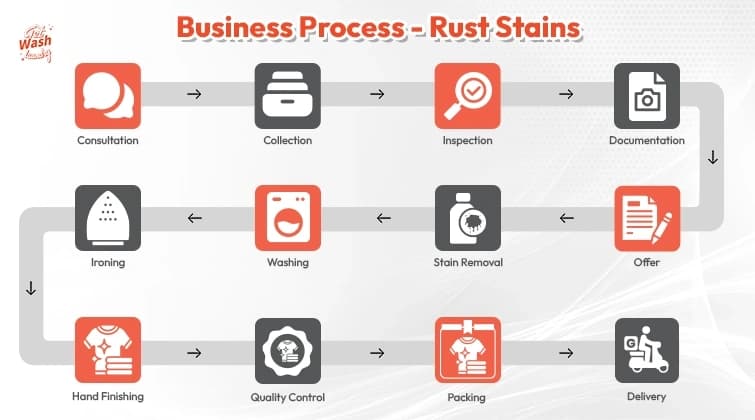
Removing rust stains professionally requires strong specialist products, and for that reason it also requires a strict procedure. Here is an outline of the process we follow.

Figure 7. Rust stain treatment process (rust-stain-treatment-process-getwash-en.png)
1. Inspection of source, material, and stain size
Every garment is inspected: the stain pattern that points to its source, the material from the label, the base colour, the size of the stain, the condition of the fibres in the stained area, and whether the stain has been exposed to bleach or other remedies. The condition is recorded before treatment.
2. Product test on a hidden area
The rust remover is first tested on a hidden area to make sure the fabric's original colour and fibres are safe. If there is a reaction, the method is adjusted or you are told that the risk is high.
3. Manual spotting with a professional rust remover
Getwash is an official distributor of professional spotting products from SEITZ (Germany) and A.L. Wilson (USA), and we use the same products in our own process. For rust stains, SEITZ makes Ferrol, a concentrated professional-only rust remover used only by manual spotting, never inside a dry-cleaning machine. A.L. Wilson also has RustGo in its range. The product is applied directly to the stained area with a measured dose and contact time. Product information is available on Getwash professional products.
4. Neutralisation
Professional rust removers are acidic and must be neutralised after use. This stage uses an alkaline product, for example Blutol from SEITZ, so the remaining product does not keep working and weaken the fibres. Neutralisation is the stage most often skipped in home attempts, and it is often why fabric becomes fragile or holed after the stain is gone.
5. Thorough rinsing
After neutralisation, the stained area is rinsed thoroughly with water or steam, then the garment is washed according to its material. Rinsing makes sure no residue is left behind, especially on garments worn against the skin.
6. Drying and final inspection
The garment is dried and checked under good lighting. If some stain remains and the fabric is still safe, treatment can be repeated. If not, the result is reported as it is. This staged process is why rust stain treatment adds about 5–7 days.
Why not try professional products yourself
Professional rust removers are concentrated, require personal protection, and must be neutralised with the right procedure. Without this knowledge, the same product can remove the stain but damage the fabric, or leave residue harmful to skin. That is why products like these are meant for professional use, not household use.
Why it adds 5–7 days
This extra time allows for inspection, product testing, staged spotting, neutralisation, rinsing, drying, and re-checking. Rust stains take a little longer than ink stains because the neutralisation stage must not be skipped. If you need your garment by a certain date, tell us from the start.
Before and after records
The garment's condition is recorded before treatment and checked again afterwards, so there is a clear comparison. Ask Customer Service if you need photos of the condition before and after.
Work clothes, prayer garments, and occasion wear
A white shirt for a meeting, a uniform that represents an institution, a prayer garment worn every day, and a kebaya for a family occasion should not be seen with rust marks. Getwash is trusted as the go-to laundry for government officials and high-profile clients because garments like these are handled one by one, with an honest explanation before work begins. Let us know if your garment is needed by a certain date.
How to prevent rust stains

Figure 8. How to prevent rust stains on clothes (how-to-prevent-rust-stains-on-clothes-getwash-en.png)
- Replace wire hangers with plastic, wooden, or coated hangers, especially for white clothes.
- Replace iron clotheslines and pegs that are starting to rust with plastic or stainless steel ones.
- Empty pockets of nails, clips, coins, keys, and hairpins before washing.
- Do not store clothes damp, especially with metal objects.
- Check the drum and metal parts of your washing machine regularly.
- Watch for iron-rich water and stop using chlorine bleach on white clothes.
Storing clothes long term
For clothes that are rarely worn, such as kebaya, suits, and spare prayer garments, make sure they are clean and completely dry before storage. Use hangers with no exposed metal, breathable fabric garment covers, and a moisture absorber in the wardrobe. Check stored clothes every few months so any stain can be treated before it ages.
Choosing the right hanger
Wire hangers from laundries or shops often have a thin paint coating that peels quickly, especially when used to hang wet clothes. For white and important clothes, choose thick plastic, wooden, or intact coated metal hangers. Avoid hanging wet clothes directly on wire hangers to dry.
Outdoor washing lines and the rainy season
Iron lines and poles outdoors rust quickly as rain and heat alternate. Wipe the line before use, replace wire lines with plastic or stainless steel, and avoid hanging white clothes on parts of the line that already show rust. In the rainy season, bring in dry laundry so it does not get wet again while touching metal.
Myths about rust stains
- "Bleach removes rust stains." Chlorine bleach can actually darken and lock in rust stains.
- "Lime, salt, and sunshine always work." Sometimes this helps on light stains on strong white fabric, but it can fade coloured fabric and weaken delicate fibres.
- "Keep washing it and it will go." Detergent does not dissolve iron oxide; repeated washing with iron-rich water adds more stain.
- "Yellowed clothes are just old." Often the cause is iron-rich water or bleach, which can be prevented.
- "Old rust stains can never come out." The chances are lower, but not always zero. A professional assessment can give a more certain answer.
Our experience
White shirts with brown lines on the shoulders from wire hangers, uniforms with orange patches from clotheslines, white T-shirts yellowed by well water, and stored kebaya with marks from metal hooks: these are the cases we receive most often. Cases brought in quickly and not yet exposed to bleach often end very well. Cases that are years old, have been bleached, or come from water that is still in use are much harder. The lesson: do not use bleach, find the source, and bring it in quickly. Almost every case that ends well follows those three simple steps from day one.
Caring for clothes after treatment
Clothes that have been successfully treated can be cared for as usual according to their label, but the rust source needs to be dealt with so the stain does not come back. Replace the hanger or line that caused the stain, and if the cause is water, wash those white clothes with cleaner water or send them to a laundry.
Why choose a laundry with spotting expertise
Most wash-and-fold laundries have no dedicated spotting stage for rust stains, and some even use bleach, which makes them worse. Getwash treats rust stains with professional products that we use and distribute ourselves, complete with testing, neutralisation, and thorough rinsing. That difference decides whether a stain comes out without damaging the fabric.
A summary to remember
- Do not use chlorine bleach on rust stains.
- Separate the garment from metal and do not scrub.
- If many clothes turn yellow, check the water and washing machine at home.
- Bring it in within the first 5 days for the best chance.
- Request the rust stain add-on when you order; it is not automatic.
Service hours and location
Customer Service hours: Monday–Friday 09.00–17.00, Saturday 09.00–15.00, closed on Sundays. Our main outlet is at Jl. Ceger Raya No.42, Jurang Mangu Barat, Kec. Pd. Aren, Kota Tangerang Selatan, Banten 15222. We serve customers in Pondok Aren, Bintaro, BSD, Ciledug, South Jakarta, and the surrounding area. If you are looking for laundry near me that can handle rust stains, send a photo of your garment first. Our team is ready to help assess the chances.
Has rust got onto your clothes? Contact WhatsApp 0812-6610-0500 now, order through the order page, or follow us on Instagram, TikTok, Facebook, and Threads.
FAQ: Questions About Rust Stains and the Getwash Service
What is the Getwash rust stain service?
An add-on service for stubborn rust stains from contact with metal, iron-rich water, or damp storage, treated with manual spotting using professional rust removers and neutralisation.
Can rust stains be removed 100%?
There is no 100% guarantee. Results depend on the age of the stain, the fabric, and what has already been done to the garment.
What is the success rate for fresh rust stains?
Fresh rust stains under 5 days old can usually be lifted 70–90%, based on our treatment experience.
What about older rust stains?
Old stains fall in the 25–60% range, and lower if they have been exposed to bleach or built up from iron-rich water.
Is this automatically included with regular laundry?
No. Rust stain removal is an add-on that must be requested when you order or mentioned to Customer Service.
Is it safe for all fabric types?
Silk, linen, and wool can be treated with the right procedure, but the risk differs for each material. Every fabric is tested first on a hidden area.
How long does it take?
Rust stain treatment adds about 5–7 days to the normal washing time.
Is there an extra charge?
Yes, as an add-on: Rust Minor Rp50,000 and Rust Major Rp70,000 per item. The cost is confirmed before processing.
How do I know if my garment is suitable?
Send a photo of the stain to WhatsApp 0812-6610-0500. The team will assess the category, chances, and risks before you decide.
How do I order this service?
Contact WhatsApp 0812-6610-0500 and request the rust stain add-on, then schedule pickup or drop it at the outlet. Do not use bleach beforehand.
Why are my white clothes turning yellow when they never touched metal?
Often the cause is iron-rich water, especially when used with chlorine bleach. Look for signs such as orange stains on the bathtub.
How much is pickup and delivery?
Since 20 June 2026: Zone 1 (0–3 km) Rp8,000, Zone 2 (3–7 km) Rp15,000, Zone 3 (over 7 km) Rp22,000 per trip.
What are Getwash Customer Service hours?
Monday–Friday 09.00–17.00 and Saturday 09.00–15.00. Closed on Sundays. Messages can be sent at any time and are answered during the next service hours.
Sources
- Getwash Laundry rust stain removal service page
- Getwash Laundry Noda Karat page (ID)
- Getwash Products page (SEITZ and A.L. Wilson)
- Getwash Laundry tracking page
- New Policy Notice: Pickup & Delivery Rates (effective 20 June 2026)