Pillow Care
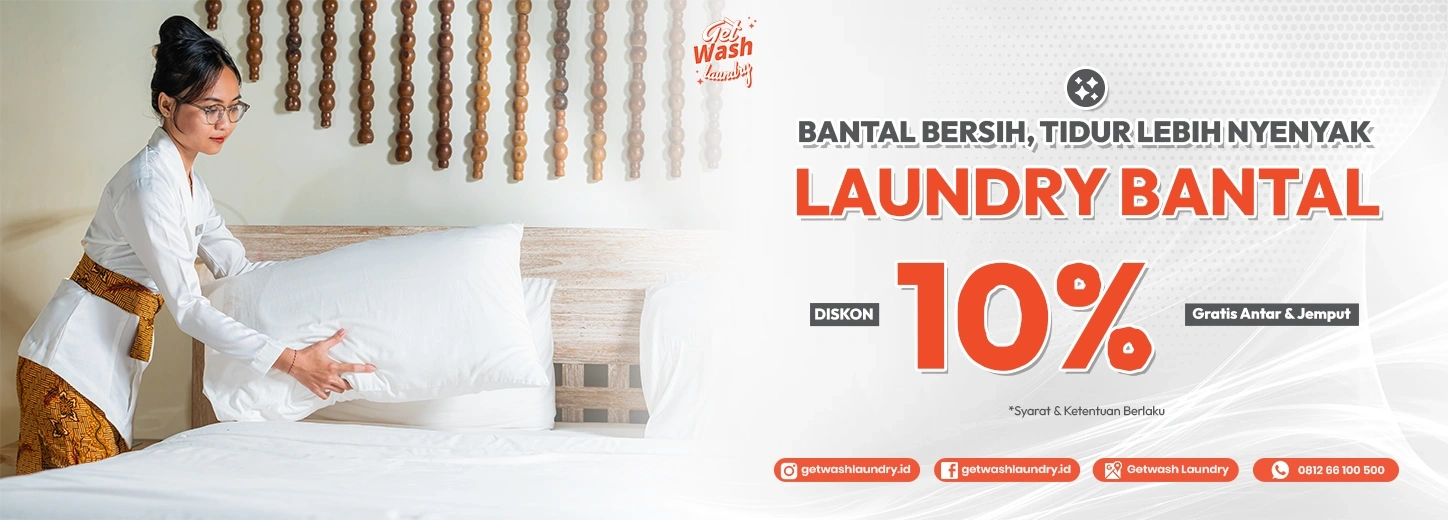
- Bantal Synthetic
Estimasi 14 Hari Kerja
Rp 75.000 - Bantal Feather / Down
Estimasi 14 Hari Kerja
Rp 135.000 - Bantal Latex / Foam
Estimasi 14 Hari Kerja
Rp 150.000 - Bantal Duck Down
Estimasi 14 Hari Kerja
Rp 200.000 - Bantal StandartRp 100.000
- Nanofiber Goose Down
addon penambahan isi bantal, harga /500gram
Rp 60.000 - Kapas Silikon
addon penambahan isi bantal, harga /500gram
Rp 40.000
Contact us to schedule your order
09:00-20:00 (Weekday) & 09:00-17:00 (Weekend)
Ulasan Pelanggan
- Fajar5.0
Layanan Laundry Bantal ini hasilnya bersih maksimal. Saya puas dan akan memakai lagi.
- BHISMO NIRMOLO SWABOWO5.0
Layanan Laundry Bantal ini hasilnya bersih maksimal. Terima kasih atas pelayanannya.
- Riza Galuh Dwi Saputro5.0
Layanan cuci bantal terbaik! Sangat bersih dan higienis, isian bulu/dacron tidak merusak struktur bantal. Pengalaman beristirahat jadi jauh lebih berkualitas. Senang sekali menemukan penyedia jasa yang jujur dan mengutamakan kualitas.
- KLIWON5.0
Layanan Laundry Bantal ini hasilnya bersih maksimal. Sangat direkomendasikan.
- Riza Galuh Dwi Saputro5.0
Layanan cuci bantal terbaik! Sangat bersih dan higienis, isian bulu/dacron tidak merusak struktur bantal. Pengalaman beristirahat jadi jauh lebih berkualitas. Senang sekali menemukan penyedia jasa yang jujur dan mengutamakan kualitas.
- KLIWON5.0
Layanan cuci bantal terbaik! Sangat bersih dan higienis, isian bulu/dacron tidak merusak struktur bantal. Pengalaman beristirahat jadi jauh lebih berkualitas. Senang sekali menemukan penyedia jasa yang jujur dan mengutamakan kualitas.
- Fajar5.0
Layanan cuci bantal terbaik! Sangat bersih dan higienis, isian bulu/dacron tidak merusak struktur bantal. Pengalaman beristirahat jadi jauh lebih berkualitas. Senang sekali menemukan penyedia jasa yang jujur dan mengutamakan kualitas.
- BHISMO NIRMOLO SWABOWO5.0
Layanan cuci bantal terbaik! Sangat bersih dan higienis, isian bulu/dacron tidak merusak struktur bantal. Pengalaman beristirahat jadi jauh lebih berkualitas. Senang sekali menemukan penyedia jasa yang jujur dan mengutamakan kualitas.
- WIDYASARI KUSUMANINGRUM5.0
Layanan cuci bantal terbaik! Sangat bersih dan higienis, isian bulu/dacron tidak merusak struktur bantal. Pengalaman beristirahat jadi jauh lebih berkualitas. Senang sekali menemukan penyedia jasa yang jujur dan mengutamakan kualitas.
- FEBRI WIDIANTO5.0
Layanan cuci bantal terbaik! Sangat bersih dan higienis, isian bulu/dacron tidak merusak struktur bantal. Pengalaman beristirahat jadi jauh lebih berkualitas. Senang sekali menemukan penyedia jasa yang jujur dan mengutamakan kualitas.
Professional Pillow Cleaning by Getwash: A Guide to Understanding Pillow Fillings, Choosing the Right Care, Reading Prices and Turnaround, and Deciding When a Pillow Needs Cleaning or Replacing
By the Getwash Laundry Team | Updated 4 November 2026 | Reading time ±27 minutes
|
QUICK ANSWER Getwash cleans pillows by filling type: Synthetic Rp75,000, Feather/Down Rp135,000, Latex/Foam Rp150,000, and Duck Down Rp200,000 per pillow. The service page also lists filling add-ons per 500 grams (Nanofiber Goose Down Rp60,000, Silicone Fibre Rp40,000). The pricelist estimates 14 working days, while the English FAQ says 1–2 days, so ask for the expected completion when you order. Pickup is charged by zone (Rp8,000, Rp15,000, or Rp22,000 per trip). Order through the order page or WhatsApp 0812-6610-0500; service hours are Monday–Friday 09.00–17.00 and Saturday 09.00–15.00, closed on Sundays. |
A pillow is the only piece of bedding that touches our face, nose, and mouth for hours every night. Yet in many homes it is the item washed least. The pillowcase is changed regularly while the filling is left for years, as if the case were protection enough.
This article looks at pillow cleaning service from that angle: the pillow as an object whose filling decides everything, from how it is washed to how long it takes to dry, to when it is time to replace it. We explain the differences between duck down, feather, latex, memory foam, and synthetic, how to read the prices and turnaround on the page, and the signs of a pillow still worth saving or ready to retire. If you are looking for a laundry near me for pillows, start with the table of contents below.
Table of Contents
1. The Pillow: The Item Closest to Your Face and Washed Least
2. The Filling Decides the Care: Duck Down, Feather, Latex, Memory Foam, Synthetic, and Orthopedic
3. Pillow Cleaning Prices: By Type, Filling Add-Ons, and Standard Sizes
4. Turnaround: How to Read 14 Working Days and Plan Around It
5. Common Pillow Problems: Musty Odour, Yellowing, Flat, Clumped, and Saliva Stains
6. Caring for Pillows at Home, in Hotels, and in Clinics, and How to Order with Pickup
7. FAQ: Questions About Getwash Pillow Cleaning
The Pillow: The Item Closest to Your Face and Washed Least
Ask what is changed most often on a bed and the answer is sheets and pillowcases. Ask when the pillow itself was last washed and many people fall silent. A pillow is nearly always assumed to be protected by its case, yet the case only holds back part of what the body releases.
What builds up inside a pillow
Every night the head releases sweat and skin oil, hair leaves oil and product residue, and the face sheds dead skin cells. Some of it stays in the case, but some seeps into the filling. Our service page says pillows that are rarely washed accumulate dust mites, dead skin cells, and sweat, which matches what many sleep-hygiene guides report.
In the humid climate of Greater Jakarta, moisture speeds everything up. A thick filling dries slowly, so trapped dampness can last for days and cause a musty smell. That is why a pillow that looks clean outside can smell the moment it is held near the nose.
Why pillows are rarely washed
There are three understandable reasons. First, it is unclear how: a pillow is not clothing, and every filling has its own rules. Second, the risk of damage: a wrongly washed pillow can clump, go flat, or lose its shape. Third, drying time: thick filling needs thorough drying to avoid mould. So many people put it off, or simply buy a new pillow.
“A pillowcase protects the filling but does not make it immune; what builds up inside still needs cleaning.” — Working principle of the Getwash team
Signs your pillow needs cleaning
- A musty or sweaty smell even when the case was just changed.
- Yellowish stains on the pillow surface under the case.
- The pillow feels damp or clammy in dry weather.
- A blocked nose or sneezing on waking with no other cause.
- The pillow feels flatter and gives less support than before.
- You have passed the cleaning rhythm you set yourself, for example every three months.
How often should a pillow be cleaned
The Indonesian service page recommends washing pillows at least every three months, while the English page says three to six months. Both ranges are sensible as general guidance. Three months suits people who sweat easily, have allergies, or sleep with pets, while six months can be enough for those who rarely sweat and use a protector that is washed regularly.
Myth: sunning a pillow is enough
Sunning a pillow does help reduce dampness and freshen its smell, and it is a good habit between washes. But sunning does not lift the sweat, oil, and skin cells that have already entered the filling. Sunning is light care, not a substitute for thorough cleaning.
Pillows and sleep quality
The position of the head and neck during sleep is set by the pillow. A pillow that is flat, smelly, or clumped supports the neck less and makes sleep less comfortable. Cleaning and caring for a pillow helps maintain that comfort, but once a pillow has lost its support, replacing it is the honest choice.
Dust mites and pillows: a relationship often misunderstood
Dust mites live on dead human skin cells, and a pillow is one of the richest places for them because the head rests there all night. What triggers a blocked nose or sneezing in sensitive people is not the mite itself but proteins from its waste and remains. That is why periodic cleaning and thorough drying mean more than simply spraying fragrance.
It is fair to say that mites cannot be removed from a bed forever. Once the pillow is used again, new particles build up. What is realistic is keeping the load low through a cleaning rhythm, a washable pillow protector, and a room that is not damp.
Pillows for children, babies, and allergy-prone households
Children's and babies' pillows often meet saliva, milk, and sweat, so they need cleaning more often. For households sensitive to dust, a clean pillow usually feels more comfortable. We do not claim washing cures allergies, but reducing dust build-up in the bed is a sensible step.
High-value pillows and personal favourites
Many people own a pillow of their own choosing: imported duck down, latex, or an orthopedic pillow bought for its comfort. Getwash is trusted as the go-to laundry for officials and high-profile customers, and that habit applies to pillows too: handled in an orderly way with privacy protected. For high-value pillows, tell us the brand and filling type before work.
The Filling Decides the Care: Duck Down, Feather, Latex, Memory Foam, Synthetic, and Orthopedic
Our service page covers six types of pillow, and that division is not a formality: each filling reacts differently to water, heat, and pressure. Here is each type and why its care differs.

Figure 1. Pillow fillings and care notes (pillow-filling-types-and-care-notes-getwash-en.png)
Duck down: light, soft, and in need of thorough drying
Duck down pillows are filled with the fine feathers of ducks, which give a soft, light feel. This filling is very sensitive to moisture: if not dried fully, the feathers clump and smell. Rough washing or too-hot drying can also damage the feathers. That is why duck down sits in the highest price group on our pricelist (Rp200,000).
Feather down: a mix of feathers and quills
Feather down pillows contain a mix of feathers and quills, giving support as well as softness. Quills are harder than fine down, so this type usually supports more firmly. Like duck down, it needs thorough drying and reshaping after washing.
Latex: elastic and durable, but not for just any wash
Latex is known for being elastic, naturally antibacterial, and long-lasting. But this rubber foam is fragile under pressure, wringing, and excess heat, so it must not be wrung out or left long in strong sun. The service page says latex needs special washing. Damaged latex is hard to repair, so do not wash it like an ordinary pillow.
Memory foam: spot-cleaned and steamed
Memory foam soaks up water like a sponge and releases it slowly, so if fully soaked it can grow mould inside. The service page explains that memory foam is spot-cleaned and steamed rather than machine-washed. This approach protects the foam structure while still refreshing it.
Synthetic and microfibre: the easiest, but still needing hygiene
Synthetic or microfibre pillows are the most common and the easiest to wash. But easy does not mean problem-free: synthetic fibre still absorbs oil and odour, and can clump if wrung roughly or dried too hot. Hygienic care still matters.
Orthopedic and neck pillows
Orthopedic, neck, and travel pillows are designed in a particular shape to support the neck. Damaging that shape means damaging its function. The service page says this type is washed by a special method so it is not damaged. Tell us the material and shape of your pillow when ordering.
Hotel pillows and large pillows
The service page says this service covers home, hotel, and clinic pillows, and the English version adds that bolsters and decorative pillows are included. For hotels or clinics with many pillows, the key is rhythm and rotation. For regular volume, contact our business team to discuss B2B laundry.
Standard pillow sizes
The service page lists standard sizes: Standard 50 × 70 cm, Queen 50 × 75 cm, King 50 × 90 cm, Neck/Travel 30 × 30 cm, and Baby 25 × 35 cm. Size helps Customer Service group your pillow, so state the size or send a photo of the pillow with its label if there is one.

Figure 2. Standard pillow sizes (standard-pillow-sizes-getwash-en.png)
Filling add-ons: when a pillow has thinned
Our pricelist lists filling add-ons per 500 grams: Nanofiber Goose Down Rp60,000 and Silicone Fibre Rp40,000. The page does not explain how they are used, but the pricing pattern suggests topping up or refilling a pillow that has thinned. Ask Customer Service whether your pillow suits a top-up and how many grams it would need.
Why a pillow should not be washed like clothing
Clothing is washed with spinning and wringing that tug the fibres repeatedly. A pillow cannot take that treatment. Feather fillings can break and clump, latex can tear, memory foam can crumble inside, and synthetic fibre can ball up. A wet pillow is also very heavy, so household machines often cannot rinse it through. Leftover soap makes the pillow stiff and smelly.
Drying matters even more. A pillow that looks dry outside but is damp in the middle will smell musty within days, and in feather or foam it can trigger mould. That is why controlled, thorough drying is the main reason many people hand pillows to a professional.
Special fabrics: bamboo, gel, and blends
Besides the six main types, there are pillows of blended materials such as latex with a gel layer, memory foam with a bamboo cover, or pillows with several filling compartments. On these, the most sensitive part decides the care. If your pillow is not one of the six types above, send a photo and the label and let the team assess the closest group.
Reading the pillow label
Many pillows carry a label naming the filling and care instructions. Even if you hand the pillow to a professional, the label is still a useful guide to the material and its limits. If the label is gone, send a photo and your best guess of the filling: light like feathers, springy like rubber, or dense like foam.
How to tell the filling when the label is gone
There are three simple ways. A feather pillow feels light, can be pressed and slowly springs back, and sometimes makes a soft rustle. A latex pillow feels springy and heavy and returns quickly after pressing. A memory foam pillow feels dense and returns slowly. A synthetic pillow feels like cotton wool or fine fibre that clumps when pressed. If still unsure, do not guess; send a photo and let the team assess.
Pillow Cleaning Prices: By Type, Filling Add-Ons, and Standard Sizes
Getwash pillow prices follow the type of filling, not just size. The service page carries an official pricelist with four main groups and one standard-pillow group.

Figure 3. Pillow cleaning prices by type (pillow-cleaning-prices-by-type-getwash-en.png)
- Synthetic pillow: Rp75,000 (estimated 14 working days).
- Feather / Down pillow: Rp135,000 (estimated 14 working days).
- Latex / Foam pillow: Rp150,000 (estimated 14 working days).
- Duck Down pillow: Rp200,000 (estimated 14 working days).
- Standard pillow: Rp100,000 (turnaround not listed on the Indonesian page).
- Filling add-ons (per 500 grams): Nanofiber Goose Down Rp60,000, Silicone Fibre Rp40,000.
Two pricelists that do not match
One thing must be said plainly: the Indonesian service page carries two sets of figures. The main pricelist holds the rates above (Rp75,000 to Rp200,000), while a separate table titled estimated prices shows a much lower range, for example Rp20,000 to Rp25,000 for synthetic and Rp45,000 to Rp60,000 for premium duck down. The page also says prices depend on size and material, and that a minimum order applies.
The two sets do not match, and the page does not explain how they relate. This article uses the main pricelist as its reference. Before ordering, ask for written confirmation over WhatsApp of the rate that applies to your pillow and whether there is a minimum order, so there is no gap at the end.
What the price covers
The English service page says the service includes enzyme-based cleaning for allergens, sweat, and odour, high-temperature sanitisation, reshaping after washing, allergen-free deodorising, and humidity-controlled drying without direct sunlight. The Indonesian page mentions low-spin machines, low-temperature drying, and optional sun drying. The two versions are not fully aligned on sunlight, so ask which drying method applies to your type of pillow.
About the 99.9% bacteria claim
The English page states that high-temperature sanitisation kills 99.9% of bacteria and mites. We do not use that figure as a promise in this article because no test evidence appears on the page. What can honestly be said: correct washing and thorough drying reduce particles, sweat, and microbes on a pillow, but a pillow takes in dust again as soon as it is used.
A cost example for one household
Here is an illustration (not a real customer case). A house has two synthetic pillows in the master bedroom (2 × Rp75,000 = Rp150,000), two latex pillows for the parents (2 × Rp150,000 = Rp300,000), and two synthetic pillows in the children's room (Rp150,000). The total is Rp600,000 before pickup. Cleaned every three months, that is four times a year.

Figure 4. Pillow cleaning cost examples (pillow-cleaning-cost-examples-getwash-en.png)
Another example: a small clinic or boutique hotel with ten synthetic pillows spends 10 × Rp75,000 = Rp750,000 per cleaning, before pickup. For regular volume, talk to us about B2B laundry. For a single personal duck down pillow, the cost is Rp200,000 per cleaning.
Working out the cost per year
Another way to judge the price is to divide it by the period of use. A synthetic pillow at Rp75,000 cleaned every three months costs Rp300,000 a year, or about Rp820 a night. A latex pillow at Rp150,000 every three months comes to Rp600,000 a year, about Rp1,640 a night. These are simple estimates, but they show pillow care is a small cost per night for something that touches your face.
Cleaning or buying a new pillow
A cheap synthetic pillow is sometimes more economical to replace than to keep cleaning. But duck down, latex, or orthopedic pillows with higher prices are usually worth caring for. A simple rule: if the pillow still supports well and is only dirty or smelly, clean it. If it is permanently flat or torn, replace it.
Pickup and delivery rates
Since 20 June 2026, pickup and delivery is no longer free. The rate is charged per trip by distance from the nearest outlet: Zone 1 (0–3 km) Rp8,000, Zone 2 (3–7 km) Rp15,000, Zone 3 (over 7 km) Rp22,000. Customer Service confirms your zone when you order. Send several pillows together in one order so the pickup charge is not paid repeatedly.
About promotions and free pickup
The meta description of the Indonesian service page mentions free pickup. Because the pickup rate policy changed on 20 June 2026, we do not use that claim. Ask Customer Service about the promotion currently in force before ordering.
Minimum order
The service page mentions a minimum order without giving the figure. Ask what minimum applies before you order, especially if you only want to clean a single pillow.
Turnaround: How to Read 14 Working Days and Plan Around It
Time is the most confusing part of the pillow service, because our page gives two very different answers. This section explains how to read them honestly.
What the page says
- Pricelist: estimated 14 working days for Synthetic, Feather/Down, Latex/Foam, and Duck Down.
- English FAQ: usually 1 to 2 days, with same-day express for some pillow types.
- Standard pillow: turnaround not listed.
The gap between 14 working days and 1 to 2 days is huge, and we will not hide it. The safest way to read it: treat 14 working days as the official estimate on the pricelist, and treat 1 to 2 days as a possibility for particular cases that must be confirmed. Ask for the expected completion for your pillow when you order and follow it on the tracking page.
Why pillows take long to dry
A pillow filling is thick and dense, so water soaks in deep and air struggles to get in. A pillow that looks dry on the surface but is damp inside will smell musty within days. That is why drying is the most decisive stage, and it cannot be rushed without risk. Duck down, feather, and memory foam need extra attention, so their time tends to be longer.
Why not every pillow can be expedited
The FAQ says express is only available for some pillow types. That makes sense: a synthetic pillow dries faster than memory foam or duck down. Forcing fast drying on the wrong filling can ruin a pillow. Ask whether your pillow is among those that can be sped up.
Why a long estimate is not always slow
Fourteen working days sounds long, but pillows do need time: washed carefully, dried slowly, checked, and reshaped. Hurried drying is the biggest cause of pillows smelling after washing. If the long estimate means your pillow is dried until it is truly done, that is better than a quick result that is damp inside. What matters is clarity: you have the right to know when your pillow will return.
How to follow your order
Once the pillow is collected, you can follow your order on the tracking page using the order number and the last five digits of the phone number on record as a PIN. If you have a question, Customer Service is available over WhatsApp 0812-6610-0500 during service hours.
Planning so your sleep is not disturbed
The easiest way to avoid a night without a pillow is to own a spare pillow or send pillows in turns. If there are four pillows at home, send two first and the next two once the first batch returns. If you only have one favourite pillow, schedule cleaning for when you can use another in the meantime.
A sample plan for a family of four
An illustration (not a real customer case): a family owns four synthetic pillows. If all are sent at once with the official 14 working day estimate, four beds without pillows for two weeks would be a hassle. The alternative is two batches: two pillows this week, two after the first batch returns. This pattern keeps sleep comfortable and spreads the cost.
Rainy season and drying
In the rainy season, pillows dried at home take long to dry and easily grow mould. This is when controlled drying feels most useful. Where possible, order before the peak of the rains, because the queue and drying needs can affect turnaround.
What to ask when you order
Because the service page holds several figures that are not aligned, four questions are worth asking before the pillow is collected: which rate applies to my pillow, what is the minimum order, what is the expected completion for my filling type, and how will it be dried. Ask for the answers in writing over WhatsApp. That conversation becomes your record if there is a difference later.
Express option
The service page mentions express service without a price or an exact time frame. Ask about the availability and cost of express laundry for your pillow. For clothing we have express laundry, but for pillows, availability follows the filling type and the queue.
Common Pillow Problems: Musty Odour, Yellowing, Flat, Clumped, and Saliva Stains
Every pillow owner has faced one of these problems. Here are the causes, the treatment, and an honest line on what can be expected.

Figure 5. Pillow problems and treatments (pillow-problems-and-treatments-getwash-en.png)
Musty odour
A musty smell comes from moisture trapped in the filling and the growth of mould or bacteria. Spraying fragrance only masks it. The right treatment cleans down into the filling, rinses thoroughly, and dries the whole pillow. A pillow stored damp after washing will smell again.
Yellowing
Yellow on a pillow comes from sweat and oil that have soaked in, and often shows on the side closest to the face. Enzyme-based treatment, as the service page describes, helps lift oil and sweat. The result depends on how deep and long-standing the stain is; we do not promise the pillow returns to brand new.
Flat pillows and lost support
A pillow that has gone flat from years of use has suffered filling fatigue. Reshaping after washing can recover some of it, and a filling add-on per 500 grams can help on certain fillings. But if the pillow has permanently lost its support, replacing it is the honest choice.
Clumped filling
Feather or fibre filling can clump if washed roughly, wrung hard, or dried unevenly. Lumps leave the pillow uneven and uncomfortable. Controlled drying and reshaping after washing help restore the form, but lumps that have hardened are difficult to remove.
Saliva and sweat stains
Marks in the middle of a pillow usually come from saliva, hair oil, and sweat. Treatment works better when the stain is recent. Avoid scrubbing hard because it can damage the filling. Tell us if there is a particular stain so it can be handled before washing.
Dust and mites
A pillow is a place dust mites like, warm and damp, and their main food is dead skin cells. Thorough washing and drying reduce particles and mite remains, but we do not promise a mite-free pillow forever, because a pillow takes in dust again once used. A pillow protector that is washed regularly helps slow the build-up.
Overpowering fragrance
A pillow that is too fragrant can bother sensitive sleepers, and a strong smell sometimes only covers mustiness. The English page mentions fragrance-free, hypoallergenic products. If you or a family member is sensitive to fragrance, say so when ordering so it can be noted.
After illness or flu season
After someone at home has been ill, many people want to refresh their pillows. That is a natural step. Send those pillows separately if you are concerned, and for particular medical conditions follow the advice of health professionals; a laundry service is not a substitute for medical advice.
Will the pillow look brand new?
We do not promise a pillow will return to its first day. A pillow used for years has natural wear and old stains that cannot all be removed. What we can aim for is a pillow that is cleaner, fresher, sweet-smelling, and comfortable, together with an honest assessment at the start.
When to replace rather than clean
Some signs say a pillow is due to retire: the filling has clumped permanently, the pillow does not spring back after folding, the cover is torn, the smell does not go after washing, or your neck aches from lack of support. In those cases replacing makes more sense than paying for more cleaning.
Pillow age and signs of wear
Pillows have a working life. Many guides suggest synthetic pillows need replacing in roughly one to two years, while feather, latex, and memory foam pillows can last longer if cared for. These figures are only estimates; the signs of wear matter more: reduced support, clumped filling, a smell that will not go, and a neck that feels uncomfortable. Cleaning extends a pillow's life, but does not stop the filling ageing.
Torn or badly mouldy pillows
A pillow with a large tear or heavy mould cannot always be washed safely. In that case we give advice before work.
Caring for Pillows at Home, in Hotels, and in Clinics, and How to Order with Pickup
The best results come from teamwork between professional cleaning and daily habits. Here is how to keep pillows fresh between cleanings, and how to order our service.
Habits that keep a pillow fresh
- Use a pillow protector and a case that are changed regularly. These two layers hold back most sweat and oil.
- Air it. Now and then put the pillow in a breezy shaded place for a few hours so moisture leaves.
- Do not eat on the pillow. Crumbs and spills are hard to clean from the filling.
- Wash hair and face before bed if you use heavy products. Oils and creams move onto the pillow.
- Deal with stains at once. Blot with a clean cloth; do not rub.
- Plump and turn the pillow regularly. This stops the filling going flat on one side.
A simple test: is your pillow still fit for use
There is a popular test for feather or fibre pillows: fold the pillow in half and let go. A healthy pillow springs back to its shape. A pillow that stays folded or recovers very slowly has lost its support. The test does not apply to latex and memory foam, which have their own recovery patterns, so for those, check whether the pillow still supports your neck comfortably.
The pillow protector: the layer often forgotten
A pillow protector is a thin layer fitted under the case. It holds back sweat, oil, and skin cells before they reach the filling. It can be washed at home like an ordinary case, which lightens the cleaning load on the filling and lets the interval between professional cleanings stretch. For those wanting to save, it is a small investment with a big effect.
Which sleeping position suits which pillow
How a person sleeps affects which pillow suits them: side sleepers usually need a higher, firmer pillow, back sleepers a medium height, and stomach sleepers often prefer a thin one. So a flat pillow is not only a matter of cleanliness but of fit. If a pillow is clean but your neck still aches, the problem may not be the dirt but the support.
Caring for pillows while travelling
Neck and travel pillows are used on planes, trains, and in cars, places that touch many people. Clean them periodically and do not pack them damp. The 30 × 30 cm size on our list belongs to this group, and its handling follows the filling of that pillow.
Storing spare pillows
If you keep a spare pillow, make sure it is clean and completely dry before storing. Keep it somewhere cool and ventilated in a breathable container, not airtight plastic for a long time. Label it with the date of the last cleaning so you know when it needs airing.
Preparing pillows for guests
Homeowners who often host overnight guests know guest pillows are easily forgotten: rarely used, yet still holding dust and moisture. Clean the guest room pillows before the visiting season and store them dry. That way the room is ready without a musty surprise when guests arrive.
Baby and children's pillows
Baby pillows, the 25 × 35 cm size on our list, touch very sensitive skin. Tell us when ordering if a pillow is for a baby, including if the skin is easily irritated by fragrance. Baby and children's bedding should be cleaned more often, and it is safer to use a protector that can be washed.
Pillows for hotels, homestays, and clinics
Our service page says this service covers home, hotel, and clinic pillows. For businesses with many pillows, the most important thing is rhythm: how many pillows per room, how often they are cleaned, and how to keep rooms ready. We suggest keeping spares so rotation does not leave rooms empty.
One clean bed, layer by layer
The pillow is only one part of a fresh bed. Sheets are changed most often, bedcover cleaning less often, and pillows and mattress least often but still need attention. Setting a rhythm for every layer means you do not need to wash everything at once, and each part stays fresh in its time.
Services that often go with pillow cleaning
Customers who clean pillows usually also have other bedding and household items needing similar care: bedcover cleaning, bedsheet laundry, carpet cleaning, wet cleaning, and per-kilo laundry. Handing everything over together saves on the pickup charge.
How to order
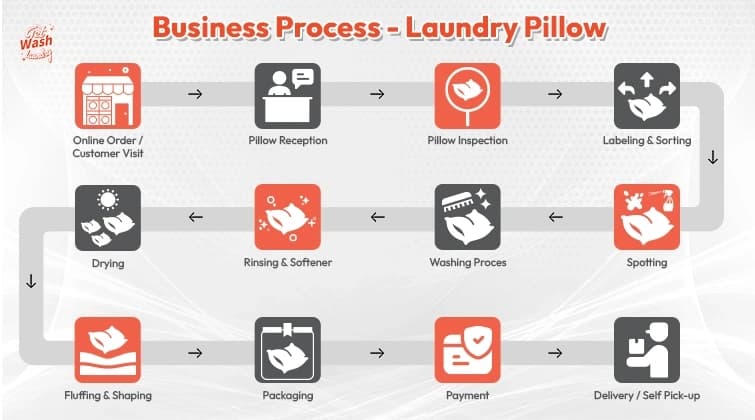
Our service page describes a simple flow: book online or via WhatsApp, a pickup at the scheduled time, washing and sanitisation suited to the material, and delivery of the clean pillow. The most dependable way: message WhatsApp 0812-6610-0500 or use the order page. You can also visit the outlet at Jl. Ceger Raya No.42, Jurang Mangu Barat, Kec. Pd. Aren, Kota Tangerang Selatan, Banten 15222.

Figure 6. Six steps to order pillow cleaning (six-steps-to-order-pillow-cleaning-getwash-en.png)
- Check the filling type and size of your pillow, or read the label if there is one.
- Send a message over WhatsApp or the order page, with a photo of the pillow and any stain.
- Customer Service confirms the price, the minimum order, the expected completion, and your pickup zone.
- A courier collects from your address.
- The pillows are washed, dried, and packed; follow progress on the tracking page.
- The pillows are delivered back to your address or collected at the outlet.
Checklist before handing over pillows
- Note the filling type and size of each pillow.
- Remove cases and protectors, as they are not part of the pillow rate.
- Photograph any stain or damage that already exists.
- Separate baby or children's pillows if they have special needs.
- State special needs: allergies, fragrance, or sensitive skin.
- Ask for the expected completion and keep the order number for tracking.
One last note on pillowcases
Cases and pillow protectors are not included in the pillow rate on the pricelist, so remove them before handing over your pillows. If you want the cases washed too, send them with bedsheet laundry or through per-kilo laundry so everything returns clean in one delivery.
Service hours and location
Service hours: Monday–Friday 09.00–17.00, Saturday 09.00–15.00, closed Sundays. Our main outlet is at Jl. Ceger Raya No.42, Jurang Mangu Barat, Kec. Pd. Aren, Kota Tangerang Selatan, Banten 15222. The service page mentions coverage in Greater Jakarta such as Bintaro, BSD, Ciputat, Pamulang, and South Jakarta, as well as other outlets and service areas listed on the outlets page.
Why we write all this so plainly
We would rather you order with full information than with a pretty promise. The pillow service depends more than most on the type of filling, and every type has its limits. By saying what is certain, what needs confirming, and what we do not promise, we hope you get a result that matches your expectations and a pillow that stays comfortable for longer.
How to choose a pillow cleaning service
Before leaving a pillow with any laundry, ask simple questions: how is the price worked out, how is each filling handled, how is drying done, what is the expected time, and what is the policy on complaints. Clear, consistent answers signal a service you can trust. The same questions apply to us.
Because some information on our service page is not yet aligned, do not hesitate to ask Customer Service for a written breakdown before you agree. Customers who understand what they are buying are almost always happier with the result, and we would rather answer a hundred questions at the start than one complaint at the end.
Ready to refresh your pillows? Order through the order page, contact WhatsApp 0812-6610-0500, or follow us on Instagram, TikTok, Facebook, and Threads.
FAQ: Questions About Getwash Pillow Cleaning
What is the pillow cleaning service at Getwash?
A service that cleans home, hotel, and clinic pillows with pickup from your location, washing suited to the filling type, and delivery back.
How much does pillow cleaning cost at Getwash?
Per pillow: Synthetic Rp75,000, Feather/Down Rp135,000, Latex/Foam Rp150,000, Duck Down Rp200,000, and Standard pillow Rp100,000. Filling add-ons per 500 grams: Nanofiber Goose Down Rp60,000 and Silicone Fibre Rp40,000.
Why are there two different pricelists on the page?
The Indonesian page carries a main pricelist and an estimated price table with lower figures, without explaining how they relate. Ask for written confirmation of the rate for your pillow before ordering.
How long does pillow cleaning take?
The pricelist says 14 working days, while the English FAQ says 1–2 days. Ask for the expected completion when you order and follow it on the tracking page.
Is there an express option for pillows?
The page mentions express for some pillow types, without a price or time frame. Ask Customer Service about availability and cost.
Does Getwash provide pickup and delivery for pillows?
Yes. Since 20 June 2026 the rate is Rp8,000 (Zone 1, 0–3 km), Rp15,000 (Zone 2, 3–7 km), or Rp22,000 (Zone 3, over 7 km) per trip.
Can memory foam and latex pillows be cleaned?
Yes, with special handling. Memory foam is spot-cleaned and steamed, while latex needs special washing and must not be wrung out.
How often should a pillow be cleaned?
The pages suggest at least every three months (Indonesian) or every three to six months (English). More often if you sweat easily, have allergies, or sleep with pets.
When should a pillow be replaced rather than cleaned?
When the filling has clumped permanently, the pillow does not spring back after folding, it is torn, the smell will not go, or your neck aches from lack of support.
Will the pillow be mite-free after cleaning?
Washing and thorough drying reduce particles and mite remains, but we do not promise a mite-free pillow forever, because a pillow takes in dust again as it is used.
How do I order?
Message over WhatsApp or use the order page, state the filling type and size, and send a photo if there is a stain. Customer Service confirms the price, time, minimum order, and zone.
What are Getwash's service hours?
Monday–Friday 09.00–17.00 and Saturday 09.00–15.00. Closed on Sundays. Messages can be sent any time and are answered in the next service hours.
Does Getwash serve high-profile customers and high-value pillows?
Yes. Getwash is trusted as the go-to laundry for officials, public figures, business people, and celebrities, and is used to handling high-value items with privacy protected.
Sources
- Getwash Laundry pillow care service page
- Getwash Laundry Bantal page (ID)
- Getwash Laundry tracking page
- New Policy Notice: Pickup & Delivery Rates (effective 20 June 2026)