Ink Stain Removal
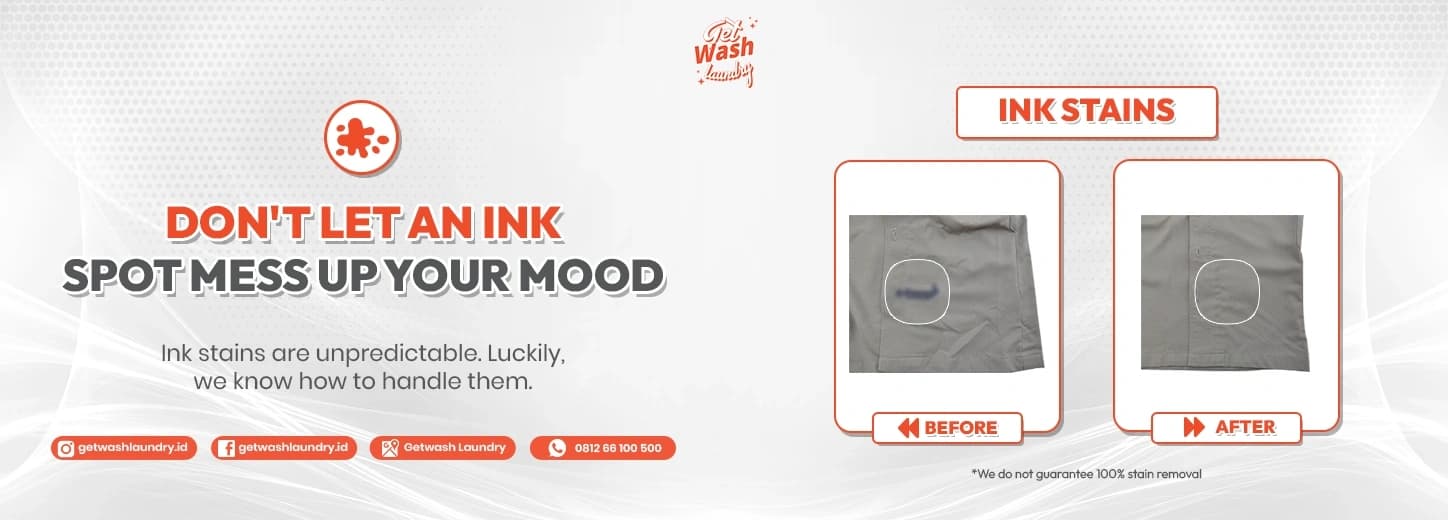
- Tinta - Major
Layanan ini bersifat add on | Harap membaca FAQ di bawah
Rp 70.000 - Tinta - Minor
Layanan ini bersifat add on | Harap membaca FAQ di bawah
Rp 50.000
Contact us to schedule your order
09:00-20:00 (Weekday) & 09:00-17:00 (Weekend)
Ulasan Pelanggan
- Mc Harris Pribadi5.0
An ink pen leaked all over my pocket, but their specialized ink stain removal service handled it perfectly. Not a single trace of ink left behind, and the fabric condition remains pristine! Would definitely recommend this to all my friends and colleagues!
- andrio heru purnomo5.0
An ink pen leaked all over my pocket, but their specialized ink stain removal service handled it perfectly. Not a single trace of ink left behind, and the fabric condition remains pristine! Would definitely recommend this to all my friends and colleagues!
- Fitri5.0
An ink pen leaked all over my pocket, but their specialized ink stain removal service handled it perfectly. Not a single trace of ink left behind, and the fabric condition remains pristine! Would definitely recommend this to all my friends and colleagues!
- Purwanto5.0
An ink pen leaked all over my pocket, but their specialized ink stain removal service handled it perfectly. Not a single trace of ink left behind, and the fabric condition remains pristine! Would definitely recommend this to all my friends and colleagues!
- OLA RAHMAT FADILLAH5.0
An ink pen leaked all over my pocket, but their specialized ink stain removal service handled it perfectly. Not a single trace of ink left behind, and the fabric condition remains pristine! Would definitely recommend this to all my friends and colleagues!
- Ahmad Kosasih5.0
An ink pen leaked all over my pocket, but their specialized ink stain removal service handled it perfectly. Not a single trace of ink left behind, and the fabric condition remains pristine! Would definitely recommend this to all my friends and colleagues!
- Nurfeby Yanti5.0
An ink pen leaked all over my pocket, but their specialized ink stain removal service handled it perfectly. Not a single trace of ink left behind, and the fabric condition remains pristine! Would definitely recommend this to all my friends and colleagues!
- ANDI MARIANTO5.0
An ink pen leaked all over my pocket, but their specialized ink stain removal service handled it perfectly. Not a single trace of ink left behind, and the fabric condition remains pristine! Would definitely recommend this to all my friends and colleagues!
- Firmansyah5.0
An ink pen leaked all over my pocket, but their specialized ink stain removal service handled it perfectly. Not a single trace of ink left behind, and the fabric condition remains pristine! Would definitely recommend this to all my friends and colleagues!
- Lingga Galih Wicaksono5.0
An ink pen leaked all over my pocket, but their specialized ink stain removal service handled it perfectly. Not a single trace of ink left behind, and the fabric condition remains pristine! Would definitely recommend this to all my friends and colleagues!
Pen and Marker Ink Stains on Clothes: Knowing Your Ink Type, First Aid That Does Not Make It Worse, Dealing With a Pen That Leaked in the Washing Machine, and How Getwash Removes Ink Stains Professionally
By the Getwash Laundry Team | Updated 5 November 2026 | Reading time ±27 minutes
|
QUICK ANSWER If ink gets on your clothes, do not rub it, do not wash it yet, and do not dry or iron it. Blot up the excess ink with a tissue from the outside in, then get it treated as soon as possible. How to remove an ink stain depends on its type: oil-based ballpoint ink, pigment-based gel ink, and alcohol-based permanent marker all need different treatment. At Getwash, ink stains are treated as an add-on service: Ink Minor Rp50,000 and Ink Major Rp70,000 per item, with the category confirmed after inspection. There is no 100% guarantee: fresh stains (under 5 days) usually succeed 75–90%, old stains 30–60%. Treatment adds about 3–5 days. Contact WhatsApp 0812-6610-0500; service hours are Monday–Friday 09.00–17.00 and Saturday 09.00–15.00, closed on Sundays. |
A pen left uncapped in a shirt pocket. A child coming home from school with marker scribbles on a uniform sleeve. Ink seeping from a cheap pen into the pocket of tailored trousers. Or the most painful moment of all: opening the washing machine to find the whole load dotted with blue because one pen was left in a pocket. Ink stains are among the stains we receive most often, and also among those most often made worse by the wrong first aid.
This article covers ink stains from our team's daily experience treating them: why each ink type behaves differently, the safe first steps and the ones that make things worse, what to do if a pen leaks in the washing machine, how likely the stain is to come out, the price and process of the Getwash [ink stain removal service](https://getwashlaundry.id/en/services/ink-stain-removal), and how to prevent it. If you are holding a garment that has just been hit by ink, go straight to the first aid section. The first few minutes often decide whether a stain can still be lifted completely or only reduced to a faint mark, so do not delay and do not experiment.
Table of Contents
1. Understanding Ink Stains: The Ink Type Decides the Treatment
2. First Aid: Safe Steps and Mistakes That Make It Worse
3. A Pen Leaked in the Washing Machine: What to Do
4. Success Rates and Risks: Being Honest About Results
5. Getwash Ink Stain Removal Prices and How to Order
6. The Professional Treatment Process and How to Prevent Ink Stains
7. FAQ: Questions About Ink Stains and the Getwash Service
Understanding Ink Stains: The Ink Type Decides the Treatment
"Ink" sounds like a single kind of stain, but it is not. Ballpoint ink, gel ink, permanent marker, whiteboard marker, highlighter, printer ink, and stamp ink have very different compositions. Some are oil based, some water based, some alcohol based, and some use solid pigments. A product that works on one ink type can spread another.

Figure 1. Types of ink stains and how they behave (types-of-ink-stains-and-how-they-behave-getwash-en.png)
Ballpoint pens: oil based
The ballpoint pens most used in offices and schools contain thick oil-based ink with dye in it. This ink does not dissolve well in water, so washing it with water and ordinary detergent often just spreads the stain without lifting it. Ballpoint stains are usually crisp lines or dots, but when a pen leaks, the ink can spread into a wide patch.
Gel and rollerball pens: water and pigment based
Gel pens use a thickened water-based ink, often with solid pigments that give a deep colour. These pigments bond strongly to fibres, so gel stains can be very hard to remove completely, especially on cotton. Rollerball ink is thinner and soaks into fabric quickly.
Permanent markers: alcohol based
Permanent markers use a fast-evaporating alcohol-based solvent that leaves behind a strongly bonded dye. The name "permanent" describes it well: permanent marker stains are among the hardest, especially once they have dried for a few days. These markers are a common source of stains on school uniforms and children's clothes.
Whiteboard markers and highlighters
Whiteboard markers are designed to wipe off smooth surfaces, but on fabric they can still leave a stain. Highlighters are generally water based with bright fluorescent dyes, and although they look light, their colour can stay in the fibres if left untreated.
Printer ink, stamp ink, and fountain pen ink
Printer ink can be water or pigment based, and printer ink stains often happen while changing a cartridge. Stamp ink and fountain pen ink are usually thin and soak deep into fabric quickly. All three need different treatment from ballpoint ink.
Crayons, coloured pencils, and stains that look like ink
Not every coloured mark is ink. Wax crayons, coloured pencils, and coloured chalk often turn up on children's clothes, and they are treated differently from ink because they contain wax or solid pigment. Lipstick is also often mistaken for ink when it is dark. If you are not sure what the stain is, just describe it; the team will assess it from its look and texture.
Does the ink colour matter?
Ink colour affects difficulty too. Blue ballpoint ink is generally easier to lift than black, which often contains a denser mix of dyes. Red ink uses dyes that can leave a pink shadow on white fabric if not fully lifted. These differences are not absolute rules, but they help estimate the chances from the start.
The fabric matters too
Besides the ink type, the fabric matters a great deal. Cotton absorbs ink more deeply, while polyester tends to hold ink closer to the surface. Blends, linen, denim, silk, and wool react differently to solvents. In our experience, ink stains on cotton, linen, polyester, denim, silk, and wool can be treated, but the method and the level of risk differ for each material.
“The hardest ink stains are not the biggest ones, but the ones that have been rubbed, washed, and dried before they reach us.” — Observation from the Getwash team
The jobs most exposed to ink
Some jobs are more prone to ink stains: office workers carrying pens in shirt pockets, teachers using whiteboard markers every day, doctors and nurses writing with pens kept in their coat pockets, cashiers and administrative staff, and students. For them, ink stains are not a rare event but a routine risk worth anticipating with the right habits.
Why ink stains are hard to remove
Ink is designed to stay permanently on paper, so it is built to last. When it hits fabric, ink gets between the fibres and its dye bonds. If it is then exposed to hot water, detergent, friction, and dryer heat, the ink spreads further and bonds more tightly. That is why an ink stain treated quickly and correctly is much easier to lift than one that has been through a wash and dry cycle.
The items we receive most often
- Work shirts with ink lines or dots on the breast pocket and cuffs.
- School uniforms with pen and marker scribbles.
- Tailored trousers and work skirts with ink seeping from a pen in the pocket.
- A whole load of laundry dotted with ink because a pen was left in a pocket during the wash.
- Children's clothes with permanent marker or crayon marks.
- Suits, blazers, and delicate garments marked by ink in the inside pocket.
For leather bags with pen marks, the treatment is different from fabric; send them for bag cleaning or Maison de Bag for luxury bags.
First Aid: Safe Steps and Mistakes That Make It Worse
What you do in the first minutes and hours matters a great deal. The principle is simple: limit the spread, add no heat, and do not experiment with products you do not understand.

Figure 2. First aid for ink on clothes (first-aid-for-ink-on-clothes-getwash-en.png)
1. Do not rub
Most people's first reflex is to rub the stain with a finger, a wet wipe, or a brush. Rubbing pushes the ink deeper into the fibres and widens the stain. Avoid rubbing in any form.
2. Blot from the outside in
If the ink is still wet, for example a pen that has just leaked, gently press a clean white tissue or cloth onto the stain to absorb the excess ink. Work from the edge of the stain towards the centre so it does not spread. Change the tissue whenever it picks up colour. Put a clean tissue or cloth under the stained area so the ink does not soak through to another layer, such as the back of a shirt.
3. Do not wash it straight away with water and detergent
With oil-based ballpoint ink, water and ordinary detergent often just spread the ink without dissolving it. Machine washing an ink-stained garment also risks moving the ink to other clothes. It is better to separate the garment and leave it until it can be treated.
4. Do not dry or iron it
Heat makes ink bond more firmly to the fibres. Do not dry an ink-stained garment in strong sunlight, do not put it in the dryer, and do not iron it. Many ink stains that could have been lifted become much harder because they were ironed so the garment could be worn once more.
5. Be careful with home remedies
The internet is full of remedies for ink stains: hand sanitiser, alcohol, hairspray, milk, toothpaste, vinegar, even bleach. Some can help with certain inks and fabrics, but they can damage others. Alcohol and hand sanitiser can strip dye from coloured fabric and spread the stain if overused. Many modern hairsprays contain little alcohol and leave a sticky residue. Bleach can damage original colour and fibres. The most harmful thing is trying several remedies one after another, because the residue from each attempt can react with the next.
6. Bring it in quickly and tell us the ink type
The sooner it is treated, the better the chances. Tell us the ink type if you know it, for example blue ballpoint, black gel pen, or red permanent marker. If you still have it, bring the pen or marker that caused the stain. Also tell us what has already been done to the stain. This information helps the team choose the right spotting product from the start.
Emergency first aid at the office or school
If an ink stain happens while you are still at the office or school, do not try to remove it with a wet wipe, soap at the sink, or hand sanitiser. Simply blot gently with a dry tissue to absorb any wet ink, then leave it. If possible, change clothes and keep the stained garment separate until you can hand it over. The most important thing is not to widen the stain and not to add anything to it.
If ink gets inside a pocket
A pen leaking in a pocket often stains the inside of the pocket and soaks through to the outer fabric. Do not turn the pocket inside out and rub it. Tuck a tissue inside the pocket to absorb remaining ink and stop it transferring to the other side, then leave it until treated.
Ink on suits, blazers, and linings
Suits and blazers have inside pockets where pens are often kept. If a pen leaks there, the ink can stain the lining and seep through to the outer fabric. Suits are usually dry-clean only and have layered structures that must not be soaked. Do not try to clean them with water at home. Hand them over as they are so they can be treated with suitable dry cleaning and spotting methods.
If you only find it after washing
Ink stains are often only noticed after the garment has been washed and dried, or even ironed. A stain like this can still be treated, but the chances are lower. Do not keep rewashing it in the hope it fades; every wash and dry cycle can bond the ink further.
What to bring when you hand over the garment
- The stained garment, ideally not yet washed, dried, or ironed.
- The pen or marker that caused the stain, if you still have it.
- When the stain happened and what has already been tried.
- The care label still attached.
- A note if the garment is needed for an event or a specific date.
A Pen Leaked in the Washing Machine: What to Do
This worst-case scenario happens surprisingly often: one pen left in a pocket goes through the wash, breaks or leaks, and its ink spreads across the whole load. Sometimes the ink also sticks to the drum and stains the next load. Here are the steps to take.

Figure 3. A pen leaked in the washing machine (pen-leaked-in-the-washing-machine-what-to-do-getwash-en.png)
1. Stop and do not go on to the dryer
If you notice before the drying cycle, stop there. Do not put the laundry in the dryer and do not dry it in strong sunlight. On a washer-dryer, switch off before it reaches the drying stage.
2. Take out all the laundry and find the source
Take out the entire load and look for the pen or marker that caused it. Also check the door seal and the machine filter, because pen fragments often get caught there. Knowing the type of pen helps with the next steps.
3. Separate stained clothes from clean ones
Check each garment one by one under bright light. Separate the stained ones, and do not pile them wet with clean clothes, because ink can still transfer. If you cannot bring them in straight away, let the stained clothes dry slowly indoors without heat.
4. Clean the drum before using it again
Ink can stick to the drum, the door seal, and gaps in the machine. Do not put the next load straight in, especially whites. Wipe the stained areas, check the door seal, then run an empty cycle or one with old rags to make sure no ink remains. If ink has stuck to a tumble dryer drum, clean that too before use, because dryer heat can transfer ink to the next load.
5. Bring the stained clothes in quickly
When a pen leaks in the machine, one load can contain a dozen garments with small ink dots everywhere. If there are many, prioritise the most important ones first. Send Customer Service photos of a few example stains so the category and chances can be assessed.
Checking for small stains that are easy to miss
When a pen leaks in the machine, small ink dots are often missed on the first check, especially in folds, collars, and inside surfaces. Check every garment under bright light, front and back, including the inside. Clothes that look clean but were in the same load should still be checked before drying or ironing.
If it happens at a laundry
If you find an ink stain on clothes you have just collected from a laundry, including ours, report it as soon as possible with a photo and the receipt. Do not rewash or iron it at home, so the chances of treatment are preserved. Customer Service will explain the applicable service policy and the steps that can be taken.
Preventing it from happening again
The only way to prevent a pen leaking in the machine is to check every pocket before washing. Get household members used to emptying their own pockets before putting clothes in the laundry basket. At Getwash, pockets are checked before washing as part of our standard procedure, but at home it is this habit that best protects your laundry.
Success Rates and Risks: Being Honest About Results
No laundry can guarantee that every ink stain will come out 100%. The result depends on the ink type, the fabric, the age of the stain, and what has already been done to the garment before it reaches us.

Figure 4. Ink stain removal success rates (ink-stain-removal-success-rates-getwash-en.png)
Fresh stains versus old stains
Based on our treatment experience, fresh ink stains under 5 days old can usually be lifted 75–90%, while stains over 5 days old fall in the 30–60% range. These figures are a general guide, not a promise for every garment. The 5-day mark for ink is shorter than for color bleed, because ink, especially oil- and pigment-based ink, dries and hardens inside the fibres quickly.
Factors that raise the chances
- The stain is fresh and has not been washed, dried, or ironed.
- The stain has not been rubbed and has not spread far.
- The ink type is known, so the right spotting product can be chosen from the start.
- The fabric is plain white or light coloured and tolerates treatment.
- No home remedies have been tried.
Factors that lower the chances or raise the risk
- The stain is old or has been through a wash and dry cycle.
- Permanent marker or gel ink with dense pigment.
- The stain has been rubbed, so it has spread and gone deeper.
- The fabric is coloured or patterned, so solvents risk affecting the original colour.
- Sensitive materials such as silk, wool, acetate, or fabrics with special coatings.
- Alcohol, bleach, or several remedies have already been tried.
Ink on dark fabric
Ink stains on dark fabric, such as black tailored trousers or a navy suit, are often less visible but still there. The challenge is different: a solvent that lifts ink can also lift some of the original colour, leaving a slightly paler area. On dark fabric, treatment is more careful and testing on a hidden area becomes essential.
Risks you need to understand
A product strong enough to dissolve ink can also affect the fabric. On coloured fabric, certain solvents can fade the original colour in the treated area. On sensitive materials such as silk or acetate, some solvents must not be used at all. Sometimes a stain is greatly reduced but a faint shadow remains, especially with gel ink and permanent marker. We explain risks like these after inspection, before treatment begins.
When the stain has already been ironed
An iron applies direct heat and pressure that make ink, especially gel ink and markers, cling very strongly to fibres. On synthetics, iron heat can also slightly melt the fibre surface, locking pigment inside. An ironed ink stain can still be treated, but the chances are lower than for a stain that has only been washed.
How we judge the result
The result is judged by comparing the condition before and after under good lighting. There are three possible outcomes: the stain is gone or barely visible, the stain is greatly reduced but a faint mark remains up close, or the stain is only slightly reduced because the ink has bonded too strongly. We tell you the result as it is when the garment is returned.
Three example cases
Case one: a white polyester work shirt with a blue ballpoint line on the breast pocket, brought in two days later without being washed. Cases like this are among the most responsive, and the stain can usually be lifted until it is no longer visible.
Case two: a cotton school uniform with black permanent marker scribbles, already washed and ironed once, brought in a week later. The stain can usually be reduced, but a faint shadow often remains.
Case three: a dark wool blazer with gel pen ink seeping from the inside pocket, already treated with hand sanitiser at home. This case is risky because of the material, the colour, and the residue from the earlier attempt. The team will explain the risks in detail before deciding with you whether to go ahead.
Why one stain can need more than one treatment
Ink rarely lifts in a single round of spotting. It is usually released layer by layer: some comes out in the first treatment, the rest in the next one after the fabric has been rinsed and checked. Speeding things up with a stronger solvent is possible, but the risk to colour and fibres is greater. That is why we choose a staged, safer treatment.
When it is better not to treat
There are cases where the risk of damage outweighs the chance of improvement, for example a months-old permanent marker stain on coloured silk. In cases like these we will say so clearly. We would rather be straightforward than promise a result we cannot be sure of.
Getwash Ink Stain Removal Prices and How to Order
Ink stain treatment at Getwash is an add-on service. This means it is added to the garments you send and is not automatically included in regular washing, so it needs to be requested when you order.

Figure 5. Ink stain removal prices (ink-stain-removal-prices-getwash-en.png)
- Ink Minor: Rp50,000 per item.
- Ink Major: Rp70,000 per item.
- Type of service: add-on, not automatically included in regular washing; request it when you order.
- Extra time: treatment adds about 3–5 days to turnaround.
The service page does not yet explain the difference between Minor and Major in detail. The category for your garment is confirmed by the team after inspection, so you know the price before treatment begins. Send photos of the stain via WhatsApp 0812-6610-0500 for an initial assessment: one close up showing the stain and one from further away showing the whole garment.
The add-on price plus the washing service
Because it is an add-on, the ink stain price is added to the washing service that suits the garment, for example laundry by the kilo for everyday clothes, wet cleaning for materials that need gentle handling, or dry cleaning for suits, blazers, and dry-clean-only garments. Customer Service will confirm the right combination.
Example calculations
- One shirt with a small pen line on the pocket (Minor): shirt washing price + Rp50,000.
- One pair of tailored trousers with a wide ink patch from the pocket (Major): washing price + Rp70,000.
- Several garments from one load hit by a leaking pen: washing price + the add-on price per item for each one's category.
When a pen has leaked in the machine and many garments are affected, tell us the number from the start and send photos of a few examples. The team will help you prioritise the garments most worth treating.
When it is worth treating
For work shirts, uniforms, suits, blazers, branded clothes, and garments of special value, professional treatment is almost always worth trying, especially when the stain is fresh. For a cheap T-shirt with marker scribbles that are months old, replacing it may make more sense. Ask the team's opinion when you send a photo; we will not push a treatment that is not worthwhile.
Other stains that often come with it
Ink-stained clothes sometimes have other stains too. If dye from other clothes has run through the whole load, there is color bleed removal, and for brown rust marks there is rust stain removal. Both are also add-on services with their own assessment.
For schools, offices, and institutions
Ink stains on school uniforms, office uniforms, and institutional linen often come in large numbers. For needs like these, send Customer Service the number of items, the fabric type, and sample photos of the stains so they can be assessed and the treatment arranged.
Pickup and delivery fees
Since 20 June 2026, pickup and delivery have been charged per trip based on distance from the nearest outlet: Zone 1 (0–3 km) Rp8,000, Zone 2 (3–7 km) Rp15,000, and Zone 3 (over 7 km) Rp22,000. You can also drop items off yourself at our outlet at Jl. Ceger Raya No.42, Jurang Mangu Barat, Kec. Pd. Aren, Kota Tangerang Selatan, Banten 15222.
How to order ink stain removal

Figure 6. How to order ink stain removal (how-to-order-ink-stain-removal-getwash-en.png)
- Protect the garment: do not rub, wash, dry, or iron it.
- Photograph the stain close up and from a distance, and note the ink type and its history.
- Contact [WhatsApp 0812-6610-0500](https://wa.me/6281266100500) and say you need the ink stain add-on.
- Schedule pickup through the order page, or drop it off at the outlet yourself.
- Inspection and confirmation: the team assesses the category, chances, and risks before treatment.
- Track the status of your order on the tracking page and receive your garment back.
The Professional Treatment Process and How to Prevent Ink Stains
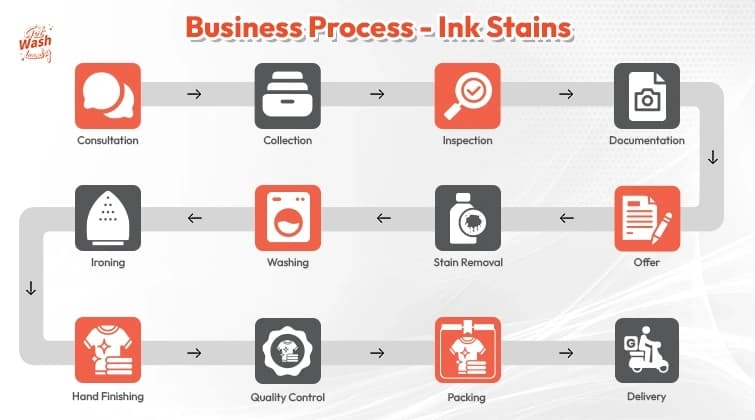
Removing ink stains professionally is about choosing the right solvent for the ink and fabric, then using it in a controlled way. Here is an outline of the process we follow.

Figure 7. Ink stain treatment process (ink-stain-treatment-process-getwash-en.png)
1. Inspection of ink type, material, and stain size
Every garment is inspected: the ink type based on your information and the look of the stain, the material from the label, the base colour, how far it has spread, and whether the stain has been washed or treated with anything. The condition is recorded before treatment.
2. Solvent test on a hidden area
Before any solvent is used on the stain, its reaction with the fabric is tested on a hidden area such as inside a seam. This test ensures the fabric's original colour and fibres are safe with the product to be used. If there is a reaction, the product or method is adjusted.
3. Pre-treatment
The stained area is prepared with a pre-treatment to loosen the ink from the fibres. SEITZ makes Purasol, a pre-treatment used to loosen stains before the main treatment and one that is safe for acetate silk. The choice of product is matched to the fabric.
4. Targeted spotting
Treatment is applied directly to the stained area using spotting techniques, not by soaking the whole garment. Getwash is an official distributor of professional spotting products from SEITZ (Germany) and A.L. Wilson (USA), and we use the same products in our own process. For stains soluble in water or solvent, including ink, SEITZ makes Quickol, which works best with a spotting gun. A.L. Wilson also has InkGo in its range. The choice of product and concentration is matched to the ink type, the fabric, and the test results. Product information is available on Getwash professional products.
5. Rinsing and washing suited to the material
Once the ink has been lifted as far as is safe, solvent residue is rinsed out thoroughly and the garment is washed according to its material, by wet cleaning or dry cleaning. For garments worn against the skin, the rinsing stage gets special attention so no residue is left behind.
6. Drying and final inspection
The garment is dried without excess heat and checked under good lighting. If some stain remains and the fabric is still safe, spotting can be repeated. If not, the result is reported as it is. This is why ink stain treatment adds about 3–5 days.
Why it adds 3–5 days
This extra time allows for staged treatment: inspection, solvent testing, pre-treatment, spotting, rinsing, and re-checking, with pauses so the fabric is not exposed to chemicals for too long at once. If you need your garment by a certain date, tell us from the start so the timing can be confirmed.
Why professional products are different
Household stain removers are designed to be safe for anyone, so their strength is limited and their scope is general. Professional spotting products are designed for specific stain types, used at measured concentrations and contact times, and some contain solvents that require ventilation, personal protection, and knowledge of how fabrics react. The difference is not only in the product but in how it is used.
Before and after records
The garment's condition is recorded before treatment and checked again afterwards, so there is a clear comparison. Ask Customer Service if you need photos of the condition before and after for your own records.
Work clothes and occasion wear
A shirt worn to an important meeting, a suit for a formal event, or a uniform that represents an institution should not be seen with an ink stain on the pocket. Getwash is trusted as the go-to laundry for government officials and high-profile clients because garments like these are handled one by one, with an honest explanation before work begins. Let us know if your garment is needed by a certain date so the schedule can be confirmed.
How to prevent ink stains

Figure 8. How to prevent ink stains on clothes (how-to-prevent-ink-stains-on-clothes-getwash-en.png)
- Check every pocket before washing, including shirt, trouser, jacket, and school uniform pockets.
- Make sure pens are capped or retracted before putting them in a pocket or bag.
- Avoid keeping pens in white shirt pockets, especially in hot weather, because ink can seep.
- Choose pens that do not leak easily for your pocket, and throw away pens that start to seep.
- Give children a pencil case so pens and markers are not kept in uniform pockets.
- Keep permanent markers away from clothes when children draw or do crafts.
Habits at the office
If you usually carry a pen in your shirt pocket, choose a pocket with a protective lining or use a pocket protector, and make sure the pen is closed with the tip pointing up. Keep spare pens in a drawer or bag, not in your pocket. This simple habit avoids most ink stains on work shirts.
Tips for parents of schoolchildren
Children often keep pens and markers in uniform pockets and often forget to take them out. Teach children to empty their pockets before putting uniforms in the laundry basket, provide an easy-to-carry pencil case, and check uniform pockets yourself before washing. For craft activities, have them wear old clothes or an apron so the uniform is protected from permanent markers and paint.
Pens on planes and in hot weather
Changes in air pressure on a plane can make pens, especially liquid-ink pens and fountain pens, seep. Heat inside a car can also make ink thinner and more likely to leak. When travelling, keep pens in a small closed pouch in your bag, not in your shirt pocket.
Ink on bedsheets, fabric bags, and canvas shoes
Ink stains are not limited to clothes. A pen taken to bed can stain sheets and pillowcases, while fabric bags and canvas shoes often pick up pen or marker scribbles. For sheets and bedding there is bedsheet laundry; for canvas shoes and sneakers there is shoe cleaning. Mention the ink stain when you order so it can be assessed at the same time.
Myths about ink stains
- "Hairspray always removes ink." This remedy was popular when hairsprays contained a lot of alcohol. Many modern hairsprays leave a sticky residue that adds to the problem.
- "Just wash it in hot water." Hot water can spread ink and bond it more firmly to the fibres.
- "Scrub it with a brush until it goes." Scrubbing pushes ink deeper and widens the stain.
- "Bleach removes all ink stains." Bleach can damage original colour and fibres, and is not effective on every ink type.
- "Permanent marker can never come out." It is hard, but on fresh stains and the right fabric it can often be greatly reduced.
Caring for clothes after treatment
Clothes that have been successfully treated can be cared for as usual according to their label. If a faint mark remains, avoid ironing that area at high heat, because heat can make remaining pigment more visible. If the same garment gets ink on it again, tell us about the earlier treatment so the team can choose the right method.
Our experience
Shirts with a blue line on the breast pocket, school uniforms with marker scribbles, tailored trousers with ink seeping from a pen left in the pocket, and a whole load dotted with blue because one pen went through the wash: these are the cases we receive most often. Cases brought in quickly and not yet washed often end very well. Cases that have been rubbed, treated with various remedies, and then ironed are much harder. The lesson is always the same: do not rub, do not dry, do not experiment, and bring it in quickly. This pattern holds for almost every ink type we encounter.
A summary to remember
- Do not rub, do not wash it yet, do not dry or iron it.
- Blot up the excess ink from the outside in.
- Know the ink type and tell us when you hand over the garment.
- Bring it in within the first 5 days for the best chance.
- Request the ink stain add-on when you order; it is not automatic.
Why choose a laundry with spotting expertise
Most wash-and-fold laundries wash clothes with detergent and machines, without a dedicated spotting stage for stains such as ink. Getwash treats stains with professional spotting products that we use and distribute ourselves, with inspection and testing before treatment. The difference shows most on difficult stains, such as ink on a white shirt or a uniform that has to be worn again tomorrow.
Service hours and location
Customer Service hours: Monday–Friday 09.00–17.00, Saturday 09.00–15.00, closed on Sundays. Our main outlet is at Jl. Ceger Raya No.42, Jurang Mangu Barat, Kec. Pd. Aren, Kota Tangerang Selatan, Banten 15222. We serve customers in Pondok Aren, Bintaro, BSD, Ciledug, South Jakarta, and the surrounding area. If you are looking for laundry near me that can handle ink stains, send a photo of your garment first.
Has ink just got on your clothes? Contact WhatsApp 0812-6610-0500 now, order through the order page, or follow us on Instagram, TikTok, Facebook, and Threads.
FAQ: Questions About Ink Stains and the Getwash Service
What is the Getwash ink stain service?
An add-on service for clothes and fabric items stained by pen, marker, printer ink, or other inks, treated with inspection, a solvent test, and targeted spotting using professional spotting products.
Is it automatically included in regular laundry?
No. Ink stain removal is an add-on that must be requested when you order, because it needs inspection and special treatment.
How much does ink stain removal cost?
Ink Minor Rp50,000 and Ink Major Rp70,000 per item, added to the washing service. The category is confirmed after inspection.
Can ink stains be removed 100%?
There is no 100% guarantee. Results depend on the ink type, the fabric, the age of the stain, and what has already been done to the garment.
What is the success rate for fresh ink stains?
Fresh ink stains under 5 days old can usually be lifted 75–90%, based on our treatment experience.
What about older ink stains?
Stains over 5 days old fall in the 30–60% range, and lower if they have been washed, dried, or ironed. The team will assess and explain the chances first.
Which fabrics can be treated?
Cotton, linen, polyester, denim, silk, and wool can be treated, with different methods and levels of risk for each. Every fabric is tested first on a hidden area.
How long does it take?
Ink stain treatment adds about 3–5 days to the normal washing time.
How do I order the ink stain service?
Send a photo of the stain to WhatsApp 0812-6610-0500 and request the ink stain add-on, then schedule pickup or drop it at the outlet. Do not wash or dry the garment beforehand.
Can permanent marker be removed?
Permanent marker is among the hardest. On fresh stains and the right fabric, it can often be greatly reduced, but a faint shadow sometimes remains.
What should I do if a pen leaks in the washing machine?
Stop before drying, take out all the laundry, find the pen, separate stained clothes, clean the drum, then bring the stained clothes in quickly.
How much is pickup and delivery?
Since 20 June 2026: Zone 1 (0–3 km) Rp8,000, Zone 2 (3–7 km) Rp15,000, Zone 3 (over 7 km) Rp22,000 per trip.
What are Getwash Customer Service hours?
Monday–Friday 09.00–17.00 and Saturday 09.00–15.00. Closed on Sundays. Messages can be sent at any time and are answered during the next service hours.
Sources
- Getwash Laundry ink stain removal service page
- Getwash Laundry Noda Tinta page (ID)
- Getwash Products page (SEITZ and A.L. Wilson)
- Getwash Laundry tracking page
- New Policy Notice: Pickup & Delivery Rates (effective 20 June 2026)