Helmet Cleaning Service
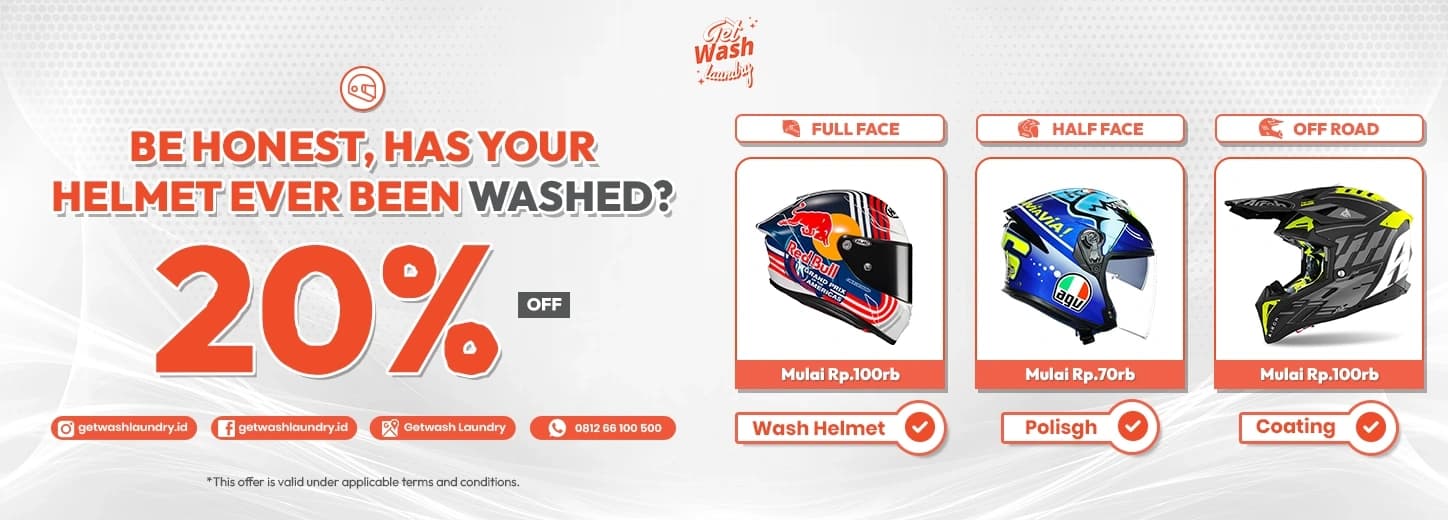
- Half Face - Deep CleanRp 70.000
- Half Face - Deep Clean & PolesRp 100.000
- Half Face - Deep Clean, Poles & Soft CoatingRp 150.000
- Full Face - Deep CleanRp 100.000
- Full Face - Deep Clean & PolesRp 135.000
- Full Face - Deep Clean, Poles & Soft CoatingRp 175.000
Contact us to schedule your order
09:00-20:00 (Weekday) & 09:00-17:00 (Weekend)
Ulasan Pelanggan
- Tes5.0
Layanan Laundry Helm ini hasilnya bersih maksimal. Saya puas dan akan memakai lagi.
- Imrano Briliand Mgb5.0
Helm wangii dan bersih tks Get Wash Loundry👍👍
- Janu Setiawan5.0
Layanan pencucian helm paling recommended. Pengerjaan cepat, bagian dalam busa dicuci higienis, dan kotoran debu pada ventilasi udara hilang bersih. Senang sekali menemukan penyedia jasa yang jujur dan mengutamakan kualitas.
- Joko Esthi Wuryanto5.0
Layanan Laundry Helm ini hasilnya bersih maksimal. Sangat direkomendasikan.
- Janu Setiawan5.0
Layanan pencucian helm paling recommended. Pengerjaan cepat, bagian dalam busa dicuci higienis, dan kotoran debu pada ventilasi udara hilang bersih. Senang sekali menemukan penyedia jasa yang jujur dan mengutamakan kualitas.
- Joko Esthi Wuryanto5.0
Layanan pencucian helm paling recommended. Pengerjaan cepat, bagian dalam busa dicuci higienis, dan kotoran debu pada ventilasi udara hilang bersih. Senang sekali menemukan penyedia jasa yang jujur dan mengutamakan kualitas.
- Tes5.0
Layanan pencucian helm paling recommended. Pengerjaan cepat, bagian dalam busa dicuci higienis, dan kotoran debu pada ventilasi udara hilang bersih. Senang sekali menemukan penyedia jasa yang jujur dan mengutamakan kualitas.
- EDIS5.0
Layanan pencucian helm paling recommended. Pengerjaan cepat, bagian dalam busa dicuci higienis, dan kotoran debu pada ventilasi udara hilang bersih. Senang sekali menemukan penyedia jasa yang jujur dan mengutamakan kualitas.
- M. IRFAN MARDIAN5.0
Layanan pencucian helm paling recommended. Pengerjaan cepat, bagian dalam busa dicuci higienis, dan kotoran debu pada ventilasi udara hilang bersih. Senang sekali menemukan penyedia jasa yang jujur dan mengutamakan kualitas.
- HERI PRIYO VANDOKO5.0
Layanan pencucian helm paling recommended. Pengerjaan cepat, bagian dalam busa dicuci higienis, dan kotoran debu pada ventilasi udara hilang bersih. Senang sekali menemukan penyedia jasa yang jujur dan mengutamakan kualitas.
Getwash Helmet Cleaning: Why Helmets Quickly Smell and Itch, the Dirtiest Parts of a Helmet, Deep Clean, Polish, and Soft Coating Packages for Half Face and Full Face, and How to Care for a Helmet So It Stays Clean and Safe to Wear
By the Getwash Laundry Team | Updated 6 November 2026 | Reading time ±27 minutes
|
QUICK ANSWER Getwash cleans half face and full face helmets in three packages: Deep Clean (half face Rp70,000, full face Rp100,000), Deep Clean & Polish (Rp100,000 / Rp135,000), and Deep Clean, Polish & Soft Coating (Rp150,000 / Rp175,000). Cleaning covers the shell, visor, padding and foam, and straps, using techniques that are safe for the foam and protective liner inside the helmet. A helmet worn every day should be deep cleaned every few weeks to every few months, depending on how much sweat and dust it collects. Contact WhatsApp 0812-6610-0500; service hours are Monday–Friday 09:00–17:00 and Saturday 09:00–15:00, closed Sunday. |
For millions of riders in Greater Jakarta, a helmet is something worn every day, often for longer than their shoes. It sits on the head for one to two hours of commuting, absorbing sweat, hair products, make-up, road dust, and exhaust fumes. Then it is left on a hot seat or hung on a mirror until the next ride. No wonder so many helmets start to smell musty, feel sticky, and even make the scalp itch.
This article covers Getwash's helmet cleaning service in full: the parts of a helmet and what they do, why helmets get smelly and dirty so quickly, how often a helmet needs cleaning, the mistakes people make cleaning helmets at home, the difference between the Deep Clean, Polish, and Soft Coating packages and their prices, the cleaning process, everyday helmet care, and when a helmet should be replaced for safety. Start from the table of contents below.
Table of Contents
1. Getwash Helmet Cleaning: Who It Is For and What Gets Cleaned
2. The Parts of a Helmet and What They Do
3. Why Helmets Smell, Itch, and Look Dull So Quickly
4. Helmet Cleaning Packages and Prices: Deep Clean, Polish, and Soft Coating
5. The Helmet Cleaning Process and How to Order
6. Everyday Helmet Care and When to Replace It
Getwash Helmet Cleaning: Who It Is For and What Gets Cleaned
Helmet cleaning is a thorough cleaning service for the outside and inside of a helmet, including the shell, visor, padding, foam, and straps, so the helmet comes back clean, fresh, and hygienic. Getwash handles the two main helmet types listed on the service page, half face and full face, each with three package options.
Who needs it most
- Daily commuters who wear a helmet one to two hours a day in heat and road dust.
- Riders who share helmets with a partner, children, or other family members.
- Touring riders and motorcycle clubs who ride long distances and often get caught in the rain.
- Owners of premium helmets who want care that is safe for the shell, paint, and visor coatings.
- Motorbike and helmet rental businesses, including in tourist areas, where helmets are worn by many different people.
- Offices and institutions with operational helmets shared among staff.
Helmets we handle
The service page lists packages for half face and full face helmets. Our service guide also mentions modular and open face helmets, and a range of local and imported brands sold in Indonesia. For helmets with special construction, such as modular helmets with a hinged chin bar, off-road helmets with a peak, or helmets fitted with a communication device, send photos first so the team can confirm the right package and price.
The working standards we hold ourselves to
Every helmet is inspected before any cleaner touches it, removable components are handled separately, products are chosen for each part of the helmet, and the helmet is dried completely before reassembly. We do not use harsh solvents on the inside of a helmet, and we do not speed up drying with excessive heat. The principle is simple: the helmet must come back clean without compromising the materials that protect your head.
Helmets for high-profile customers
Some of our customers are officials, executives, and public figures who go touring at weekends with valuable premium helmets. Helmets like these often have special paint, limited-edition graphics, and visors with anti-fog or anti-scratch coatings. They choose Getwash because helmets are handled with care, everything can be arranged on WhatsApp with pickup and delivery, and customer confidentiality is protected.
Why a hose-down at the bike wash is not enough
Many riders clean their helmet while their motorbike is being washed, with a pressure spray and vehicle soap. This only cleans the outside surface, while the padding, foam, and straps that cause the smell are not properly cleaned. A pressure spray can also force water deep into the foam and gaps, leaving the helmet damp for days. Some vehicle soaps are not designed for fabrics that touch the skin directly.
About helmet brands
Getwash is an independent care provider, not an authorised service centre for any helmet brand. Our service is cleaning and cosmetic care, not safety testing or helmet certification. If your helmet needs official replacement parts, such as replacement padding, a visor, or a locking mechanism, use parts from the manufacturer or its official distributor.
Confidentiality and items left behind
Helmets often come in with small items tucked away, such as parking cards, cash, earphones, or glasses in the helmet bag. Our team checks inside the helmet and its bag during inspection, and anything found is kept separately and returned with the helmet. We do not publish photos of customers' helmets without permission.
What we do not promise
We do not promise a helmet will come back like new. Deep scratches in the shell, chipped paint, foam broken down with age, and deeply scratched visors cannot be removed by cleaning or polishing. Nor do we judge whether a helmet is still safe after a fall or impact. What we do promise is cleaning that respects the helmet's materials, and an honest assessment if we see anything you should be aware of.
“A helmet is the one piece of clothing we wear every day yet almost never wash.” — Observation from the Getwash team
The Parts of a Helmet and What They Do
A helmet is not just a hard shell. It is made of several layers with different jobs, and each part needs a different cleaning approach.

Figure 1. Parts of a helmet and what they do (bagian-bagian-helm-dan-fungsinya-getwash-en.png)
Outer shell
The shell is the hard outer layer that spreads impact forces and protects against sharp objects. It is usually made of hard thermoplastic, or of composite materials such as fibreglass on more premium helmets. The shell is coated with paint and lacquer that can dull, scratch, or discolour in sunlight.
Impact-absorbing liner
Behind the shell is a layer of rigid foam, usually expanded polystyrene, known as EPS. This liner absorbs impact by crushing or compressing in a crash. It is crucial for safety, and it can be damaged by solvents such as petrol, thinner, or harsh chemical cleaners. That is why a helmet must not be cleaned with just any liquid.
Comfort padding and foam
The padding is soft foam wrapped in fabric that rests against the head and cheeks. It absorbs the most sweat, hair oil, and dead skin, making it the main source of odour. On many helmets the padding is removable; on others it is glued or sewn in permanently and has to be cleaned in place.
Visor
The visor protects the eyes and face from wind, dust, insects, and rain. Many visors have anti-scratch or anti-fog coatings that are easily damaged by ordinary glass cleaners containing ammonia or alcohol, and by rough cloths. A scratched or cloudy visor impairs vision, especially at night and in the rain.
Chin strap and fastener
The chin strap keeps the helmet on in an impact. It absorbs sweat from the neck and chin, so it is often the smelliest part. The fastener, whether a click buckle or double D-ring, needs to keep working properly and stay free of rust.
Chin guard and breath deflector
On full face helmets, the chin area often has padding and a breath deflector that directs exhaled air so the visor does not fog. This area is hit by breath and moisture every time the helmet is worn, so it easily becomes damp and smelly if not cleaned.
Vents
Vents help air circulate so the head does not overheat. They can be clogged with dust, insects, and dirt, reducing airflow so the head sweats sooner.
Padding materials
Helmet padding usually consists of soft foam wrapped in fabric such as mesh, smooth synthetic fabric, or a moisture-wicking fabric. Foam that has been used for a long time can thin and lose its springiness, so the helmet feels looser. The fabric covering can tear or pill where it rubs against hair and ears.
Visor mechanism and anti-fog inserts
The visor is mounted on a hinge mechanism on each side of the helmet, and many helmets have a tool-free visor release. Some visors have an anti-fog layer or an extra inner lens held in place by small pins. Mechanisms and inserts like these need to be removed and refitted carefully so they do not break or sit crooked.
Modular, open face, and off-road helmets
Modular helmets have a chin bar that lifts on hinges and latches, so there are more joints that collect dust and need a function check. Open face helmets have a more open interior that dries faster, but their visors are often more prone to scratches. Off-road helmets have a peak and are usually worn with separate goggles. Each type needs some adjustment in how it is cleaned.
Why each part needs a different method
The shell can be cleaned with mild soap, but the EPS liner must not touch solvents. Padding needs cleaning that lifts sweat and bacteria from deep in the foam, but without damaging the foam or the glue that holds it. The visor needs a cleaner that is safe for its coating. That is why a helmet should not be cleaned all at once in one way, and certainly not soaked whole.
Why Helmets Smell, Itch, and Look Dull So Quickly
A helmet is an ideal environment for bacteria and mould: warm, damp, dark, and full of sweat. Here are the problems we see most and their causes.

Figure 2. Why helmets get smelly and dirty (penyebab-helm-bau-dan-kotor-getwash-en.png)
Early signs that are easy to miss
Helmet problems usually start with small signs: a faint smell when you put the helmet on in the morning, padding that feels slightly tacky, forehead fabric starting to discolour, or a visor that leaves streaks when wiped. At this stage the helmet is still relatively easy to clean. Left for months, the smell becomes permanent, mould appears, and the foam deteriorates faster.
Musty odour
Helmet odour comes from bacteria breaking down the sweat and skin oils that soak into the padding and straps. A hot, humid climate speeds this up. The smell is usually strongest after the helmet has been worn on a hot day or caught in the rain, then stored before it could dry.
Itchy scalp and forehead breakouts
Dirty padding holds bacteria, dead skin, and oil residue that touch the scalp, forehead, and cheeks every day. Many riders notice a more itchy scalp or breakouts where the helmet presses. Cleaning your helmet regularly is a simple hygiene step. If skin complaints persist, see a doctor.
Shared helmets
Helmets worn by more than one person, such as a passenger helmet at home, rental helmets, or office helmets, collect sweat and oil from many heads. Besides smelling sooner, many people feel uncomfortable wearing a helmet someone else has just worn. Regular cleaning, plus a thin personal or disposable head liner, makes shared helmets more hygienic.
Hair product and make-up residue
Hair oil, gel, pomade, sunscreen, and foundation stick to the forehead and cheek padding. This residue makes the padding feel sticky, discolours it, and attracts dust. On full face helmets, the cheek and chin areas are often the dirtiest because they touch the face directly.
Mould
A helmet stored damp, for example after rain and then straight into a cupboard or under-seat storage, can grow mould on its padding and straps. The first signs are white or black spots and a very sharp smell.
Cloudy, streaky visors
Visors go cloudy from dust, insect remains, finger oils, and fine scratches from being wiped with dirty cloths or rough tissue. Fine scratches scatter the light from oncoming headlights, making night riding more dazzling.
Dull, yellowing shells
Sunlight, exhaust fumes, and dust strip the shell's paint of its shine. White or light-coloured helmets can look yellowed. Fine scratches from everyday handling add to the dull look.
Road dust, fumes, and heat
Road dust and exhaust fumes stick to the shell and get in through the vents, then mix with sweat inside. A helmet left on a sun-baked seat or in a hot under-seat compartment also goes through repeated high temperatures. Heat speeds up the release of odour and, over time, the ageing of materials, including the glue that holds the padding.
How often a helmet needs cleaning

Figure 3. How often to clean a helmet (seberapa-sering-helm-dibersihkan-getwash-en.png)
There is no fixed rule, but these practical benchmarks help. Wipe the visor and shell after every ride, especially to remove insects and dust. Air the inside of the helmet every day. For a thorough clean, daily commuters in a hot climate generally need one every few weeks to every few months, while rarely used helmets can go longer. Clean a helmet straight away if it smells, after rain if it could not dry, or before someone else wears it.
What is safe to do at home
Some things are safe to do at home between deep cleans: wiping the shell with a damp cloth and mild soap, cleaning the visor with clean water and a microfibre cloth, hand-washing padding that is designed to be removed in cold water as the manufacturer instructs, and airing the helmet every day. What to avoid is soaking the whole helmet and using unknown chemicals.
Mistakes when cleaning a helmet at home

Figure 4. Mistakes when cleaning a helmet at home (kesalahan-mencuci-helm-sendiri-getwash-en.png)
- Cleaning with petrol, thinner, or solvents. These can damage the impact-absorbing liner and the shell's paint, even when the damage is not visible from outside.
- Soaking the whole helmet. The EPS liner and padding glue can stay waterlogged too long, and the helmet takes a very long time to dry fully.
- Drying with excessive heat, such as a hot hair dryer, near the exhaust, or inside a sun-baked car.
- Drying in hot sun for long periods, which speeds up paint fading and material ageing.
- Using ordinary glass cleaner on the visor, which can damage anti-fog or anti-scratch coatings.
- Just spraying fragrance without cleaning, so the smell is masked for a while but the bacteria remain.
If you have already tried cleaning the helmet yourself, say what you did when you order. This helps the team assess the helmet's condition.
Helmet Cleaning Packages and Prices: Deep Clean, Polish, and Soft Coating
Getwash's service page lists three packages for each helmet type. Here are the full prices.

Figure 5. Half face and full face helmet cleaning prices (tarif-laundry-helm-half-face-full-face-getwash-en.png)
Half face
- Deep Clean: Rp70,000
- Deep Clean & Polish: Rp100,000
- Deep Clean, Polish & Soft Coating: Rp150,000
Full face
- Deep Clean: Rp100,000
- Deep Clean & Polish: Rp135,000
- Deep Clean, Polish & Soft Coating: Rp175,000
The page does not yet list turnaround times or detailed descriptions of each package. Confirm via WhatsApp 0812-6610-0500 before handing your helmet over.
Deep Clean
This base package focuses on thorough cleanliness: the shell, visor, padding, foam, straps, and vents are cleaned to lift dirt, sweat, and odour. It suits helmets whose outside still looks good but whose inside smells or is dirty.
Deep Clean & Polish
Besides thorough cleaning, the shell is polished to help restore its shine and soften fine scratches in the paint surface. This package suits helmets whose shell has started to look dull. Note that polishing only helps with fine surface scratches; deep scratches through the paint will not disappear.
Deep Clean, Polish & Soft Coating
The full package adds a protective layer after the shell is cleaned and polished. Coatings like this generally aim to help preserve shine and make dirt less likely to stick. The page does not yet explain the type or durability of the soft coating used, so ask Customer Service if you want more detail.
Choosing the right package
- New or still glossy helmet with a smelly inside: Deep Clean.
- Everyday helmet whose shell is starting to look dull: Deep Clean & Polish.
- Premium or treasured helmet you want looking its best: Deep Clean, Polish & Soft Coating.
- Helmet with matte paint: ask first about polishing and coating, because a matte finish is not meant to shine.
Helmets for the whole family
Many families own several helmets: the rider's, the passenger's, and the children's. Handing them all over in one pickup saves on delivery fees and means every helmet at home is clean at the same time. Mark or tell us whose helmet is whose so they are easy to identify on return.
Matte helmets and special graphics
Helmets with matte paint, and helmets with particular stickers and graphics, need special attention. Polishing a matte surface can make parts of it slightly glossy. Tell us the type of paint on your helmet when you order, and the team will suggest a suitable package.
Why full face costs more
A full face helmet has a larger interior, including cheek pads, a chin guard, and often a breath deflector or extra chin curtain. Its visor is also larger and its mechanism more complex. More parts are taken apart, cleaned, dried, and refitted, so the work takes longer than for a half face helmet.
Helmets in special condition
Heavily mouldy helmets, padding that is starting to crumble, helmets splashed with paint or chemicals, or helmets with electronics fitted may need special handling. Send photos of the condition before handing it over, so the team can tell you what is realistic and whether there is anything else to consider.
Worked examples
- One full face helmet for a daily commuter, Deep Clean: Rp100,000.
- Two family half face helmets, Deep Clean & Polish: Rp100,000 × 2 = Rp200,000.
- One full face touring helmet and one half face, full package: Rp175,000 + Rp150,000 = Rp325,000.
The examples above do not include pickup and delivery. The final cost is confirmed after the helmet is inspected.
For rental businesses and offices
Motorbike rental businesses, offices with operational helmets, and motorcycle clubs bringing many helmets at once can ask Customer Service about regular scheduling. Send the number and types of helmets so the need can be assessed. For wider business needs, see also our B2B laundry service.
When the cost may differ
The prices above apply to cleaning under each package. If a helmet needs handling beyond the package, such as heavy mould or another special condition, the team will tell you first. No extra work is done without your approval.
Pickup and delivery fees
Since 20 June 2026, pickup and delivery is charged per trip based on distance from the nearest outlet: Zone 1 (0–3 km) Rp8,000, Zone 2 (3–7 km) Rp15,000, and Zone 3 (over 7 km) Rp22,000. You can also drop off at our outlet at Jl. Ceger Raya No.42, Jurang Mangu Barat, Kec. Pd. Aren, Kota Tangerang Selatan, Banten 15222.
The Helmet Cleaning Process and How to Order
Every helmet goes through the same workflow, adjusted for the helmet type and the chosen package.

Figure 6. Helmet cleaning process (proses-laundry-helm-getwash-en.png)
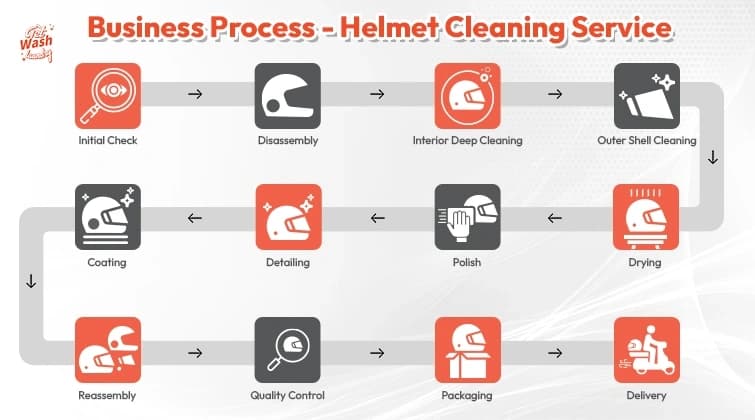
1. Inspection
The helmet is inspected to identify its type, materials, paint condition, visor condition, whether the padding is removable, and any existing damage. If there are signs of structural damage, such as a cracked shell or a dented liner, the team will let you know.
2. Removing components
Padding, cheek pads, and visors designed to be removed are taken off carefully so they can be cleaned separately and thoroughly. Permanent components are cleaned in place.
3. Cleaning padding and straps
Padding, foam, and straps are cleaned to lift sweat, oil, and bacteria from deep in the fibres and foam, using techniques that are safe for the foam so it does not crumble or lose its shape.
4. Cleaning the shell, visor, and vents
The shell is cleaned of dust, insects, and marks. The visor is cleaned with products safe for its coating. The vents are cleared of debris.
5. Drying
The padding and inside of the helmet are dried thoroughly without excessive heat. Complete drying is essential so odour and mould do not return, and this stage cannot be rushed.
6. Polish, coating, and final check
Depending on the package, the shell is polished and given a protective coating. Components are refitted, the fastener and strap are checked, and the helmet is inspected in full before packing. Track your order on the tracking page.
Why drying takes time
Padding foam absorbs water deep inside, and the inside of a helmet has many gaps that air struggles to reach. If a helmet is reassembled before it is completely dry, the remaining moisture will cause odour and mould within days. Drying with high heat is faster, but risks damaging the foam, glue, and liner inside the helmet. That is why we dry helmets gradually and thoroughly.
If damage is found
During cleaning, the team may find things that were not visible before, such as fine cracks in the shell, a dented liner behind the padding, or a worn strap fastener. We will tell you about findings like these, with photos, because they concern safety. The decision to keep using or replace the helmet remains yours.
Turnaround
The service page does not yet list a turnaround time. Our service guide says about 5–7 days for helmet cleaning. Because helmets are often worn daily, many customers use a spare helmet while their main one is being cleaned. Let us know if you need the helmet by a particular date.
How to order

Figure 7. How to order helmet cleaning (cara-pesan-laundry-helm-getwash-en.png)
- Photograph the helmet from the front, side, and inside.
- Send it via [WhatsApp 0812-6610-0500](https://wa.me/6281266100500) with the helmet type, half face or full face.
- Choose a package: Deep Clean, Deep Clean & Polish, or the full package with Soft Coating.
- Schedule a pickup via the order page, or drop it at the outlet yourself.
- Use a spare helmet while yours is being cleaned.
- Track the status on the tracking page and receive your helmet back.
Information worth sharing
Besides photos, tell us the helmet's brand and model if you know them, the paint type (glossy or matte), whether the padding is removable, your main concern such as odour, mould, or a cloudy visor, and whether you have washed it yourself before. This helps the team prepare the right treatment.
Preparing your helmet before handing it over
Remove accessories that do not need cleaning, such as action cameras, communication units, or extra head liners. If the helmet has a tinted or spare visor, say whether you want it cleaned too. If the helmet is still wet from rain, let it dry in the shade first, or mention its condition when you order. Include the helmet bag if you have one.
While your helmet is with Getwash
While your helmet is being cleaned, use a spare helmet that fits and meets the SNI standard. Do not ride without a helmet or borrow one that is too big, because a helmet that does not fit does not protect you as it should. Safety on the road comes first, and a good spare helmet is a small investment in it.
When you get your helmet back
Check the helmet in good light: the shell, visor, padding, straps, and fastener. Put it on and make sure it fits as usual. If anything feels different or you have a question, contact Customer Service promptly.
Everyday Helmet Care and When to Replace It
Small daily habits keep a helmet cleaner for longer and stretch the time between deep cleans.

Figure 8. Everyday helmet care (cara-merawat-helm-sehari-hari-getwash-en.png)
Air it after riding
After riding, leave the helmet in a shaded, breezy spot with the inside open, rather than putting it straight into the under-seat compartment or a closed cupboard. This lets sweat evaporate before bacteria can multiply.
Wipe the visor properly
Clean the visor with clean water and a soft microfibre cloth. For dried insects, soften them first with a damp cloth for a moment so they lift easily, then wipe without pressing hard. Avoid rough tissue, dirty rags, and ordinary glass cleaner.
Wear a thin head liner
A thin head liner or balaclava absorbs most of the sweat and oil before it reaches the padding. It is far easier to wash every day than the helmet. This helps daily riders and shared helmets in particular.
Store it properly
Store the helmet somewhere shaded, dry, and ventilated, away from direct sunlight, engine heat, and chemicals such as petrol or paint. Do not hang the helmet on the mirror or handlebar, as the inside can be compressed and deformed, and the helmet can easily fall.
Do not leave it just anywhere
A helmet that falls off a seat or table can suffer damage you cannot see. Put it on a stable surface, ideally where it cannot roll. Avoid leaving it on a sun-baked seat for long.
When your helmet gets rained on
If your helmet gets wet in the rain, remove any removable padding, wipe the shell and visor, then let every part dry naturally in a shaded, breezy spot. Do not use a hot dryer or place it near the exhaust. Make sure it is completely dry before storing or wearing it again.
About fragrance and antibacterial sprays
Helmet-specific fragrance or antibacterial sprays can help freshen the inside between cleans, as long as the product is designed for helmets and used as directed. But a spray is no substitute for cleaning: the sweat and oil built up in the padding are still there and will smell again. Avoid spraying so much that the padding gets wet, and let the helmet dry before wearing it. Do not use solvent-based sprays with unclear ingredients.
A simple care routine
- After every ride: wipe the visor and air the inside.
- Every week: wipe the shell, check the strap and fastener, clear dust from the vents.
- Every few weeks: wash your head liner and removable padding, or hand it in for a deep clean.
- Every few months: check the foam, shell, and visor thoroughly.
When touring
On long rides, a helmet faces more sweat, dust, insects, and often rain. Carry a small microfibre cloth for the visor, use a head liner you can change daily, and air the helmet at every rest stop. After a tour, the helmet is best deep cleaned soon before it is stored, so sweat and moisture do not turn into odour and mould.
Long-term storage
If a helmet will not be used for a long time, clean it first, make sure it is completely dry, then store it in a ventilated fabric helmet bag. Avoid sealed plastic bags. Keep it somewhere cool and dry, and take it out now and then to air.
When a helmet must be replaced

Figure 9. When a helmet must be replaced (kapan-helm-harus-diganti-getwash-en.png)
Cleaning makes a helmet clean and comfortable, but it does not restore its ability to protect your head. A helmet needs replacing, not just cleaning, in these situations:
- After an impact or crash, even if it looks fine from the outside. The impact-absorbing liner may already be compressed and no longer work as it should.
- A cracked shell, or a liner that looks dented or crushed.
- A damaged strap or fastener that no longer holds the helmet securely.
- Inner foam that has crumbled so the helmet feels loose or shifts.
- A helmet that is many years old. Many manufacturers and safety bodies recommend replacing a helmet about five years after it is first used, because materials age even if the helmet has never been hit. Follow your helmet manufacturer's guidance.
- A helmet that no longer fits and moves easily when you shake your head.
SNI-standard helmets
In Indonesia, motorcycle riders and passengers are required to wear helmets that meet the Indonesian National Standard (SNI). When buying a new helmet, make sure it carries a valid SNI mark, fits properly, and has a strap that can be tightened well. Cleaning at Getwash does not change a helmet's standard status, and we do not provide safety assessments or certification.
Choosing a new helmet that fits
When it is time to replace your helmet, choose an SNI-standard helmet in the right size: it should sit snugly all round the head without painful pressure points, not move when you shake your head, and the strap should tighten to leave about one or two fingers' space under the chin. Consider ventilation for a hot climate, removable padding for easy cleaning, and a clear, easily replaceable visor.
Keep a spare helmet
For daily riders, a spare helmet helps a great deal. The main helmet can be cleaned, or dried fully after rain, while the spare stays in use. Alternating gives both helmets time to dry and makes them last longer.
Children's helmets
Children riding pillion also need a helmet that fits their head, not an adult helmet that is too big. Children's helmets often get dirty faster from sweat and food, and need replacing as the child's head grows. Cleaning children's helmets regularly helps keep their scalps clean.
Other riding gear
Besides helmets, riding jackets, gloves, and shoes also absorb sweat and dust. Leather jackets can be looked after through leather jacket care, shoes through shoe cleaning, and touring gear such as bags through outdoor gear cleaning. All of them can be combined in a single pickup.
Our experience
Commuter full face helmets smelling strongly after the rainy season, half face helmets shared by a whole family, touring helmets with visors covered in insects, and premium helmets with paint starting to dull: these are the cases we see most. Most can be made clean, fresh, and comfortable again. For conditions that cleaning cannot fix, such as crumbled foam or a deeply scratched visor, we say so honestly at inspection.
Service hours and location
Customer Service hours: Monday–Friday 09:00–17:00, Saturday 09:00–15:00, closed Sunday. Our main outlet is at Jl. Ceger Raya No.42, Jurang Mangu Barat, Kec. Pd. Aren, Kota Tangerang Selatan, Banten 15222. We serve Pondok Aren, Bintaro, BSD, Ciledug, Ciputat, South Jakarta, and surrounding areas. If you are searching for laundry near me that can clean helmets, send us photos of your helmet first.
Is your helmet starting to smell? Contact WhatsApp 0812-6610-0500, order via the order page, or follow us on Instagram, TikTok, Facebook, and Threads.
FAQ: Helmet Cleaning
How much does helmet cleaning cost at Getwash?
Half face: Deep Clean Rp70,000, Deep Clean & Polish Rp100,000, full package with Soft Coating Rp150,000. Full face: Rp100,000, Rp135,000, and Rp175,000. The final cost is confirmed after inspection.
Which parts of the helmet are cleaned?
The shell, visor, padding, foam, cheek pads, chin strap, and vents. Padding and visors designed to be removed are cleaned separately, while permanent components are cleaned in place with techniques safe for the foam and glue.
What is the difference between Deep Clean, Polish, and Soft Coating?
Deep Clean cleans the helmet inside and out. Polish adds shell polishing to help restore shine and soften fine scratches. Soft Coating adds a protective layer after polishing. The page does not yet detail the coating type or durability; ask Customer Service for details.
Can helmet foam be damaged by cleaning?
Padding and foam are cleaned with foam-safe techniques and dried without excessive heat. Foam that has already crumbled with age cannot be restored, and we will tell you at inspection.
Can helmet odour be removed?
The odour comes from bacteria in the sweat and oil soaked into the padding and straps. Thorough cleaning and complete drying remove its source. Very long-standing odour may not disappear entirely from old foam.
Can a mouldy helmet be cleaned?
It can be assessed. Light mould on padding and straps can generally be cleaned. Long-standing mould can leave marks on the padding fabric.
How long does helmet cleaning take?
The page does not yet list a turnaround time. Our service guide says about 5–7 days, because the padding and inside of the helmet must dry fully without excessive heat. Use a spare helmet while yours is being cleaned.
Will polishing remove scratches from the shell?
Polishing helps soften fine scratches in the paint surface. Deep scratches through the paint will not disappear.
Can a matte helmet be polished?
Ask before choosing a package, because polishing a matte surface can make parts of it slightly glossy.
Can Getwash check my helmet's safety?
No. We clean and care for the helmet's appearance; we do not test safety or provide certification. If we see cracks or damage during cleaning, we will tell you. A helmet that has had an impact should be replaced, even if it looks fine.
When should a helmet be replaced?
After an impact or crash, if the shell is cracked, the foam has crumbled, the strap or fastener is damaged, or the helmet is many years old. Many manufacturers recommend about five years; follow your helmet manufacturer's guidance.
How much is pickup and delivery?
Since 20 June 2026: Zone 1 (0–3 km) Rp8,000, Zone 2 (3–7 km) Rp15,000, and Zone 3 (over 7 km) Rp22,000 per trip. You can also drop off at the outlet yourself.
What are Getwash Customer Service hours?
Monday–Friday 09:00–17:00 and Saturday 09:00–15:00. Closed Sunday. WhatsApp messages can be sent at any time and will be answered during the next service hours.
Sources
- Getwash Helmet Cleaning Service page (EN)
- Getwash Laundry Helm page (ID)
- Getwash Laundry tracking page
- New Policy Notice: Pickup & Delivery Rates