Diving Gear Cleaning
- Booties - Scubapro - DeltaRp 50.000
- Rash Guard - Scubapro - UPF50Rp 35.000
- BCD - Scubapro - Hydros XRp 250.000
- BCD - Scubapro - Hydros ProRp 200.000
- BCD - Donut OmsRp 250.000
- Wetsuite - Scubapro - YulexRp 100.000
- Wetsuite - Scubapro Hooded VestRp 75.000
- Wetsuite - Scubapro Hybrid Vest HoodedRp 75.000
- Wetsuite Pants - Scubapro Everflex 1.5mmRp 75.000
- Wetsuite Pants - Scubapro Hybrid CargoRp 140.000
- Wetsuite Tops - Scubapro EverflexRp 75.000
- Regulator - Scubapro - MK25Rp 350.000
- Regulator - Scubapro - MK19Rp 300.000
- Mask - Scubapro - D-MaskRp 40.000
- Mask - Scubapro - Synergy 2Rp 35.000
- Drybag - SuuntoRp 20.000
- Rash Guard - ScubaproRp 50.000
- Sock - AquaRp 30.000
- Towel - OceanariumRp 20.000
Contact us to schedule your order
09:00-20:00 (Weekday) & 09:00-17:00 (Weekend)
Ulasan Pelanggan
- Muhammad Tsany Zulfahmi5.0
Layanan Laundry Peralatan Diving ini hasilnya bersih maksimal. Saya puas dan akan memakai lagi.
- ADI LESMANA5.0
Layanan Laundry Peralatan Diving ini hasilnya bersih maksimal. Terima kasih atas pelayanannya.
- Antoni Sofyan5.0
Layanan pencucian alat selam yang sangat teliti. Bebas dari penumpukan kristal garam di resleting wetsuit dan bcd. Semua perlengkapan siap digunakan untuk trip menyelam berikutnya. Komunikasi sangat lancar dari awal pengajuan sampai pengerjaan selesai.
- EKO PURWANTO5.0
Layanan Laundry Peralatan Diving ini hasilnya bersih maksimal. Sangat direkomendasikan.
- Herman Piliang5.0
Layanan Laundry Peralatan Diving ini pengerjaannya rapi dan cepat. Layanan seperti ini yang saya cari.
- Antoni Sofyan5.0
Layanan pencucian alat selam yang sangat teliti. Bebas dari penumpukan kristal garam di resleting wetsuit dan bcd. Semua perlengkapan siap digunakan untuk trip menyelam berikutnya. Komunikasi sangat lancar dari awal pengajuan sampai pengerjaan selesai.
- EKO PURWANTO5.0
Layanan pencucian alat selam yang sangat teliti. Bebas dari penumpukan kristal garam di resleting wetsuit dan bcd. Semua perlengkapan siap digunakan untuk trip menyelam berikutnya. Komunikasi sangat lancar dari awal pengajuan sampai pengerjaan selesai.
- Muhammad Tsany Zulfahmi5.0
Layanan pencucian alat selam yang sangat teliti. Bebas dari penumpukan kristal garam di resleting wetsuit dan bcd. Semua perlengkapan siap digunakan untuk trip menyelam berikutnya. Komunikasi sangat lancar dari awal pengajuan sampai pengerjaan selesai.
- ADI LESMANA5.0
Layanan pencucian alat selam yang sangat teliti. Bebas dari penumpukan kristal garam di resleting wetsuit dan bcd. Semua perlengkapan siap digunakan untuk trip menyelam berikutnya. Komunikasi sangat lancar dari awal pengajuan sampai pengerjaan selesai.
- SOFIYAN DANI5.0
Layanan pencucian alat selam yang sangat teliti. Bebas dari penumpukan kristal garam di resleting wetsuit dan bcd. Semua perlengkapan siap digunakan untuk trip menyelam berikutnya. Komunikasi sangat lancar dari awal pengajuan sampai pengerjaan selesai.
Diving Gear Cleaning by Getwash: A Guide to Caring for Wetsuits, BCDs, Regulators, Masks, and Booties After a Dive, Understanding the Effects of Salt Water and Neoprene, Prices per Item, and Storing Your Gear So It Is Ready for the Next Trip
By the Getwash Laundry Team | Updated 5 November 2026 | Reading time ±28 minutes
|
QUICK ANSWER Getwash cleans diving gear per item: wetsuits from Rp75,000 to Rp140,000, BCDs from Rp200,000 to Rp250,000, regulators from Rp300,000 to Rp350,000, masks from Rp35,000 to Rp40,000, booties Rp50,000, rash guards from Rp35,000 to Rp50,000, and drybags, socks, and towels from Rp20,000. Every item is processed separately with low-pressure rinsing, cleaners suited to the material, and drying in a ventilated room away from direct sun. The service page states a return time of 5–7 working days. Pickup is charged by zone (Rp8,000, Rp15,000, or Rp22,000 per trip). Order through the order page or WhatsApp 0812-6610-0500; service hours are Monday–Friday 09.00–17.00 and Saturday 09.00–15.00, closed on Sundays. |
Every diver knows this moment: coming home from Bali, Komodo, Raja Ampat, or the Thousand Islands with a bag full of damp wetsuits, a BCD still holding sea water, and booties that are starting to smell. At the dive centre, the gear only had a quick dip in a shared rinse tank. At home, the bag ends up in a corner and is only opened again just before the next trip, when the wetsuit smells musty, there are white crystals on the BCD, and the zips have started to stick.
This article covers the Getwash diving gear cleaning service in full: what salt water, sun, and humidity do to scuba equipment, what materials make up wetsuits, BCDs, regulators, and masks, what each item costs, how the cleaning process works, which problems can and cannot be fixed, and how to look after your gear between trips. If you are looking for laundry near me that understands diving equipment, start with the table of contents below.
Table of Contents
1. Salt, Sun, and Humidity: Why Diving Gear Wears Out Quickly
2. Understanding Diving Gear Materials: Neoprene, Silicone, BCD Bladders, and Regulator Metal
3. Diving Gear Cleaning Prices per Item
4. The Cleaning Process for Each Type of Gear, and Turnaround
5. Common Problems: Odour, Mould, Salt Crystals, Yellowed Masks, Stuck Zips, and Stiff Neoprene
6. Caring for Gear After a Dive, for Dive Centres, and How to Order
7. FAQ: Questions About Getwash Diving Gear Cleaning
Salt, Sun, and Humidity: Why Diving Gear Wears Out Quickly
Scuba equipment is designed to work underwater, but most of its damage happens above water: when gear is left to dry with salt still on it, laid out under the tropical sun, or stored damp inside a bag. Understanding these three main enemies is the first step to caring for gear properly.

Figure 1. Effects of salt water on diving gear (effects-of-salt-water-on-diving-gear-getwash-en.png)
Salt water: it dries into crystals
Sea water contains salt that forms small crystals as it dries. These crystals build up in wetsuit seams, zip teeth, BCD valves, and the metal parts of regulators. Every time the gear is flexed or worn, those sharp crystals rub against fibres and rubber from the inside. Over time, seams weaken, zips jam, inflator buttons stick, and metal parts begin to corrode. This damage happens slowly, so it often goes unnoticed until the gear fails.
Tropical sun: the enemy of neoprene and silicone
Ultraviolet light damages neoprene, rubber, and silicone. A wetsuit that is often laid out on a boat deck or a guesthouse terrace loses its flexibility, fades, and develops fine surface cracks. Clear silicone mask skirts and regulator mouthpieces can turn yellow and sticky. In Indonesia the sun is strong almost all year round, so the habit of drying gear in direct sunlight speeds up its wear.
Humidity: mould and odour
Wetsuits, booties, and the inside of BCDs stored damp become an ideal home for bacteria and mould. Add sweat, skin cells, and, let us be honest, the urine that often happens during dives, and the smell can be very strong. Greater Jakarta's humid climate means gear dried indoors takes a long time to dry properly, giving mould time to grow.
“Diving gear rarely gets ruined in the sea; it gets ruined in the bag, left holding salt and moisture after the trip.” — Observation from the Getwash team
The dive centre rinse tank is not enough
Most dive centres provide a fresh water tank for dipping gear after a dive. It helps, but the water is shared by many divers and quickly becomes brackish after a few dips. A quick dip also does not clean the inside of a BCD bladder, the folds of a wetsuit, or the sweat in booties. The dive centre rinse is first aid, not a thorough clean.
From the Thousand Islands to Raja Ampat
Divers from Greater Jakarta have plenty of choice: the Thousand Islands and the Banten coast for weekend trips, Bali and Lombok for short holidays, and Komodo, Wakatobi, Bunaken, and Raja Ampat for longer trips. Each location brings its own challenges for gear. A liveaboard trip means gear stays wet for days on a boat. Sites with black volcanic sand leave fine grains in zips and booties. Several dives a day mean the wetsuit hardly ever dries until the trip is over.
Expensive gear, a long-term investment
A full set of personal scuba gear, wetsuit, BCD, regulator with octopus and gauge, mask, fins, and booties, is a major investment. Many divers buy it piece by piece over years, some of it abroad. Proper care after every trip makes this gear last years longer, and makes every dive more comfortable, because clean gear does not smell and does not irritate the skin.
Comfort and personal hygiene
A wetsuit sits directly against the skin for hours. A wetsuit that is not clean can cause irritation, itching, or rashes, especially for divers with sensitive skin. A regulator mouthpiece goes into the mouth, and a mask sits on the face. Clean gear is not just about lifespan; it is also about health and comfort on every dive.
Snorkelling and freediving need care too
It is not only scuba divers. Snorkellers and freedivers also bring home masks, snorkels, long fins, rash guards, and thin wetsuits exposed to just as much salt and sun. Freedivers often use open-cell wetsuits that are softer and more prone to tearing, so they need even more careful handling. The principles are the same: rinse in fresh water, clean the inside, and dry away from direct sun.
Who needs this service most
- Recreational divers just back from a trip who have not had time to care for their gear properly.
- Occasional divers, whose gear is stored for months between trips.
- Owners of gear that has started to smell or grow mould, especially wetsuits and booties.
- Busy divers in executive roles, who want their gear always ready without having to look after it themselves.
- Dive centres, dive schools, and dive clubs that manage large amounts of rental gear.
- Divers about to sell used gear in clean, presentable condition.
Getwash is known as the go-to laundry for government officials and high-profile clients, and many of them are divers who only have time to dive on holiday. For them, gear that is collected, cleaned, and returned ready to use means one less thing to think about before the next trip.
Understanding Diving Gear Materials: Neoprene, Silicone, BCD Bladders, and Regulator Metal
Scuba equipment is made of very different materials, and each needs different treatment. That is why diving gear cannot be washed in a washing machine like ordinary clothes.
Neoprene: rubber full of air bubbles
Wetsuits, booties, hoods, and dive gloves are usually made of neoprene, a synthetic rubber filled with millions of tiny air bubbles. Those bubbles provide the warmth. Neoprene is sensitive to hot water, harsh detergents, bleach, dryer heat, and sunlight. Hot water and wringing burst and flatten the bubbles, so the wetsuit becomes thin, stiff, and less warm. That is why neoprene should be rinsed in cold or lukewarm water, cleaned with a gentle cleaner, and dried without wringing and without heat.
Alternative neoprene and fabric linings
Some modern wetsuits use alternative materials such as natural rubber or Yulex, with fabric linings on the outside and inside. Our page lists a Yulex wetsuit. Materials like these also need gentle treatment, just like neoprene. The soft inner lining absorbs sweat and becomes a place for bacteria to grow, so it needs cleaning right through, not just a surface rinse.
Wetsuit thickness and how it affects care
Wetsuits come in a range of thicknesses, from 1.5 mm for warm water to 5 mm or more for cooler water, for example sites with thermoclines such as Nusa Penida. The thicker the neoprene, the more water it holds and the longer it takes to dry. A thick wetsuit packed half dry is the most common cause of stubborn odour. Our page lists Everflex 1.5 mm wetsuit pants, vests, and a Yulex wetsuit.
Drysuits: watertight, different care
Unlike a wetsuit, a drysuit keeps the diver dry with a watertight zip and neck and wrist seals made of latex, neoprene, or silicone. The watertight zip and seals are the most sensitive parts and the most expensive to replace. Drysuits are rarely used in Indonesia's warm waters, but some divers own one for trips abroad. Our page mentions drysuits as gear we can handle; confirm the price and treatment before pickup.
BCDs: coated fabric, bladders, and valves
A BCD (buoyancy control device) consists of strong coated nylon fabric, a bladder or air cell inside, an inflator with buttons, dump valves, plastic buckles, straps, and often integrated weight pockets. Sea water enters the bladder every time the diver dumps air underwater. If it is not rinsed out from the inside, salt settles in the bladder and valves, causing odour and sticky valves. Our page lists jacket BCDs and a donut (backplate and wing) BCD.
Regulators: metal, rubber, and silicone
A regulator consists of a metal first stage that attaches to the tank, hoses, a second stage with a silicone mouthpiece, and in many configurations an octopus and gauge. The inside of a regulator is very sensitive to water entering the first stage, so the dust cap must be fitted tightly and the purge button must not be pressed while rinsing without air pressure. Cleaning a regulator at a laundry is different from a scheduled service; a service that opens the regulator and replaces internal parts is done by an authorised technician according to the manufacturer's recommendations.
Masks and snorkels: silicone and tempered glass
Dive masks usually consist of tempered glass lenses, a plastic frame, and a silicone skirt and strap. Clear silicone can yellow from sun, skin oil, and sunscreen. Lenses can be marked by anti-fog residue and salt. Masks need gentle cleaning so the lenses are not scratched and the silicone is not damaged by harsh chemicals.
Booties, fins, and accessories
Neoprene booties with rubber soles are the part of the kit that smells fastest, because they absorb foot sweat, sand, and sea water in an enclosed space. Rubber or plastic fins are fairly tough, but their foot pockets and straps hold sand and salt. Synthetic rash guards dry quickly but hold on to sunscreen and sweat. Drybags, socks, and towels complete the list of accessories you can send.
Why not use a home washing machine
A home washing machine wrings, spins hard, and sometimes uses warm water, all enemies of neoprene. A wetsuit spun in a machine can stretch at the seams, lose warmth, and its zip can damage the drum. A BCD cannot be machine washed because of its bladder and valves, and a regulator should obviously never go in a machine. Every item of diving gear needs manual handling suited to its material.
Diving Gear Cleaning Prices per Item
Below are the prices listed on the Getwash Diving Gear Cleaning service page. The price list on the page is organised by model, and most of the listed models are Scubapro. Getwash is an independent care service, not an official service centre for any brand. For other brands and models, send a photo of your gear so Customer Service can give you an equivalent price.
BCD and regulator prices

Figure 2. BCD and regulator prices (bcd-and-regulator-cleaning-prices-getwash-en.png)
- Scubapro Hydros X BCD: Rp250,000
- Scubapro Hydros Pro BCD: Rp200,000
- Donut BCD (backplate and wing): Rp250,000
- Scubapro MK25 regulator: Rp350,000
- Scubapro MK19 regulator: Rp300,000
BCDs and regulators carry the highest prices because cleaning involves their insides and sensitive components. Ask Customer Service whether the regulator price includes the octopus, hoses, and gauge in your set, because every diver's configuration is different.
Wetsuit prices

Figure 3. Wetsuit prices (wetsuit-cleaning-prices-getwash-en.png)
- Scubapro Yulex wetsuit: Rp100,000
- Scubapro hooded vest: Rp75,000
- Scubapro hybrid hooded vest: Rp75,000
- Scubapro Everflex 1.5 mm wetsuit pants: Rp75,000
- Scubapro hybrid cargo wetsuit pants: Rp140,000
- Scubapro Everflex wetsuit top: Rp75,000
Our page also mentions drysuits, shorties, full suits, and two-piece suits as gear we can handle, but does not yet list prices for each. For thick full suits or drysuits, confirm the price before pickup.
Mask, booties, and accessory prices

Figure 4. Mask, booties, and accessory prices (mask-booties-and-diving-accessory-prices-getwash-en.png)
- Scubapro Delta booties: Rp50,000
- Scubapro UPF50 rash guard: Rp35,000
- Scubapro rash guard (accessories): Rp50,000
- Scubapro D-Mask: Rp40,000
- Scubapro Synergy 2 mask: Rp35,000
- Drybag: Rp20,000
- Socks: Rp30,000
- Towel: Rp20,000
The page mentions fins, snorkels, gloves, hoods, weight belts, and harnesses as gear that can be cleaned, but does not yet list their prices. Include them in your list when you confirm your order.
Cost examples

Figure 5. Diving gear cleaning cost examples (diving-gear-cleaning-cost-examples-getwash-en.png)
- A personal set after a trip: Hydros Pro BCD + MK19 regulator + Yulex wetsuit + Synergy 2 mask + Delta booties = Rp200,000 + Rp300,000 + Rp100,000 + Rp35,000 + Rp50,000 = Rp685,000.
- Wetsuit and booties only: Yulex wetsuit + Delta booties = Rp100,000 + Rp50,000 = Rp150,000.
- Snorkelling set: UPF50 rash guard + Synergy 2 mask + socks = Rp35,000 + Rp35,000 + Rp30,000 = Rp100,000.
- A diving couple, exposure gear: 2 Yulex wetsuits + 2 pairs of Delta booties = Rp200,000 + Rp100,000 = Rp300,000.
None of these examples include pickup and delivery, and they are calculated from the prices of the listed models. Prices for other models may differ; confirm the final total when you order.
Pickup and delivery fees
Since 20 June 2026, pickup and delivery have been charged per trip based on distance from the nearest outlet: Zone 1 (0–3 km) Rp8,000, Zone 2 (3–7 km) Rp15,000, and Zone 3 (over 7 km) Rp22,000. Gear can be collected from your home, apartment, office, or dive centre in Greater Jakarta. You can also drop it off yourself at our outlet at Jl. Ceger Raya No.42, Jurang Mangu Barat, Kec. Pd. Aren, Kota Tangerang Selatan, Banten 15222.
Things to confirm
A few things are not yet explained in detail on the page: prices for models and brands outside the list, prices for fins, snorkels, gloves, hoods, and drysuits, the scope of work on regulators, the availability and price of the express service, and the cost of extra disinfection. We prefer not to guess figures. Send photos and a list of your gear via WhatsApp 0812-6610-0500 to get confirmation before pickup.
The Cleaning Process for Each Type of Gear, and Turnaround
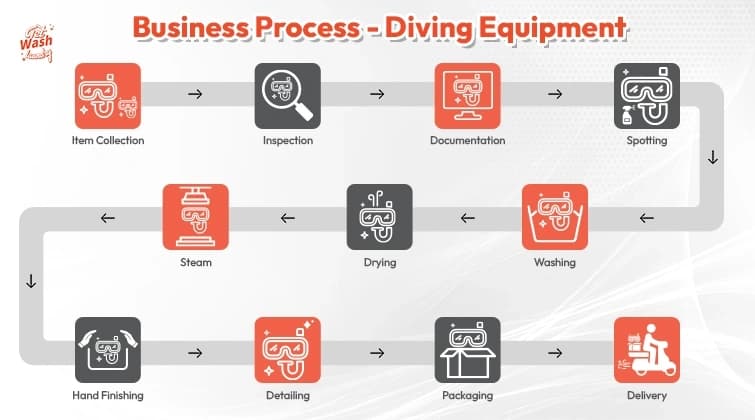
Each item of diving gear is processed separately, never mixed with other gear, and handled according to its material. The principle is simple: lift salt, sand, and dirt right from the inside, clean with a cleaner that does not harm the material, then dry slowly and thoroughly without heat and without direct sun.
Why every item is processed separately
Our page says gear is not mixed. This matters because neoprene, silicone, metal, and coated fabric all need different treatment, and because personal gear should not be mixed with anyone else's. Each set is recorded per owner, so your wetsuit, booties, and mask come back to you as the same set.
Inspection and condition notes
When gear arrives, our team inspects and records its condition: mould, odour, salt crystals, open seams, cracked neoprene, stuck zips, brittle straps, or yellowed silicone. Conditions that cleaning cannot fix, such as flattened and cracked neoprene or a leaking bladder, are reported from the start so expectations are clear.
Wetsuits, hoods, and rash guards
Wetsuits are rinsed with low-pressure fresh water to lift salt and sand, then cleaned inside and out with a gentle neoprene cleaner. The smelliest areas, armpits, crotch, neck, and wrists, get special attention. Zips are cleared of salt crystals and sand. Wetsuits are never wrung or heated; they are hung on wide hangers in a ventilated room, inside dried first and then turned out to dry the outside.
BCDs
BCDs are rinsed on the outside, in the pockets, and along the straps, then the bladder inside is rinsed with fresh water through the inflator and drained through the dump valve so salt does not settle. The inflator and valves are cleared of sand and salt crystals. BCDs are dried slightly inflated so the inner layers of the bladder do not stick together, and hung in a ventilated room.
Regulators
Regulators are cleaned with the first stage dust cap fitted tightly so water does not get in. The second stage, mouthpiece, hoses, octopus, and gauge housing are rinsed and cleaned of salt, sand, and dirt without pressing the purge button. Hoses are dried in a position where they do not kink. This cleaning is external care, not a service; regulators still need regular servicing by an authorised technician according to the manufacturer's schedule or when they show symptoms such as free flow, heavy breathing, or leaks.
Masks and snorkels
Lenses, frames, skirts, and straps are cleaned gently so the lenses are not scratched and the silicone is not damaged. Snorkels are cleaned including the mouthpiece and purge valve. Masks and snorkels are dried in the shade, away from sunlight.
Booties, socks, fins, and accessories
Booties are cleared of sand and salt on the soles and inside, cleaned to reduce odour, and dried inside out until the inside is completely dry. Fins are rinsed of sand in the foot pockets and straps. Drybags are cleaned and dried open. Towels and socks are washed to remove salt and odour.
Drying: the stage that cannot be rushed
The key to caring for diving gear in a tropical climate is thorough drying without heat and without direct sun. Our page mentions drying in a ventilated room. Thick neoprene, BCD bladders, and booties need time to dry right through, and gear packed while still damp will smell and grow mould again. That is why we do not rush this stage.
Final inspection and packing
Once dry, the gear is checked again: no salt left in zips and valves, no odour, and no sharp folds in the neoprene. Gear is packed neatly without hard creases in wetsuits, and regulator hoses are coiled loosely.
Turnaround
Our service page states a return time of 5–7 working days. The page also mentions an express service when available, but does not list its price or conditions; ask Customer Service if you have a trip coming up soon. Very mouldy or very thick gear may need longer to dry. Follow your order status on the tracking page.
Common Problems: Odour, Mould, Salt Crystals, Yellowed Masks, Stuck Zips, and Stiff Neoprene
Most of the diving gear that reaches us has one of the following problems. We explain what can usually be restored and what cannot, so you can decide with honest information.

Figure 6. Diving gear problems and treatments (diving-gear-problems-and-treatments-getwash-en.png)
Smelly wetsuits and booties
Odour in wetsuits and booties comes from bacteria growing in damp neoprene along with sweat, skin cells, and urine. A rinse alone is not enough, because the bacteria live in the pores and the inner fabric lining. Cleaning the inside with a suitable cleaner and then drying thoroughly usually solves the odour. Odour that has built up over years in old neoprene can be greatly reduced but does not always disappear completely.
Mould on wetsuits and BCDs
Gear stored damp in a closed bag for weeks can grow mould as black, green, or white spots. Surface mould can usually be cleaned. Mould that has been there a long time and has penetrated a light-coloured fabric lining can leave marks even after the mould itself is gone. The sooner it is treated, the better the result.
Salt crystals in zips, valves, and buckles
The white crystals that build up on wetsuit zips, BCD inflators, dump valves, and buckles are dried salt. These crystals can be dissolved by soaking and rinsing in fresh water. If the salt has already caused corrosion on metal parts, cleaning alone cannot remove it, and parts may need replacing.
Stuck zips
Zips on wetsuits, drysuits, and drybags often jam because of salt and sand. Cleaning usually makes them run smoothly again. A zip whose teeth are damaged or missing needs repair, not cleaning. For drysuit watertight zips, care and repair should follow the manufacturer's instructions.
Yellowed mask silicone
Clear silicone mask skirts and mouthpieces that have yellowed from sun, skin oil, and sunscreen can be cleaned and look less yellow, but they do not always become clear again, because the colour change happens inside the material. Keeping your mask in its box and away from the sun prevents this from the start.
Stiff, flattened, or cracked neoprene
A wetsuit that is often dried in the sun, washed in hot water, or stored with sharp folds can become stiff, flattened, and finely cracked. This shows that the air bubbles in the neoprene are already damaged. Cleaning makes the wetsuit clean and odour-free, but cannot restore its thickness and warmth. If a wetsuit has reached this stage, consider replacing it.
Peeling linings and open seams
On older wetsuits, the fabric lining can separate from the neoprene, and seams at the shoulders, armpits, or knees can open. This needs wetsuit repair, not cleaning. We will tell you during inspection so you can decide what to do next.
Diesel and oil smells from the boat
Gear left on the deck or near a boat's engine room sometimes gets drips of diesel, oil, or exhaust fumes. This smell is different from mustiness and harder to remove because it is oil based. Tell us if your gear has been exposed to something like this so it can be treated with a suitable cleaner. Old oil stains that have soaked into a fabric lining may not come out completely.
Sunscreen and stains on rash guards
Sunscreen worn before diving or snorkelling sticks to rash guards, wetsuit collars, and mask straps, leaving yellowish marks and a slippery film. Besides spoiling the look of your gear, many Indonesian dive sites now encourage reef-safe sunscreen. Using a rash guard and wetsuit as sun protection reduces the need for sunscreen and reduces stains too.
Odour inside the BCD
A BCD that smells from the inside, especially when you blow into it through the oral inflator, shows that sea water and dirt have settled in the bladder. Rinsing the inside and drying it inflated usually helps. If the bladder is leaking or the inflator is faulty, the BCD needs a technical check, not cleaning.
When gear needs a technician, not a laundry
- The regulator free flows, breathing feels heavy, or bubbles come from the first stage.
- The BCD inflator sticks or leaks, or the BCD will not hold air.
- Regulator hoses are cracked, bulging, or have corroded fittings.
- The gauge shows unusual readings or fogs up inside.
- The regular service date for the regulator and BCD recommended by the manufacturer has arrived.
Problems like these concern safety and must be handled by an authorised technician at a dive shop or official service centre. Our cleaning keeps gear clean and well cared for, but it is not a substitute for technical servicing.
Caring for Gear After a Dive, for Dive Centres, and How to Order
Professional cleaning lasts much longer when it is followed by a few simple habits after every day of diving. These habits can be done at the dive centre, at your accommodation, or at home.

Figure 7. How to rinse diving gear after a dive (how-to-rinse-diving-gear-after-a-dive-getwash-en.png)
Habits after every day of diving
- Rinse all gear in fresh water as soon as possible, ideally before the salt dries.
- Fit the regulator dust cap tightly before rinsing, and do not press the purge button when the regulator is not pressurised.
- Rinse the inside of the BCD by pouring a little fresh water in through the oral inflator, sloshing it around, then draining it through the valve.
- Hang the wetsuit on a wide hanger in a breezy, shaded spot, inside first, then turned out.
- Dry booties inside out and keep them out of direct sun.
- Keep your mask in its box and away from sunlight.
At the dive centre and on the boat
At the dive centre, use the rinse tank as early as possible before the water turns brackish, and keep regulators, masks, and cameras in separate tanks where available. On a liveaboard, hang wetsuits in the shade, not on a deck exposed to the sun all day. Do not pile wet wetsuits into your gear bag for the journey home if there is still time to dry them.
The journey home
The journey home from a dive destination often takes a whole day or more, and wet gear locked in a closed bag will start to smell. Where possible, dry gear briefly before packing, separate wetsuits and booties into breathable bags, and schedule pickup as soon as you get home. The sooner gear is cleaned after a trip, the better the result.
One simple habit helps a lot: carry a mesh bag for wet wetsuits and booties instead of a plastic bag. A mesh bag lets air in during the journey, so gear is not trapped damp for hours before it reaches home.
Storing gear between trips
Many divers in Greater Jakarta only dive a few times a year, so gear is stored for months. Store it clean and dry, in a cool, ventilated room, away from sunlight and from ozone sources such as electric motors. Hang wetsuits on wide hangers or roll them loosely; do not fold them sharply. Store BCDs with a little air inside. Coil regulator hoses loosely without sharp bends. Do not store gear in your car boot.
Before your trip
Two to three weeks before a trip, take your gear out of storage and check its condition. If it smells, has mould, or still holds salt from the last trip, schedule cleaning so there is time for the turnaround. At the same time, check the service dates for your regulator and BCD, because technical servicing also takes time.
Dive computers, cameras, and torches
Dive computers, underwater cameras with housings, and dive torches are electronic devices that should be rinsed in fresh water after a dive, but their deeper care, such as battery, O-ring, and seal replacement, follows the manufacturer's instructions. These devices are not listed in our service, so keep and care for them yourself, and do not include them in the gear bag for pickup unless confirmed.
Dive seasons and care schedules
Many Indonesian dive sites have their own best seasons, and divers often plan several trips in one season. Schedule a thorough clean after every long trip and before gear goes into long-term storage. For divers who dive every month, cleaning after each trip keeps gear always ready without salt building up from trip to trip.
Rental gear versus personal gear
Many new divers use rental gear and buy their own gradually, usually starting with a mask, booties, and wetsuit, because these three are the most personal and most affect comfort. Personal gear is more hygienic and fits better, but it is also your responsibility to look after. Regular cleaning keeps that first investment comfortable on every trip.
Signs your gear needs professional cleaning
- Your wetsuit or booties still smell after a fresh water rinse.
- There are black, green, or white mould spots on the neoprene or BCD.
- Salt crystals are visible on zips, inflators, or buckles.
- Zips feel stiff or hard to pull.
- Gear has just come back from a long trip or liveaboard and has not been rinsed properly.
- Gear will be stored for more than a month before the next trip.
If any of these signs appear, do not wait until the next trip. Salt and mould work slowly while gear is in storage, and the longer they are left, the harder they are to reverse.
For dive centres, dive schools, and resorts
Our page mentions service for individuals as well as dive centres, dive schools, and resorts. Rental gear is used by many people in turn, so cleanliness and odour strongly affect the guest experience. Scheduled cleaning for rental wetsuits, booties, BCDs, and masks can be arranged in volume. Tell Customer Service the number and type of items, the frequency, and the location so a suitable arrangement can be discussed.
Other things that often come along on a trip
Divers usually come home with other things that need attention too: a suitcase or wheeled bag dirty from travel, a large gear bag, shoes, and holiday clothes. For items like these, there is suitcase cleaning, bag cleaning, shoe cleaning, and laundry by the kilo for clothes. If you also hike or camp, there is adventure gear cleaning. Everything can be combined in one pickup.
Preparing gear before pickup
A few small preparations make the process faster. Remove the regulator from the tank and fit the dust cap. Take weights out of BCD pockets or the weight belt. Remove batteries and dive computers from accessories that are not part of the service, and keep your camera and housing yourself. Leave wet gear open in the shade until pickup rather than sealing it in plastic. Note the brand and model of each item so its price can be confirmed.
If you are sending gear for more than one person, for example a family's or a couple's, separate each set in a bag or pouch labelled with a name. This makes recording easier at pickup and ensures every wetsuit, mask, and pair of booties returns to its owner. For gear in similar sizes, a small label inside helps a lot.
How to order diving gear cleaning

Figure 8. How to order diving gear cleaning (how-to-order-diving-gear-cleaning-getwash-en.png)
- Prepare your gear: remove the regulator from the tank, fit the dust cap, and take out weights.
- Photograph the gear and note brand and model: wetsuit, BCD, regulator, mask, booties, accessories.
- Confirm prices, turnaround, and your pickup zone via WhatsApp 0812-6610-0500.
- Schedule pickup through the order page at your home, apartment, office, or dive centre, or drop it off at the outlet yourself.
- Track the status of your order on the tracking page.
- Receive your gear back clean, dry, and ready for the next trip.
Service hours and location
Customer Service hours: Monday–Friday 09.00–17.00, Saturday 09.00–15.00, closed on Sundays. Our main outlet is at Jl. Ceger Raya No.42, Jurang Mangu Barat, Kec. Pd. Aren, Kota Tangerang Selatan, Banten 15222. We serve customers in Pondok Aren, Bintaro, BSD, South Jakarta, and the surrounding area.
About diving equipment brands
Our price list includes several Scubapro models, and the service page mentions experience with a range of international brands. Getwash is an independent care service, not an official service centre for any brand, so we do not handle warranty claims, technical servicing, or parts replacement. For those, contact a dive shop or the official distributor of your gear's brand.
Our experience
Wetsuits that smell the moment the bag is opened, booties with sand still stuck in them from a trip three months ago, BCDs with salt crystals around the inflator, masks with yellowed skirts from being left on a boat deck: this is the gear we receive most often. Almost all of it starts with one habit, gear put away before being properly rinsed and dried. We have written this experience down so your next trip starts with gear that is clean, dry, and comfortable to wear.
Ready to hand over your diving gear? Contact WhatsApp 0812-6610-0500, order through the order page, or follow us on Instagram, TikTok, Facebook, and Threads.
FAQ: Questions About Getwash Diving Gear Cleaning
What diving gear can Getwash clean?
Wetsuits and drysuits (shorty, full suit, two-piece), BCDs, regulators, masks, snorkels, fins, booties, gloves, hoods, rash guards, weight belts, harnesses, drybags, socks, and towels.
How much does wetsuit cleaning cost?
Scubapro Yulex wetsuit Rp100,000; Everflex hooded vest, top, and pants Rp75,000; hybrid cargo pants Rp140,000. Other models are confirmed from a photo.
How much does BCD and regulator cleaning cost?
BCDs from Rp200,000 to Rp250,000 and regulators from Rp300,000 to Rp350,000 for the listed models. Ask whether the regulator price covers the octopus and gauge in your set.
Do you use special detergent?
Yes. Gear is cleaned with cleaners suited to neoprene, silicone, plastic, and metal, without bleach and without hot water.
Can sea smell and mustiness be removed?
Usually yes, with cleaning of the inside and thorough drying. Odour that has built up over years in old neoprene can be greatly reduced but does not always disappear completely.
How is gear dried?
Gear is hung in a ventilated room without heat and without direct sun, wetsuits on wide hangers and BCDs slightly inflated.
How long does it take?
The service page states a return time of 5–7 working days. An express service is mentioned when slots allow; ask Customer Service for its price and conditions.
Is it safe for expensive wetsuits?
Every item is processed separately with methods for neoprene. Neoprene that is flattened, cracked, or has a peeling lining cannot be restored, and we report that during inspection.
Does Getwash service regulators?
No. We clean the outside of the regulator with the dust cap fitted. Scheduled servicing and repairs are still done by an authorised technician at a dive shop or official service centre.
Can I ask for extra disinfection?
Mention it when you order, and ask whether there is an extra charge for that treatment.
Can cleaning be scheduled after every trip or for a dive centre?
Yes, it can be arranged. Tell Customer Service the amount of gear, your trip dates, or the frequency for rental gear.
How much is pickup and delivery?
Since 20 June 2026: Zone 1 (0–3 km) Rp8,000, Zone 2 (3–7 km) Rp15,000, Zone 3 (over 7 km) Rp22,000 per trip.
What are Getwash Customer Service hours?
Monday–Friday 09.00–17.00 and Saturday 09.00–15.00. Closed on Sundays. Messages can be sent at any time and are answered during the next service hours.
Sources
- Getwash Laundry diving gear cleaning service page
- Getwash Laundry Peralatan Diving page (ID)
- Getwash Laundry tracking page
- New Policy Notice: Pickup & Delivery Rates (effective 20 June 2026)