Color Bleed Removal
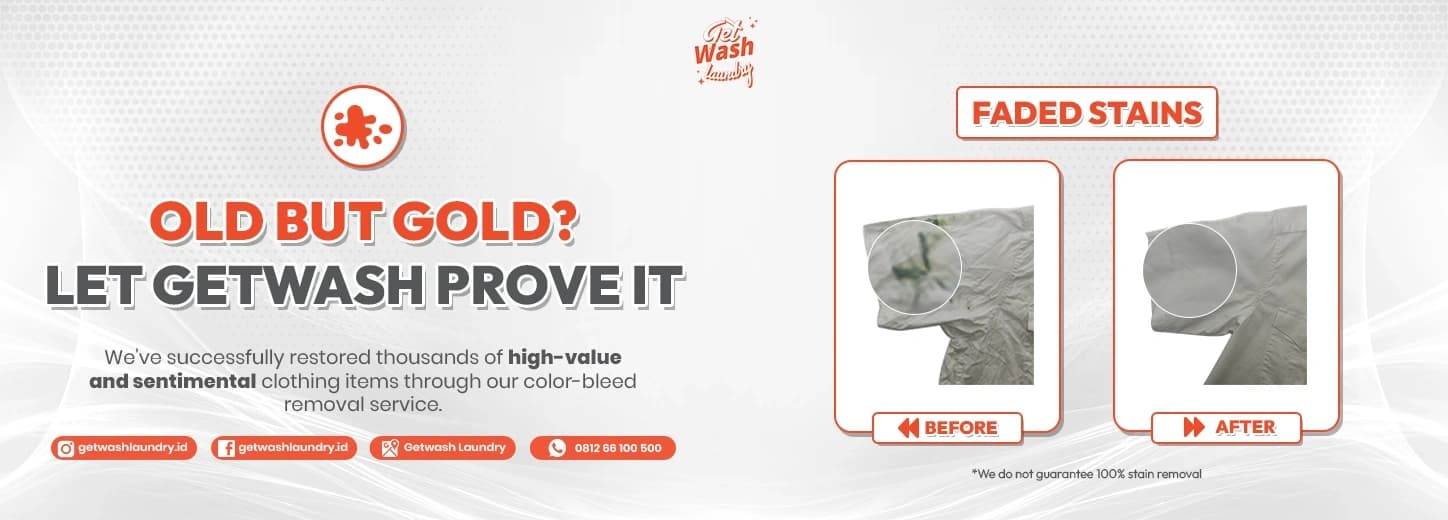
- Luntur - Major
Layanan ini bersifat add on | Harap membaca FAQ di bawah
Rp 70.000 - Luntur - Minor
Layanan ini bersifat add on | Harap membaca FAQ di bawah
Rp 50.000
Contact us to schedule your order
09:00-20:00 (Weekday) & 09:00-17:00 (Weekend)
Ulasan Pelanggan
- Leony5.0
Layanan Noda Luntur ini hasilnya bersih maksimal. Terima kasih atas pelayanannya.
- Iman Buhairi Santoso5.0
Penanganan noda luntur yang sangat profesional. Baju saya kembali ke warna aslinya tanpa ada bagian yang pudar. Pengerjaannya teliti dan komunikasi petugasnya sangat ramah. Senang sekali menemukan penyedia jasa yang jujur dan mengutamakan kualitas.
- Djoko purnomo5.0
Layanan Noda Luntur ini hasilnya bersih maksimal. Sangat direkomendasikan.
- Fahri Mubarok5.0
Terbaik memang kalau mengatasi stain dan luntur
- Sri Maslikha5.0
Layanan Noda Luntur ini pengerjaannya rapi dan cepat. Layanan seperti ini yang saya cari.
- Iman Buhairi Santoso5.0
Penanganan noda luntur yang sangat profesional. Baju saya kembali ke warna aslinya tanpa ada bagian yang pudar. Pengerjaannya teliti dan komunikasi petugasnya sangat ramah. Senang sekali menemukan penyedia jasa yang jujur dan mengutamakan kualitas.
- Djoko purnomo5.0
Penanganan noda luntur yang sangat profesional. Baju saya kembali ke warna aslinya tanpa ada bagian yang pudar. Pengerjaannya teliti dan komunikasi petugasnya sangat ramah. Senang sekali menemukan penyedia jasa yang jujur dan mengutamakan kualitas.
- Jumadi5.0
Penanganan noda luntur yang sangat profesional. Baju saya kembali ke warna aslinya tanpa ada bagian yang pudar. Pengerjaannya teliti dan komunikasi petugasnya sangat ramah. Senang sekali menemukan penyedia jasa yang jujur dan mengutamakan kualitas.
- Leony5.0
Penanganan noda luntur yang sangat profesional. Baju saya kembali ke warna aslinya tanpa ada bagian yang pudar. Pengerjaannya teliti dan komunikasi petugasnya sangat ramah. Senang sekali menemukan penyedia jasa yang jujur dan mengutamakan kualitas.
- RIDHO SUGIHARTO5.0
Penanganan noda luntur yang sangat profesional. Baju saya kembali ke warna aslinya tanpa ada bagian yang pudar. Pengerjaannya teliti dan komunikasi petugasnya sangat ramah. Senang sekali menemukan penyedia jasa yang jujur dan mengutamakan kualitas.
Color Bleed on Clothes: Why Dye Transfers, the Right First Aid, Realistic Success Rates, and How Getwash Treats Dye-Stained Clothes Professionally
By the Getwash Laundry Team | Updated 5 November 2026 | Reading time ±27 minutes
|
QUICK ANSWER If dye has run onto your clothes, do not dry them and do not iron them. Separate them, rinse in cold water, and get them treated as soon as possible, because fresh stains have a much higher chance of success. At Getwash, color bleed removal is an add-on service requested when you order: Color Bleed Minor Rp50,000 and Color Bleed Major Rp70,000 per item, with the category confirmed after inspection. There is no 100% guarantee: fresh stains (under 7 days) usually succeed 75–90%, while old stains (over 7 days) succeed 30–60%. Treatment adds 7–14 days, and risks such as fading or texture change are explained before work begins. Contact WhatsApp 0812-6610-0500; service hours are Monday–Friday 09.00–17.00 and Saturday 09.00–15.00, closed on Sundays. |
Almost everyone has been there. A white work shirt comes out of the washing machine with a pink tinge because one red T-shirt slipped in. A child's school uniform turns bluish after being washed with new jeans. A white prayer garment is marked with purple patches from a prayer mat soaked alongside it. Or a softly coloured kebaya picks up dye from a newly bought batik cloth. The first moment after you spot color bleed is the most decisive moment, and unfortunately it is also when most people take the wrong step.
This article covers color bleed in full, drawing on our team's daily experience with clothes: why dye can move from one fabric to another, what you should and should not do in the first 24 hours, how likely a stain is to come out, the risks you need to understand before deciding, the price and process of the Getwash [color bleed removal service](https://getwashlaundry.id/en/services/color-bleed-removal), and how to prevent it. If you are holding a garment that has just picked up dye, go straight to the first aid section. Every minute you save at the start can decide the final result.
Table of Contents
1. What Color Bleed Is and Why Dye Transfers
2. First Aid: What to Do and What to Avoid in the First 24 Hours
3. Success Rates and Risks: Being Honest About Results
4. Getwash Color Bleed Removal Prices and How to Order
5. The Professional Color Bleed Treatment Process
6. Preventing Color Bleed: Sorting, Testing Fabrics, and Care by Material
7. FAQ: Questions About Color Bleed and the Getwash Service
What Color Bleed Is and Why Dye Transfers
Color bleed, also called dye transfer, is the movement of dye from one fabric to another, usually during washing or soaking, or when wet fabrics touch each other. Unlike food or ink stains that sit on the surface, color bleed is textile dye that has entered the fibres of another fabric. That is what makes it harder to treat than most stains.

Figure 1. Causes of color bleed on clothes (causes-of-color-bleed-on-clothes-getwash-en.png)
Excess dye that is not fixed
Every coloured fabric is dyed at the factory with dye that should bond firmly to the fibres. In practice, some dye does not bond perfectly and remains on the surface of the fibres. This excess dye is released when the fabric first meets water and then looks for somewhere new to settle, often a white or light fabric nearby. That is why new clothes, especially dark or bright ones, are the most common source of bleeding.
The colours that bleed most often
In our experience, red, maroon, navy, purple, and black are the most common sources of color bleed. Indigo denim is also known for releasing colour, not only in the wash but through friction, for example the inside of a light-coloured bag or car seat turning bluish after repeated contact with jeans. Batik and woven fabrics with traditional dyes also need special attention because not all of them are wash-fast.
Cotton and polyester react differently
Cotton and linen are generally dyed with water-soluble dyes. If these dyes are not fully fixed, they come out easily in the wash and readily settle on other cotton. Polyester and other synthetics are dyed differently, and their dye tends to migrate when heated, for example in a dryer or under an iron. Blended garments, such as cotton-polyester T-shirts, can experience both. These differences affect the products and methods chosen during treatment.
Bleeding through friction
Not all dye transfer happens in water. Dry or damp friction between a coloured fabric and a light one, for example dark jeans on a light sofa, a coloured bag strap on a white shirt, or a seat belt on clothing, can also move colour. This is known as crocking. The marks often appear in areas that rub a lot, such as the shoulders, waist, or thighs.
Sweat can trigger bleeding too
Sweat can be slightly acidic or alkaline depending on the body, and together with body heat it can release dye from coloured clothing onto an undershirt or white shirt beneath. That is why white undershirts are sometimes marked at the armpits or back by the colour of a shirt or jacket worn over them, especially in hot weather like Jakarta's.
Hot water, long soaks, and harsh detergent
Hot water opens up fabric fibres and speeds up dye release. Soaking a mixed load for too long, for example overnight, gives dye plenty of time to move. Detergents with bleach or that are too harsh can also make dye come out more easily. All three often happen together at home: laundry soaked in warm water with detergent, then left until morning.
Wet fabrics touching each other
Color bleed does not always happen inside the machine. Wet fabrics left piled in a bucket, in the machine after the cycle has ended, or hung tightly together can also transfer colour. Sweaty sports clothes piled with white towels in a bag can cause similar marks.
Dryer heat and ironing make it more permanent
Once a dye-stained garment is tumble dried, dried in strong sunlight, or ironed, the transferred dye tends to bond more firmly to its new fibres. On synthetics such as polyester, heat can also push the dye deeper. This is the number one reason color bleed that has been dried and ironed is much harder to remove.
“Color bleed is easiest to treat in the first few hours, while the fabric is still wet and has not been heated. Every day that passes lowers the chances.” — Observation from the Getwash team
Color bleed is not the same as fading
It is worth distinguishing color bleed from fading. Color bleed is a foreign colour sitting on another fabric. Fading is the loss of a fabric's own original colour, for example a black T-shirt turning greyish after many washes or sun exposure. Color bleed removal deals with the first, lifting the foreign colour. An original colour that has already faded cannot be brought back by stain treatment.
Why white fabric shows it most
Color bleed can happen on fabric of any colour, but it is most obvious on white and light colours. On dark fabric, a little foreign dye often cannot be seen. That is why most cases brought to us are white garments, even though dye transfer also happens to other clothes in the same load.
Children's and baby clothes
Children's clothes are often brightly coloured and washed in large batches, so bleeding happens fairly often. White or pastel baby clothes are also easily marked by adult clothes washed with them. Because children's skin is more sensitive, treating stains on children's clothing calls for especially thorough rinsing so no chemical residue is left behind.
The items we receive most often
- White work shirts and uniforms marked by dye from other clothes.
- Children's school uniforms turned bluish or pinkish after being washed together.
- White prayer garments marked while washed with a prayer mat or coloured clothing.
- White T-shirts and polos with a pink or grey tinge.
- Bedsheets, pillowcases, and towels marked while washed with coloured fabrics.
- Softly coloured kebaya, dresses, and occasion wear that picked up colour from another fabric.
First Aid: What to Do and What to Avoid in the First 24 Hours
This is the most important part of the whole article. What you do in the first few hours after spotting color bleed often decides whether the stain can still be lifted.

Figure 2. First aid for color bleed on clothes (first-aid-for-color-bleed-on-clothes-getwash-en.png)
1. Do not dry it
This is the most important rule. Do not put the stained garment in a dryer and do not dry it in strong sunlight. Heat makes the transferred dye bond more firmly. If you cannot deal with it immediately, leave the garment damp in the shade, or let it dry slowly indoors without heat.
2. Separate it from the dye source
Take the garment that caused the bleeding out of the load straight away, and separate every stained item. Do not pile wet stained clothes together, because dye can keep transferring as long as the fabrics are wet and touching.
3. Rinse in cold water
Rinse the stained garment in clean cold water, away from other clothes. Cold water helps release some of the dye that has not yet bonded firmly, without opening the fibres further. Do not use hot water in the hope of a quick fix; hot water can actually make it worse.
4. Do not iron it
Ironing a dye-stained garment, even just to tidy it, applies direct heat that can make the stain semi-permanent. Hold off ironing until the stain has been properly treated.
5. Be careful with bleach and internet remedies
Chlorine bleach on coloured or patterned clothes can remove the fabric's original colour and leave permanent pale patches, and on some materials it can weaken the fibres. Many internet remedies, from bleach, vinegar, and baking soda to soaking for days, may work in some cases but damage in others, depending on the fabric and dye. If the garment matters to you, do not experiment. Every failed attempt can lower the chances of professional treatment.
6. Bring it in quickly and tell us its history
The sooner a garment is treated, the better its chances. When you hand it over, tell us what happened: when the stain appeared, which garment caused it, whether it has been dried or ironed, and whether anything has already been tried on it. This information helps our team choose the right treatment.
Do not scrub hard
Scrubbing a stain with a hard brush or rubbing it over and over does not release dye faster, but it can damage the fabric surface, make the fibres fuzzy, and spread the stain over a wider area. Simply rinse gently in cold water, then hand over the rest of the treatment.
What to bring when you hand over the garment
- The stained garment, ideally not yet heat dried.
- The garment that caused the bleeding, if you still have it, so the team knows the type of dye.
- When the stain happened and what has already been done.
- The care label still attached; do not cut it off.
- A note if the garment has special value or is needed for a particular event.
If you only find it once dry
Sometimes color bleed only becomes visible after the garment is dry, or even after ironing. A stain like this can still be treated, but the chances are lower. Do not delay any further, and do not try washing it again and again in hot water, because every hot wash can bond the stain further.
If it happens while travelling
Color bleed also often happens while travelling, for example when wet clothes are packed in a suitcase with other clothes, or washed in a hotel sink with hot water. If this happens, separate the stained garment, rinse it in cold water, and let it dry indoors without putting it in the sun or using a hairdryer. As soon as you get home, hand it over for treatment.
If you find it on clothes just back from a laundry
If you find color bleed on clothes you have just collected from a laundry, including ours, report it as soon as possible with a photo and the receipt. Do not rewash or iron it at home, so the chances of treatment are preserved. Customer Service will explain the applicable service policy and the steps that can be taken.
Success Rates and Risks: Being Honest About Results
Many services promise that color bleed will disappear completely. We prefer to be straightforward: no laundry can guarantee that every color bleed stain will come out 100%. The result depends on the age of the stain, the type of fabric, the type of dye, and what has already happened to the garment before it reaches us.

Figure 3. Color bleed removal success rates (color-bleed-removal-success-rates-getwash-en.png)
Fresh stains versus old stains
Based on our treatment experience, fresh color bleed under 7 days old can usually be lifted 75–90%, while stains over 7 days old fall in the 30–60% range. These figures are a general guide, not a promise for every garment. On fresh stains, the dye has not yet bonded firmly, so it is easier to release. On old stains, especially those washed and dried many times, the dye has become part of the fibre.
Why the age of a stain matters so much
In the first hours and days, the foreign dye sits mostly on the surface of the fibres and is weakly bonded. Every time the fabric is dried, put in the sun, ironed, or rewashed, the dye moves deeper and the bond strengthens. After a few weeks and several wash cycles, the foreign dye has essentially become part of the fabric. That is why the 7-day mark is an important benchmark for estimating the chances.
Factors that raise the chances
- The stain is fresh and the garment has not been heat dried.
- The stained fabric is plain white or light coloured.
- The material is cotton, linen, or polyester that tolerates treatment.
- Nothing like bleach or other chemicals has been tried at home.
- The stained area is not too large.
Factors that lower the chances or raise the risk
- The stain is old, or has been dried, ironed, or rewashed many times in hot water.
- The stained fabric is also coloured or patterned, so its original colour risks being lifted too.
- Sensitive materials such as silk, wool, rayon, viscose, or fabrics with traditional dyes.
- There are screen prints, sequins, embroidery, or appliqués that could be damaged by treatment.
- Bleach has already been tried, which may have weakened the fibres or removed original colour.
Risks you need to understand

Figure 4. Risks of color bleed treatment (risks-of-color-bleed-treatment-getwash-en.png)
Lifting foreign dye from fibres requires professional spotting chemicals, and a product strong enough to release foreign dye can also affect the fabric's own dye. That is why there are risks we explain before treatment: the original colour may fade, the fabric's texture may change, and on fabrics that are already fragile the fibres may weaken. Sometimes a stain is greatly reduced but a faint mark remains. You decide whether to go ahead once you understand these risks.
When the original and foreign colours are similar
The hardest cases are when the stained garment is also coloured, for example a light blue shirt with navy bleeding, or a patterned fabric marked by another colour. A product that lifts the foreign dye can also react with an original dye of a similar colour. In cases like these, treatment is more careful and the result is harder to predict. Plain white fabric is the most responsive case.
Why we do not promise 100%
We would rather lose an order than promise something we cannot be sure of. Textile dyes vary enormously, and how each fabric will react cannot always be predicted before treatment. What we can promise is careful inspection, an honest explanation before treatment, methods chosen to suit the material, and the use of professional spotting chemicals that we use and distribute ourselves.
How we judge the result
The result is judged by comparing the condition before and after under good lighting. There are three possible outcomes. The stain is gone or barely visible. The stain is greatly reduced but a faint mark remains up close. Or the stain is only slightly reduced because the dye has bonded too strongly. We tell you the result as it is when the garment is returned.
Three example cases
Case one: a white cotton work shirt with a pink tinge from a red T-shirt, brought in the next day without being dried. Cases like this are among the most responsive, and the stain can usually be lifted until it is no longer visible.
Case two: a white polyester school uniform with a blue tinge from jeans, found after it had been dried and ironed, then brought in a week later. The stain can usually be reduced a lot, but does not always disappear completely.
Case three: a cream kebaya with embroidery, marked by batik dye and already treated with bleach at home. Cases like this are high risk, because the original colour and the embroidery could be affected. The team will explain the risks in detail before deciding with you whether to go ahead.
When it is better not to treat
There are cases where we advise against going ahead, for example a very old stain on old silk, or a patterned garment whose original colour bleeds very easily. In cases like these, the risk of damage is greater than the chance of improvement. We will say so clearly, so you can decide with full information.
Getwash Color Bleed Removal Prices and How to Order
Color bleed treatment at Getwash is an add-on service, meaning it is added to the garments you send and is not automatically included in regular washing. It needs to be requested when you order.

Figure 5. Color bleed removal prices (color-bleed-removal-prices-getwash-en.png)
- Color Bleed Minor: Rp50,000 per item.
- Color Bleed Major: Rp70,000 per item.
- Type of service: add-on, not automatically included in regular washing; request it when you order.
- Extra time: treatment adds about 7–14 days to turnaround.
The service page does not yet explain the difference between Minor and Major in detail. The category for your garment is confirmed by the team after inspection, so you know the price before treatment begins. Send a photo of the stain via WhatsApp 0812-6610-0500 for an initial assessment.
The add-on price plus the washing service
Because it is an add-on, the color bleed price is added to the washing service that suits the garment, for example laundry by the kilo for everyday clothes, wet cleaning for materials that need gentle handling, or dry cleaning for suits and dry-clean-only garments. Customer Service will confirm the right combination.
When it is worth treating
Weigh the value of the garment against the cost and the chances. For work shirts, uniforms, kebaya, dresses, branded clothes, or garments with sentimental value, professional treatment is almost always worth trying, especially when the stain is fresh. For a cheap T-shirt with a stain that is months old, replacing it may make more sense. We will not push a treatment that is not worthwhile; ask the team's opinion when you send a photo.
Example calculations
- One white shirt with a small mark (Minor): shirt washing price + Rp50,000.
- One white T-shirt turned pink almost all over (Major): washing price + Rp70,000.
- Three school uniforms marked blue: washing price + 3 × the add-on price for each one's category.
The category for each item is decided after inspection. If several garments were stained in the same incident, send them together so they can all be assessed at once.
If you are not sure which category your garment falls into, send two photos, one close up showing the stain and one from further away showing the whole garment. These two photos are usually enough for the team to give an idea of the category and the chances before pickup.
Other stains that often come with it
Clothes with color bleed sometimes have other stains too. For pen and marker ink there is ink stain removal, and for yellowish brown rust marks there is rust stain removal. Both are also add-on services with their own assessment.
For schools, hotels, and institutions
Color bleed in large numbers often happens with school uniforms, office uniforms, hotel linen, and institutional uniforms, for example when a batch of new uniforms is washed together for the first time. For needs like these, send Customer Service the number of items, the fabric type, and sample photos of the stains so they can be assessed and the treatment arranged. Getwash also handles regular laundry for institutions.
Pickup and delivery fees
Since 20 June 2026, pickup and delivery have been charged per trip based on distance from the nearest outlet: Zone 1 (0–3 km) Rp8,000, Zone 2 (3–7 km) Rp15,000, and Zone 3 (over 7 km) Rp22,000. You can also drop items off yourself at our outlet at Jl. Ceger Raya No.42, Jurang Mangu Barat, Kec. Pd. Aren, Kota Tangerang Selatan, Banten 15222.
How to order color bleed removal

Figure 6. How to order color bleed removal (how-to-order-color-bleed-removal-getwash-en.png)
- Protect the garment: do not heat dry it, separate it from the dye source, and rinse in cold water.
- Photograph the stain close up and from a distance, and note its history: when it happened, the dye source, whether it has been dried or treated with anything.
- Contact [WhatsApp 0812-6610-0500](https://wa.me/6281266100500) and say you need the color bleed add-on.
- Schedule pickup through the order page, or drop it off at the outlet yourself.
- Inspection and approval: the team assesses the category, chances, and risks, and explains them before treatment.
- Track the status of your order on the tracking page and receive your garment back.
The Professional Color Bleed Treatment Process
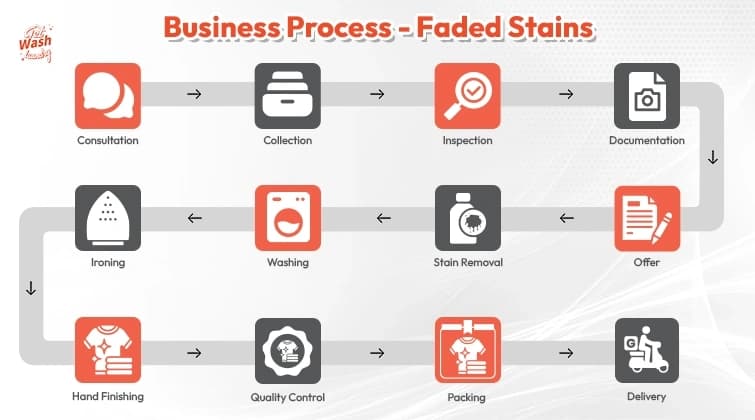
Treating color bleed is not just rewashing. The process is staged, with decisions at each stage based on how the fabric reacts. Here is an outline of the process we follow.

Figure 7. Color bleed treatment process (color-bleed-treatment-process-getwash-en.png)
1. Inspection and notes
Every garment is inspected: the material from the label, the base colour, the size and intensity of the stain, the age of the stain based on your information, and the condition of the fabric, such as thin areas, prints, or appliqués. The condition is recorded before treatment so there is a reference point afterwards.
2. Colourfastness test
Before any chemical is used on the stained area, the fabric's reaction is tested on a hidden area, such as inside a seam or at the end of a hem. This test shows whether the fabric's original colour is safe under treatment. If the original colour lifts during the test, the method is adjusted or you are told that the risk is high.
3. Pre-treatment
The stained area is prepared with a pre-treatment suited to the material to loosen the foreign dye from the fibres. This stage is not rushed, because bonded dye needs time to be released in a controlled way.
4. Targeted spotting
Treatment is applied directly to the stained area using spotting techniques, not by soaking the whole garment, so the unstained parts of the fabric are not exposed. Getwash is an official distributor of professional spotting products from SEITZ (Germany) and A.L. Wilson (USA), and we use the same products in our own process. For dye transfer between fabrics, SEITZ makes Colorsol X, a post-spotting product designed as a final rescue for bled textile dye. The choice of product and concentration is matched to the results of the earlier test. Product information is available on Getwash professional products.
5. Neutralisation and rinsing
Once the stain has been lifted as far as is safe, chemical residue is neutralised and rinsed out thoroughly. This stage matters so that no residue is left that could weaken the fibres or irritate the skin when the garment is worn.
6. Drying and final inspection
The garment is dried without excess heat and then checked again under good lighting. If a stain remains and the fabric is still safe to treat, the spotting stage can be repeated. If not, we report the result as it is. This is why color bleed treatment needs an extra 7–14 days.
Safe for skin after treatment
Professional spotting chemicals must be neutralised and rinsed out thoroughly before a garment is returned. Garments worn directly against the skin, such as shirts, undershirts, children's clothes, and prayer garments, get special attention at this stage, so they are safe to wear again without irritating residue.
Why it takes 7–14 days
Color bleed often does not come out in a single treatment. Dye is released gradually, with pauses so the fabric is not exposed to chemicals for too long at once. Speeding up the process with higher concentrations is possible, but the risk to the original colour and the fibres is much greater. We choose a longer but safer process.
Why professional products differ from household ones
Household stain removers are designed to be safe for anyone to use without training, so their strength is limited and their scope is general. Professional spotting products are designed for specific stain types, used at measured concentrations and contact times, and require knowledge of how fabrics react, personal protection, and neutralisation afterwards. The difference is not only in the product but in how it is used.
Before and after records
The garment's condition is recorded before treatment and checked again afterwards. Ask Customer Service if you need photos of the condition before and after. Records like these make it easier for you to judge the result and serve as a reference if the same garment needs treatment again later.
Garments with sentimental value and occasion wear
A family wedding kebaya, a uniform that cannot be replaced, or clothing handed down from parents is often worth far more than its price. Getwash is trusted as the go-to laundry for government officials and high-profile clients precisely for garments like these, which must be handled one by one with an honest explanation before any work begins. Let us know if your garment has special value so it is noted and handled with extra care.
Preventing Color Bleed: Sorting, Testing Fabrics, and Care by Material
The best way to deal with color bleed is to prevent it. Most of the cases we receive could have been avoided with a few simple habits.

Figure 8. How to prevent color bleed (how-to-prevent-color-bleed-getwash-en.png)
Wash new clothes separately
New clothes, especially red, navy, black, or denim, should be washed separately for the first few washes until the rinse water no longer runs coloured. This is the simplest and most effective way to prevent color bleed.
Separate whites, lights, and darks
Sort laundry into three groups: whites, lights, and darks. A red sock, a coloured handkerchief, or one coloured T-shirt slipped in among the whites is the classic cause. Check the machine before starting, especially if other members of the household also add laundry.
Test colourfastness yourself
For clothes you are unsure about, do a simple test: dampen a small hidden area of the garment, then press a damp white cloth or white tissue against it for a moment. If any colour transfers to the white cloth, the garment is likely to bleed and must be washed separately.
Cold water and short soaks
Use cold water for coloured clothes, and avoid soaking mixed loads for too long. If you need to soak very dirty clothes, soak only similar colours and do not leave them overnight.
Take laundry out of the machine straight away
Wet laundry left piled in the machine after the cycle ends, or in a bucket, can transfer colour between items. Take it out and hang it as soon as the machine stops.
Reading the care label
Care labels often include instructions directly related to bleeding risk, such as "wash separately", "wash with like colours", or "do not soak". These instructions are not a formality: manufacturers write them because they know the dye may run. Do not cut off the label until you fully understand how to care for the garment.
Colour catcher sheets: helpful, not a guarantee
Colour catcher sheets placed in the washing machine can absorb some of the dye released into the water. They help as an extra layer of protection, but they do not replace sorting your laundry. With clothes that bleed very easily, these sheets are not enough.
Care by material
- Denim and jeans: wash inside out in cold water, away from light clothes, especially when new.
- Batik and woven fabrics: wash separately in cold water with a mild soap, do not soak for long, dry in the shade.
- Red and dark cotton: wash separately for the first few washes, then keep them with the darks.
- Silk, wool, rayon: follow the care label; if it says dry clean, send it for dry cleaning.
- White uniforms: wash only with whites; do not mix with coloured ties, skirts, or trousers.
- White prayer garments: wash separately from prayer mats, sarongs, and coloured clothing.
Sheets, towels, and household linen
Dark bedsheets, new towels, and patterned pillowcases are also common sources of bleeding onto white sheets and towels. Wash new sets separately for the first few washes, and keep sorting household linen too. For sheets and bedding, there is bedsheet laundry with proper separation.
Habits in a busy household
In a household with many people, color bleed often happens because laundry from several people is mixed in one basket. Set up two or three separate baskets for whites, lights, and darks, and tell everyone in the house, including household staff, about new clothes that must be washed separately. This small habit prevents most color bleed at home.
When you send laundry out
When you send laundry to any wash-and-fold service, separate clothes you know bleed easily or are still new yourself, and tell the staff. Very important white clothes, such as work shirts or uniforms, should not be mixed in one bag with coloured clothes. This habit protects your clothes at any laundry, including Getwash.
Myths about color bleed
- "Adding salt to the wash locks in colour." This is a long-standing habit, but it cannot be relied on for the dyes in most modern clothing. Washing separately is far more effective.
- "Drying in strong sun will bleach out the stain." Sun heat can actually bond the foreign dye more firmly, and sunlight can fade the fabric's original colour.
- "Bleach removes all color bleed." Chlorine bleach can strip the original colour from coloured fabric and weaken fibres, and on some white fabrics it can even cause yellowish marks.
- "Just rewash it in hot water a few times." Repeated hot washing and drying bonds the stain further.
- "Old stains can never come out." The chances are lower, but not always zero. A professional assessment can give a more certain answer.
Caring for clothes after treatment
Clothes that have been successfully treated still need proper care so they are not stained again. Wash them with the same colour group, use cold water, and avoid mixing them again with the garment that caused the bleeding. If the source garment still releases colour often, wash it separately or send it to a laundry with a special note.
Our experience
White shirts turned pink by one red T-shirt, school uniforms turned bluish after being washed with a sibling's jeans, prayer garments marked by a prayer mat, and kebaya brought in after bleach was tried at home: these are the cases we receive most often. When a garment is brought in quickly and has not been dried, the result is often very satisfying. When it is months old or has been through various products, the chances are much smaller. The biggest lesson is always the same: do not dry it, do not experiment, and bring it in quickly.
A summary to remember
- Do not dry it, do not iron it, do not use bleach on coloured fabric.
- Separate it and rinse in cold water.
- Bring it in quickly: stains under 7 days have a much better chance.
- Request the color bleed add-on when you order; it is not automatic.
- Understand the risks before approving treatment.
Service hours and location
Customer Service hours: Monday–Friday 09.00–17.00, Saturday 09.00–15.00, closed on Sundays. Our main outlet is at Jl. Ceger Raya No.42, Jurang Mangu Barat, Kec. Pd. Aren, Kota Tangerang Selatan, Banten 15222. We serve customers in Pondok Aren, Bintaro, BSD, Ciledug, South Jakarta, and the surrounding area. If you are looking for laundry near me that can handle color bleed, send a photo of your garment first.
Has dye just run onto your clothes? Contact WhatsApp 0812-6610-0500 now, order through the order page, or follow us on Instagram, TikTok, Facebook, and Threads.
FAQ: Questions About Color Bleed and the Getwash Service
What is the Getwash color bleed removal service?
An add-on service that lifts dye transferred from another fabric onto your garment, with inspection, a colourfastness test, and targeted spotting using professional spotting products.
Is it automatically included in regular laundry?
No. Color bleed removal is an add-on that must be requested when you order, because it requires inspection, risk approval, and extra time.
How much does color bleed removal cost?
Color Bleed Minor Rp50,000 and Color Bleed Major Rp70,000 per item, added to the washing service. The category is confirmed after inspection.
Can color bleed be removed 100%?
There is no 100% guarantee. Fresh stains (under 7 days) usually succeed 75–90%, while old stains (over 7 days) succeed 30–60%, depending on the fabric and the garment's history.
What about color bleed that has been there a long time?
It can still be tried, but the chances are lower, especially if it has been dried, ironed, or treated with other products. The team will assess and explain the chances first.
How long does it take?
Color bleed treatment adds about 7–14 days, because dye is released gradually to keep the fabric safe.
Is it safe for all fabric types?
Not all fabrics carry the same risk. Cotton, linen, and polyester are generally safer; silk, wool, rayon, patterned, and screen-printed fabrics carry more risk. Every fabric is tested first on a hidden area.
Can the fabric's original colour fade?
Yes, especially on coloured or patterned fabric. This risk is explained before treatment, and the method is adjusted to the colourfastness test result.
Can fabric become fragile after treatment?
On old or fragile materials, fibres can weaken. That is why fabric is inspected first, and in high-risk cases we may advise not to go ahead.
Will I be informed before treatment begins?
Yes. The price category, chances, and risks are explained after inspection, and treatment goes ahead once you understand and agree.
What should I do when dye has just run onto my clothes?
Do not dry or iron them, separate them from the dye source, rinse in cold water, do not use bleach on coloured fabric, and bring them in quickly.
How much is pickup and delivery?
Since 20 June 2026: Zone 1 (0–3 km) Rp8,000, Zone 2 (3–7 km) Rp15,000, Zone 3 (over 7 km) Rp22,000 per trip.
What are Getwash Customer Service hours?
Monday–Friday 09.00–17.00 and Saturday 09.00–15.00. Closed on Sundays. Messages can be sent at any time and are answered during the next service hours.
Sources
- Getwash Laundry color bleed removal service page
- Getwash Laundry Noda Luntur page (ID)
- Getwash Products page (SEITZ and A.L. Wilson)
- Getwash Laundry tracking page
- New Policy Notice: Pickup & Delivery Rates (effective 20 June 2026)