Baby Kilo Laundry
- RegulerRp 25.000
- ExpressRp 50.000
Contact us to schedule your order
09:00-20:00 (Weekday) & 09:00-17:00 (Weekend)
Ulasan Pelanggan
- Hananto adi k5.0
Immaculate hygiene standards for baby apparel. Processed separately from regular laundry with gentle care. Highly recommended for new parents! Thank you so much for such an outstanding customer experience!
- Cevino fadel pradipta5.0
Immaculate hygiene standards for baby apparel. Processed separately from regular laundry with gentle care. Highly recommended for new parents! Thank you so much for such an outstanding customer experience!
- Yogi5.0
Immaculate hygiene standards for baby apparel. Processed separately from regular laundry with gentle care. Highly recommended for new parents! Thank you so much for such an outstanding customer experience!
- EKO BUDI SANTOSO5.0
Immaculate hygiene standards for baby apparel. Processed separately from regular laundry with gentle care. Highly recommended for new parents! Thank you so much for such an outstanding customer experience!
- ADITYA5.0
Immaculate hygiene standards for baby apparel. Processed separately from regular laundry with gentle care. Highly recommended for new parents! Thank you so much for such an outstanding customer experience!
- UZI FAUZIAH5.0
Immaculate hygiene standards for baby apparel. Processed separately from regular laundry with gentle care. Highly recommended for new parents! Thank you so much for such an outstanding customer experience!
- Totok5.0
Immaculate hygiene standards for baby apparel. Processed separately from regular laundry with gentle care. Highly recommended for new parents! Thank you so much for such an outstanding customer experience!
- Lady Meta5.0
Immaculate hygiene standards for baby apparel. Processed separately from regular laundry with gentle care. Highly recommended for new parents! Thank you so much for such an outstanding customer experience!
- Junaidi Irawan5.0
Immaculate hygiene standards for baby apparel. Processed separately from regular laundry with gentle care. Highly recommended for new parents! Thank you so much for such an outstanding customer experience!
- Maiza Ziqril Iqmi5.0
Immaculate hygiene standards for baby apparel. Processed separately from regular laundry with gentle care. Highly recommended for new parents! Thank you so much for such an outstanding customer experience!
Getwash Baby Kilo Laundry: Why Baby Clothes Need Washing Differently, How to Handle Breast Milk, Formula, Baby Food, and Poop Stains, Regular and Express Prices, and How to Care for Your Little One's Clothes at Home
By the Getwash Laundry Team | Updated 6 November 2026 | Reading time ±27 minutes
|
QUICK ANSWER Getwash baby kilo laundry washes baby clothes and essentials separately from other laundry, with a baby detergent that the service page describes as fragrance-free and dye-free, rinses them repeatedly, then dries and packs them hygienically. Prices are Rp25,000 for Regular (3–4 working days) and Rp50,000 for Express (12–24 hours in selected areas). Accepted items include everyday clothes, diaper pants, swaddles, blankets, hats, mittens, towels, small pillows and bolsters, sleep mats, and baby carrier cloths. For breast milk, formula, baby food, and poop stains, rinse with cold water as soon as possible before handing them over. Contact WhatsApp 0812-6610-0500; service hours are Monday–Friday 09:00–17:00 and Saturday 09:00–15:00. |
New parents are often surprised by how much laundry a baby creates. In a single day, a baby can change outfits several times because of spit-up, leaking nappies, sweat, or spilled milk. Swaddles, waterproof mats, towels, and blankets pile up too. Amid broken sleep and feeding schedules, washing, drying, and folding baby clothes properly becomes a job of its own.
This article covers Getwash's baby kilo laundry service in full: why baby clothes are best washed differently from adult clothes, the stains that appear most on baby clothes and how to give them first aid at home, which items can be washed, prices and how to estimate what you need, the washing process, and how to care for baby clothes at home between laundry runs. Start from the table of contents below.
Table of Contents
1. Getwash Baby Kilo Laundry: How It Differs from Regular Laundry
2. Why Baby Clothes Need Washing Differently
3. The Most Common Stains on Baby Clothes
4. Prices, Minimums, and What Can Be Washed
5. The Baby Laundry Process and How to Order
6. Caring for Baby Clothes at Home
Getwash Baby Kilo Laundry: How It Differs from Regular Laundry
Baby kilo laundry is a wash, dry, and fold service charged by weight, specifically for baby clothes and essentials. It differs from regular kilo laundry in three ways: the detergent used, how items are washed, and the attention paid to soap residue left in the fabric.
Baby-specific detergent
Our service page states that baby clothes are washed with a hypoallergenic detergent formulated for babies, free of fragrance and dye, and free of parabens and SLS. The aim is to reduce unnecessary substances on fabrics that touch a baby's skin directly.
Washed separately
Baby clothes are not mixed with adult laundry or with other customers' laundry. This separation prevents the transfer of dirt, residue from adult products such as strong fragrances, and fibres or lint from other clothes.
Repeated rinsing
Baby clothes are rinsed repeatedly to reduce soap left in the fabric. Detergent residue is one of parents' most common worries, especially on fabrics that stay against the skin for long periods, such as swaddles and sleepwear.
Who needs it most
- New parents overwhelmed by the amount of laundry in the first weeks.
- Working parents who want their time at home spent with their child, not washing.
- Families preparing for a birth who want every new baby item washed before use.
- Families without enough drying space, such as apartment residents.
- Families recovering from illness who want all baby clothes washed thoroughly at once.
- Grandparents and nannies helping care for a baby who want laundry handled safely.
Twins and families with several young children
Families with twins, or with a toddler and a baby at the same time, face double the laundry. This is where kilo laundry with regular pickup really helps. If you want each child's clothes packed separately so they are easy to put away, say so when you order and separate their laundry into different bags. Label each bag with a name or colour so it is easy to recognise on return.
Families with busy schedules
Many of our customers are professional families, including the families of officials and high-profile figures, whose schedules are packed but who still want the highest standard of cleanliness for their children. For them, a process arranged over WhatsApp with pickup and delivery, plus the assurance that baby clothes are washed separately, is the main reason to choose Getwash.
The working standards we hold ourselves to
Baby laundry is received, weighed, and recorded separately. Clothes are sorted before washing, stains are checked one by one, detergent is never overdosed, and rinsing is never cut short. Clothes are dried completely, because half-dry fabric smells and is uncomfortable for a baby. Every package is labelled so each family's laundry comes back complete to its owner.
When to start using baby laundry
There is no wrong time. Some families start while preparing for the birth, to wash all the new essentials. Others start after the baby arrives, when the laundry starts to pile up. Some use the service only at particular times, such as the rainy season, when travelling, or when the baby is unwell. Choose the pattern that suits your family's rhythm.
After coming home from hospital
The first weeks after giving birth are a time of recovery for the mother and adjustment for the whole family. Baby clothes, swaddles, nursing items, and the mother's hospital clothes all pile up at once. Many families hand this laundry to us so the mother can rest and the family can focus on the baby.
Family trust
We understand that handing baby clothes to someone else takes trust. That is why each family's laundry is handled separately and labelled, items left in pockets are returned, and we do not publish customer information. We never name the families who use our service in promotional material.
Baby laundry for nannies and daycare
Nannies, childcare centres, and baby daycare handle clothes, towels, and sleep mats from many babies at once. For needs like these, per-child labelling and a regular pickup schedule are essential. Ask Customer Service about regular scheduling, or see our B2B laundry service for large volumes.
What we do not promise
We do not claim baby clothes become sterile or one hundred percent bacteria-free, and we do not promise that our service prevents or cures skin problems. A baby's skin is affected by many things, from weather, sweat, and nappies to their health. If your baby has eczema, allergies, or a rash that does not go away, consult a doctor or midwife, and tell us about any special needs when you order.
“Baby clothes do not need washing harder. They need washing more carefully: just enough soap, thorough rinsing, and fabric that is truly dry.” — Working principle of the Getwash team
Why Baby Clothes Need Washing Differently
Baby clothes touch the skin almost all day, including during sleep. So what is left in the fabric after washing matters as much as what is removed from it.

Figure 1. Why baby clothes are washed differently (mengapa-pakaian-bayi-dicuci-berbeda-getwash-en.png)
Baby skin is more sensitive
A baby's skin, especially in the first months, is thinner and more easily irritated than adult skin. Friction, sweat, and certain substances in fabric can leave some babies with redness. That is why many health professionals recommend a gentle, fragrance-free detergent for baby clothes.
Detergent residue
Too much detergent or incomplete rinsing leaves soap in the fabric's fibres. On adult clothes this residue may go unnoticed. On swaddles, sleepwear, and sleep mats that stay against a baby's skin for hours, it is exactly what you want to avoid. The right detergent dose and repeated rinsing are the key.
Fragrance and fabric softener
Strong fragrance and fabric softener make laundry smell nice and feel soft, but leave a layer of substances on the fabric. For baby clothes, many parents and health professionals prefer to avoid them, especially if the baby has sensitive skin. The natural fresh smell of fabric that is truly clean and dry is enough.
Fragrant is not the same as clean
Clothes that smell nice are not necessarily clean, and clean clothes do not have to smell of anything. Strong fragrance can mask the smell of milk or sweat still left in the fabric. For baby clothes, the better measure is no smell at all: not musty, not sour, and not reeking of soap.
Protein stains need cold water
Most stains on baby clothes are protein and fat stains: breast milk, formula, spit-up, and poop. Protein stains that meet hot water first can actually bond more firmly to the fibres. That is why baby stains are best rinsed with cold water before washing.
Adult clothes bring dirt from outside
Adult clothes carry road dust, smoke, sweat from activities outside the home, and residue from products such as perfume, deodorant, or sunscreen. Washing baby clothes separately reduces the transfer of that dirt and residue. At Getwash, that separation applies not only to your family's clothes but also to other customers' laundry.
Finer baby fabrics
Baby clothes are usually made of thin cotton, jersey, flannel, or muslin, which are finer and more easily damaged than adult fabrics. An overly rough spin and too hot a dryer can make fabric thin, pill, or shrink quickly. Baby clothes also often have tiny buttons and press studs that need care so they do not come off.
Water temperature and fabric
Water that is too hot can set protein stains and shrink cotton baby clothes, while water that is too cold is less effective on some oily dirt. Temperature is chosen to suit the fabric, the care label, and the type of stain. Follow the care label on baby clothes if you wash at home.
Rashes on baby skin
Redness on a baby's skin can have many causes, such as sweat and heat, moisture in the nappy area, friction, food, or particular skin conditions. Clean, residue-free laundry is one thing you can control, but it is not the only factor. If a rash does not improve or comes with other symptoms, have your baby checked by a doctor or midwife.
Adult fabrics that touch the baby
Baby clothes are not the only fabrics that touch a baby's skin. A mother's top while breastfeeding, nursing covers, towels used at bath time, and the sheets where the baby sleeps all touch the baby too. Many families choose to wash these just as gently. Let us know if you want some parents' clothes washed together with the baby laundry.
Read the care label
Baby clothes, especially wool, knits, or items with embellishments, often have special care instructions on the label, such as a maximum temperature, no tumble drying, or hand wash only. These instructions help keep garments in shape and size. If any items have special labels, mention them when you hand over the laundry.
When new baby clothes should be washed
Clothes, swaddles, blankets, and baby essentials bought new are best washed before first use. New fabric from factories and shops can carry finishing residues, warehouse dust, and dirt from packaging. Many families wash all their baby essentials a few weeks before the due date, so everything is ready and neatly stored.
The Most Common Stains on Baby Clothes
Stains are an inseparable part of caring for a baby. Knowing what they are helps you give the right first aid at home, so the stain is more likely to come out in the wash.

Figure 2. Baby clothes stains and how to handle them (noda-pakaian-bayi-dan-penanganannya-getwash-en.png)
Breast milk and formula
Breast milk and formula contain protein and fat. Left to dry, these stains can leave yellowish marks and a sour smell. Rinse the affected area with cold water as soon as possible, not hot water, then leave it until it is washed or handed over.
Spit-up and vomit
Spit-up is a mix of milk and stomach fluid. Besides staining, it leaves a fairly strong smell. Remove any solids, rinse with cold water, and do not leave clothes rolled up damp for long before washing.
Baby poop
Baby poop, especially in breastfed babies, is often yellow and can leave a strong stain. Tip solids into the toilet first, then rinse the stained area with cold water from the back of the fabric so the dirt is pushed out rather than into the fibres. For hygiene, keep poop-soiled clothes in a separate bag before handing them over.
Baby food
When babies start solids, new stains appear: carrot, pumpkin, sweet potato, tomato, beetroot, and green vegetables. Coloured stains from carrot and pumpkin are among the hardest because their pigments dissolve in fat. Rinse straight away with cold water and avoid scrubbing too hard. A feeding bib helps reduce stains on clothes.
Telon oil, baby oil, and creams
Telon oil, baby oil, lotion, and nappy cream leave oily stains that can turn yellowish and rancid as they build up. Do not rub oily stains with water alone, as they can spread. Mention it when you order if there is a lot of oily staining.
Sweat at the collar and creases
Babies sweat easily in hot weather, especially on the head, neck, and skin folds. Sweat that builds up at the collar and inside hats can leave yellowish marks and odour. Clothes worn all day in hot weather are best washed promptly rather than reused.
Bibs, burp cloths, and fabric toys
Bibs and burp cloths catch most baby food stains and drool, so they get dirty and smelly quickly. Small fabric toys that are often chewed also need regular cleaning. For larger dolls and fabric toys, there is our doll laundry service.
Wee
Wee that dries on sleep mats, trousers, and swaddles leaves odour and yellowish marks. Rinse with cold water or hand it in for washing promptly, and do not let wee-soaked fabric pile up in a closed laundry basket.
Blood in the first weeks
In the first weeks, baby clothes sometimes get small spots of blood or fluid from the drying umbilical stump. As with other protein stains, rinse with cold water, not hot. If you are concerned about your baby's umbilical stump, ask a midwife or doctor.
Old stains that turn yellow
Baby clothes stored for a long time often show yellow patches at the collar and chest, even though they looked clean when put away. These patches usually come from milk, spit-up, or oil residue that was not fully removed and changes colour over time. Washing baby clothes thoroughly before long storage is the best prevention.
Why baby stains often reappear
Sometimes a stain that seemed to vanish in the wash reappears as a yellowish patch weeks later. This happens because invisible fat and protein residue stays in the fibres and changes colour over time, especially with heat. Thorough stain treatment from the start, and drying that is not too hot on stained areas, help prevent it.
Sour smells on baby clothes
A sour smell on baby clothes usually comes from milk and spit-up trapped in the fabric, especially if the clothes stayed damp too long. A smell like this does not go away with fragrance. What it needs is thorough washing and rinsing, then complete drying.
Medicine and vitamin drop stains
Medicine syrups and vitamin drops are often coloured and can stain clothes and swaddles. Rinse with cold water as soon as possible. Dried stains from coloured medicines can be hard to remove completely, so tell us the type of stain when you hand over the laundry.
First aid at home

Figure 3. First aid for baby stains (pertolongan-pertama-noda-bayi-getwash-en.png)
- Remove solids with a tissue or spoon.
- Rinse with cold water from the back of the fabric.
- Do not use hot water on milk, spit-up, or poop stains.
- Do not scrub too hard, so the stain is not pushed deeper.
- Keep stained items in a separate bag.
- Hand them over promptly, ideally within one or two days.
Stain treatment at Getwash
Getwash is an official distributor of SEITZ (Germany) and A.L. Wilson (USA) professional spotting agents, including products for protein stains such as milk and blood. For baby clothes, we choose stain treatment very carefully and still put thorough rinsing first. Stains that have been left to dry for a long time, especially oily stains and coloured baby food stains, cannot always be removed completely, and we will tell you honestly.
Stains best not tackled yourself
Avoid using chlorine bleach, household cleaning fluids, or stain removers with unclear ingredients on baby clothes. Besides risking damage to the fabric, products like these can leave residue. For stubborn stains, it is better to hand them to us and tell us what the stain is.
Prices, Minimums, and What Can Be Washed
Below are the prices listed on Getwash's Baby Kilo Laundry service page.

Figure 4. Baby kilo laundry prices (tarif-laundry-kiloan-bayi-getwash-en.png)
- Regular: Rp25,000, 3–4 working days.
- Express: Rp50,000, 12–24 hours, in selected areas.
As a kilo laundry service, prices are by weight. The page does not yet state the unit explicitly, and our service guide gives a 3 kg minimum. Confirm the unit, minimum, and express areas via WhatsApp 0812-6610-0500 before ordering.
Why baby laundry costs more than regular kilo laundry
Baby clothes are small, so one kilogram holds far more pieces than adult clothing. Every piece needs checking for stains, folding, and packing individually. Add the special detergent, separate washing, and repeated rinsing, and the time and attention needed per kilogram is far greater.
Regular or express
Regular suits routine needs, for example when you have enough baby clothes in stock for a few days. Express suits times when stock runs low, when you are travelling, or when something urgent comes up, such as after the baby has been unwell and many clothes get dirty at once. Express is only available in selected areas, so ask whether it covers your address.
Worked examples
- 3 kg regular: 3 × Rp25,000 = Rp75,000.
- 5 kg regular: 5 × Rp25,000 = Rp125,000.
- 3 kg express: 3 × Rp50,000 = Rp150,000.
The examples above assume pricing per kilogram and do not include pickup and delivery. The final cost follows the weight of the laundry when weighed.
Estimating the weight of baby laundry
If you are not used to estimating laundry weight, the easiest way is with bathroom scales: weigh yourself holding the laundry basket, then subtract your own weight. That way you can estimate the cost before ordering and decide whether the laundry has reached the minimum.
Preparing essentials before the birth
Many families wash all their baby essentials a few weeks before the due date. Items usually included:
- Tops, trousers, and diaper pants in the first few sizes.
- Swaddles, blankets, and baby carrier cloths.
- Hats, mittens, and socks.
- Towels, washcloths, and waterproof mats.
- Small pillow and bolster covers, and sleep mats.
- Items to take to the hospital.
Once washed, store the essentials in a clean, dry cupboard, and keep the items for the hospital in a separate bag.
One family, several bags
If you hand over baby laundry together with other family laundry, such as parents' clothes for regular kilo laundry, separate them into different bags and label them clearly. That way each load goes to the right service and comes back in separate packaging.
What can be washed

Figure 5. Baby items that can be washed (barang-bayi-yang-bisa-dicuci-getwash-en.png)
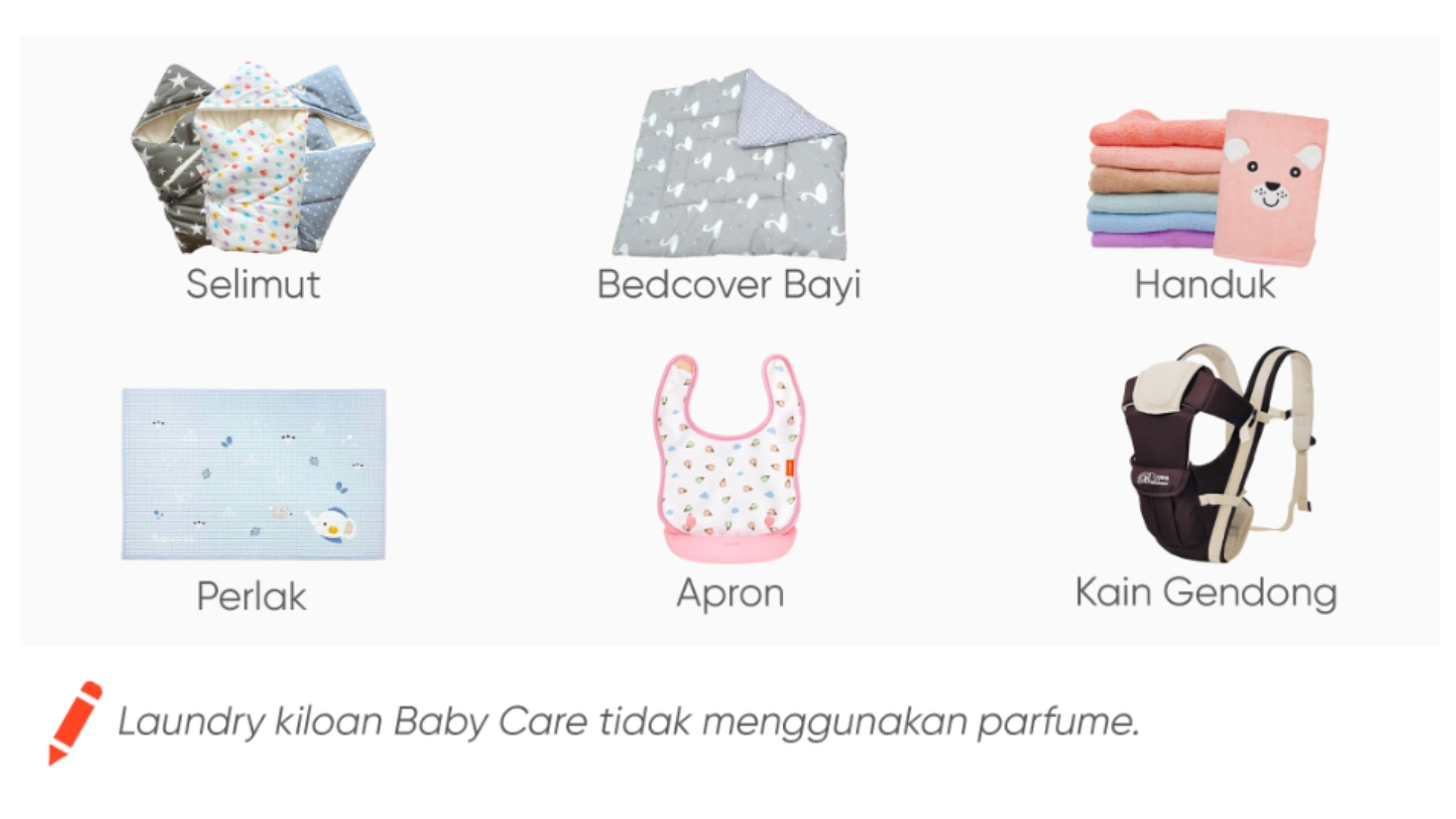
- Everyday clothes and diaper pants.
- Swaddles and blankets.
- Baby hats and mittens.
- Baby towels.
- Small pillows and bolsters.
- Sleep mats and baby carrier cloths.
The page also has a list of excluded items, but it is currently shown only as an image. If you are unsure whether an item can be washed, ask Customer Service.
Larger baby equipment
For larger baby items or ones with a frame, there are separate services: stroller cleaning for prams and pushchairs, doll laundry for dolls and fabric toys, and bedcover cleaning for bedcovers and thick blankets.
Regular subscription
Our service guide mentions a weekly subscription option for baby laundry. It suits families who want fixed pickup days without ordering each time. Ask Customer Service for details. With a fixed schedule, for example every Monday and Thursday, you simply put out the laundry bag on the same days each week, and your stock of clean clothes is always topped up before it runs out. A pattern like this helps enormously in the first months, when parents' time and energy are most limited.
When the cost may differ
The final cost follows the weight of the laundry when weighed and the service chosen. If an item turns out to suit another service better, such as a thick blanket or a large doll, the team will tell you first. There are no extra charges without your approval.
Pickup and delivery fees
Since 20 June 2026, pickup and delivery is charged per trip based on distance from the nearest outlet: Zone 1 (0–3 km) Rp8,000, Zone 2 (3–7 km) Rp15,000, and Zone 3 (over 7 km) Rp22,000. You can also drop off at our outlet at Jl. Ceger Raya No.42, Jurang Mangu Barat, Kec. Pd. Aren, Kota Tangerang Selatan, Banten 15222.
The Baby Laundry Process and How to Order
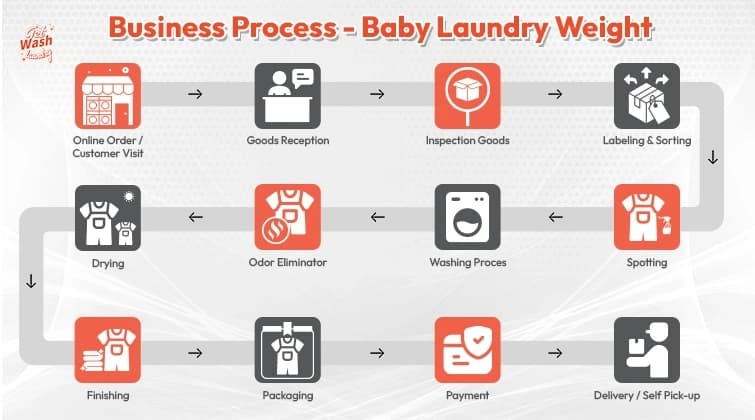
Our service page sets out the baby laundry process in five main stages. Here is what each stage involves.

Figure 6. Baby kilo laundry process (proses-laundry-kiloan-bayi-getwash-en.png)
1. Separating and sorting
Baby clothes are separated from other laundry and sorted by colour, fabric type, and stains. Heavily stained items are marked for treatment first.
2. Washing with baby detergent
Clothes are washed with baby detergent at the right dose, on a gentle programme for fine fabrics.
3. Repeated rinsing
Clothes are rinsed more than once to reduce soap left in the fibres.
4. Hygienic drying
Clothes are dried until completely dry, at temperatures that are not excessive so fabrics do not shrink or get damaged. The service page mentions extra sterilisation where needed.
5. Folding and packing
Clothes are neatly folded and hygienically packed so they stay clean until they reach your home. Our service guide also mentions steam ironing for baby clothes. Track your order on the tracking page.
Why not mix with other laundry
Mixing baby laundry with other laundry is not only a hygiene issue. Strong fragrance and adult product residue can transfer, dye from adult clothes can bleed onto baby clothes, which are usually light-coloured, and lint or fibres from towels and other clothes can cling. Separation means every step, from detergent dose to rinsing, can be tailored to baby clothes.
Why complete drying matters
Baby clothes folded while slightly damp will smell musty within days and can become a breeding ground for mould, especially in a humid climate like Greater Jakarta's. The slowest parts to dry are seams, collars, and thick fabrics such as towels and blankets. That is why drying continues until complete, at temperatures that do not damage the fabric.
About ironing
Many baby clothes made of jersey do not really need ironing. But some parents want clothes that are neat and warm from steam ironing. Our service guide mentions steam ironing for baby clothes. If you do not want certain items ironed, such as clothes with prints or appliqués, say so when you order.
How to order

Figure 7. How to order baby kilo laundry (cara-pesan-laundry-kiloan-bayi-getwash-en.png)
- Gather baby clothes separately from adult laundry.
- Rinse stains from breast milk, formula, spit-up, and poop with cold water.
- Send a message via [WhatsApp 0812-6610-0500](https://wa.me/6281266100500) and mention any special needs.
- Choose Regular or Express as needed.
- Schedule a pickup via the order page, or drop it at the outlet yourself.
- Track the status on the tracking page and receive clean baby clothes back.
Information worth sharing
When you order, share your baby's age if you are happy to, the main types of stains, whether any clothes are made of special fabrics such as wool or silk, and whether any items must not be tumble dried. This helps the team choose the most suitable treatment.
Preparing baby laundry
Empty pockets and remove accessories that cannot be washed, such as brooches, clips, or small attached toys. Close press studs so they do not snag. Keep clothes soiled with poop or vomit in a separate bag. If there are treasured items, such as clothes given by relatives or embroidered pieces, mention them when you order.
Share any special needs
If your baby has sensitive skin, eczema, or particular allergies, or if a doctor has advised anything about laundry, let us know. We will explain what we can adjust and what we cannot, so you can decide with full information.
Items left in pockets
Dummies, small hair clips, stray socks, or even medicine droppers sometimes get carried along in the pockets and folds of baby clothes. Our team checks laundry before washing, and anything found is kept separately and returned with the laundry. Even so, check pockets before handing laundry over.
When your laundry comes back
Check the laundry when it arrives: the number of pieces, cleanliness, and stains that were treated. Store baby clothes in a clean, dry cupboard. If you have any questions, contact Customer Service promptly.
Caring for Baby Clothes at Home
Between laundry runs, simple habits at home make baby clothes last longer and stains easier to remove.

Figure 8. How to care for baby clothes at home (cara-merawat-pakaian-bayi-di-rumah-getwash-en.png)
Keep a separate baby laundry basket
Set up a basket just for baby clothes, separate from adult laundry. Use a ventilated basket so damp clothes do not start to smell. Keep a small bag ready for clothes soiled with poop or vomit too.
Do not let it pile up too long
Baby clothes with milk or spit-up stains left damp for several days will smell and the stains become harder to remove. Schedule regular pickups, for example twice a week, so laundry does not pile up.
Work out how many clothes you need
Keep enough clothes in stock to cover the time laundry spends at the laundry. With the regular service, stock for the next few days will keep you relaxed. Newborns generally change clothes more often than older babies, so they need more stock.
Store it properly
Keep clean baby clothes in a clean, dry wardrobe or drawer, closed off from dust. Avoid mothballs and strongly scented wardrobe fresheners in baby clothes storage. Clothes stored for a long time, such as the next size up, are best washed again before use.
In the rainy season
In the rainy season, baby clothes dried at home often do not dry fully and smell musty. Damp clothes are not only uncomfortable but can also become a home for mould. At times like this, a laundry service with dryers helps make sure baby clothes are dried completely.
Muslin, flannel, and knits
Thin, breathable muslin dries quickly but creases easily and shrinks with high heat. Flannel is soft and warm but can pill after frequent washing. Knits, such as baby jumpers and hats, can stretch or shrink if washed and dried the wrong way. Mention any knits or special fabrics when you order.
If you dry clothes at home
If you wash some baby clothes yourself, dry them somewhere breezy and out of harsh direct sun, as colours can fade. Make sure clothes are completely dry before folding, especially at seams, collars, and thick fabrics such as towels and blankets. Do not dry baby clothes near kitchen smoke or a busy road.
If you want to wash some items yourself
- Use a baby detergent at the recommended dose, never more.
- Rinse more than once until the rinse water no longer foams.
- Avoid fabric softener and strong fragrance.
- Wash separately from adult clothes.
- Close press studs and zips so they do not snag.
- Dry completely before storing.
Nursing essentials
Nursing covers, nursing pillow covers, aprons, and nursing bras often get drops of breast milk and sweat on them. These items touch the baby while feeding, so they deserve the same care as baby clothes. Rinse breast milk drips with cold water before washing.
Hand-me-down baby clothes
Many families keep an older sibling's clothes for a younger one, or receive second-hand clothes from relatives. Clothes stored for a long time can be dusty, smelly, or yellowed in places. Wash everything again before use, and check the buttons and seams.
When your baby is unwell
When a baby has a fever, diarrhoea, or vomiting, laundry can surge in a single day. Keep clothes and fabrics soiled by vomit or diarrhoea in a closed bag, wash your hands after handling them, and hand them over promptly. Express can help when stock runs low. For your baby's health, follow your doctor's advice.
Travelling with a baby
When travelling, carry a waterproof bag for dirty clothes, and rinse milk or spit-up stains with cold water where you can. When you get home, gather all the dirty clothes from the trip and hand them over together. Long trips with a baby usually produce more laundry than expected.
Sizes that change quickly
Babies grow fast, and the first size of clothes is often worn for only a few weeks. Before storing outgrown clothes, for a younger sibling or to give to another family, wash them until clean and completely dry. Clothes stored clean are much easier to use again without yellow stains and musty smells.
A simple routine for parents
- Every day: put dirty clothes in the baby basket and rinse stains with cold water.
- Twice a week: hand the baby laundry over for pickup.
- Every week: check your stock of clean clothes and sizes that are getting tight.
- Every month: wash items that are rarely washed, such as carriers, pillows, and sleep mats.
Other items around the baby
Baby hygiene is not just about their clothes. The sheets and pillowcases of parents sleeping near the baby, nursery curtains, and the carpet where the baby crawls also need regular cleaning. For these there is bedsheet laundry, curtain cleaning, and carpet cleaning.
Our experience
Swaddles with yellowed spit-up stains, tops with poop stains left overnight, bibs covered in carrot, and piles of baby clothes smelling musty after drying in the rainy season: this is the baby laundry we receive most. Most of it comes back clean and fresh. For old stains that cannot be removed completely, we say so honestly.
Service hours and location
Customer Service hours: Monday–Friday 09:00–17:00, Saturday 09:00–15:00, closed Sunday. Our main outlet is at Jl. Ceger Raya No.42, Jurang Mangu Barat, Kec. Pd. Aren, Kota Tangerang Selatan, Banten 15222. We serve Pondok Aren, Bintaro, BSD, Ciledug, Ciputat, South Jakarta, and surrounding areas. If you are looking for laundry near me that is safe for baby clothes, contact us to ask about pickup times.
Is your little one's laundry piling up? Contact WhatsApp 0812-6610-0500, order via the order page, or follow us on Instagram, TikTok, Facebook, and Threads.
FAQ: Baby Kilo Laundry
How much is baby kilo laundry at Getwash?
Regular is Rp25,000 with a 3–4 working day estimate, and Express is Rp50,000 with a 12–24 hour estimate in selected areas. As a kilo service, prices are by weight; confirm the unit and minimum on WhatsApp.
How is it different from regular kilo laundry?
Baby clothes are washed separately from other laundry, with a baby detergent that the service page describes as fragrance-free and dye-free, rinsed repeatedly to reduce soap residue, then dried completely and packed hygienically.
Are baby clothes washed separately from other customers' laundry?
Yes. Baby clothes are not mixed with adult laundry or with other customers' laundry.
What is the minimum weight for baby laundry?
Our service guide gives a 3 kg minimum. Confirm with Customer Service when you order.
Is ironing included?
Our service guide mentions steam ironing for baby clothes. Confirm with Customer Service if you have particular preferences.
Can breast milk and poop stains be removed?
Stains rinsed promptly with cold water and handed over quickly have a better chance of coming out. Old dried stains, especially coloured baby food stains and oily stains, cannot always be removed completely, and we will tell you honestly.
Is it suitable for babies with allergies or eczema?
The detergent is formulated for babies, but we cannot guarantee it suits every skin condition, because redness on a baby's skin can have many causes. Consult your doctor and mention any special needs when you order.
Which items can be washed?
Everyday clothes, diaper pants, swaddles, blankets, hats, mittens, towels, small pillows and bolsters, sleep mats, and baby carrier cloths.
Do new baby clothes need washing before use?
Yes, it is recommended. New fabric can carry finishing residues and dust from warehouses or shops. Many families wash all their baby essentials a few weeks before the due date.
Can I set up a weekly pickup?
Our service guide mentions a weekly subscription option. Ask Customer Service for details.
Why does baby laundry cost more than regular kilo laundry?
A kilogram of baby clothes holds far more pieces, and each piece is checked, folded, and packed, plus special detergent, separate washing, and repeated rinsing.
How much is pickup and delivery?
Since 20 June 2026: Zone 1 (0–3 km) Rp8,000, Zone 2 (3–7 km) Rp15,000, and Zone 3 (over 7 km) Rp22,000 per trip.
What are Getwash Customer Service hours?
Monday–Friday 09:00–17:00 and Saturday 09:00–15:00. Closed Sunday. WhatsApp messages can be sent at any time and will be answered during the next service hours.
Sources
- Getwash Baby Kilo Laundry service page (EN)
- Getwash Laundry Kiloan Bayi page (ID)
- Getwash Laundry tracking page
- New Policy Notice: Pickup & Delivery Rates