Memuat halaman...
Memuat halaman...

Unlimited Stock | Belum Termasuk Ongkir
Lacol is a professional pre- and post-spotting fluid from SEITZ (Germany), formulated to dissolve paint, lacquer, adhesives, natural and synthetic resins, oil/grease, nail polish, metallic abrasion, ink (ballpoint, felt pen, marking ink), lipstick, wax, and grease-bound stains of unknown origin.
Effectively removes stains from:
How to use: Apply Lacol on the stain and treat with a soft brush. For aged or hard-to-remove stains, let it react for a longer time. Frequently re-moisten the stained area to intensify the solubilizing power. Then rinse with water or steam.
Attention: Lacol contains solvent and should only be used at the post-spotting table, rinsed with steam or water. For safety reasons, Lacol must never enter dry-cleaning machines operated with hydrocarbon or silicon solvents! Lacol may damage the dyes of acetate fabrics — always test on a hidden area of the fabric first.
Available in 2 sizes:
Best for: Professional laundries, dry cleaning, hotel laundry, garment care, and home-based laundry businesses that need an advanced solution for paint/lacquer/adhesive stains.
β οΈ Professional-use chemical product. Always wear gloves during application and keep out of reach of children. Read the Safety Data Sheet (SDS) before use.
Chat with our admin to request the Safety Data Sheet!
Site Title: SEITZ Lacol 1L/5L | Paint, Lacquer & Adhesive Stain Remover - Getwash
Meta Description: Lacol by SEITZ Germany — pre & post-spotting agent for paint, lacquer, adhesive, resin, nail polish & ink stains. Handles the toughest stains. Available 1L & 5L at Getwash.
Sometimes the stains a professional laundry faces aren't from food or sweat at all — they're the result of workplace accidents or creative activities: paint stuck to clothes during a renovation job, glue from a craft project, or marker ink spilled on a uniform. These stains require a far stronger chemical approach than a regular spotting agent can offer. This is exactly the problem SEITZ Germany addresses with Lacol, a professional spotting agent specifically designed as a pre- and post-spotting solution for paint, lacquer, and adhesive stains.
This article covers everything about Lacol — what it is, how it works, the stain types it handles, correct application, and the critical safety points your laundry team must understand before using it.
Lacol is a spotting fluid produced by SEITZ GmbH, a company based in Kriftel, Germany, long trusted by the international laundry and dry-cleaning industry under their tagline "The fresher company." Lacol is positioned as a pre- and post-spotting agent specifically for paint, lacquer, and adhesive stains — a category that requires stronger dissolving power than other SEITZ products like Quickol.
Lacol is able to dissolve a wide range of complex stains: paint and lacquer, adhesives, natural and synthetic resins, natural and mineral oil or grease, nail polish, metallic abrasion, ballpoint pen, felt pen, and marking ink, lipstick, ink, wax, and even grease-bound stains of unknown origin. This scope makes Lacol one of the most versatile spotting agents available for "heavy-duty" stains in the laundry and dry-cleaning industry.
Pre-spotting refers to treating a stain before the main wash cycle, while post-spotting refers to treating a stain after the main wash cycle has already been completed but the stain is still visible. Lacol is designed to work at both stages, making it a flexible solution that can be relied on at multiple points in your laundry workflow — either as a first step or as a final rescue when a stain remains after washing.
Lacol works by dissolving the non-polar bonds found in paint, lacquer, adhesive, and resin-based stains through a solvent component stronger than the water & solvent soluble formula found in products like Quickol. Paint and lacquer stains form a hard, long-lasting film layer once dry, while glue and resin have a molecular structure specifically designed to bond permanently — both require a chemical solvent capable of effectively penetrating these structures.
When applied directly to a stain and helped along with a soft brush, Lacol penetrates the stain layer and begins breaking down its molecular bonds. The "frequent re-moistening" step recommended in the usage instructions works to continuously reinforce the liquid's dissolving power against complex stains, especially old stains that have fully hardened.
Because of its high solvent strength, Lacol comes with several usage restrictions your laundry team must understand:
Paint and lacquer form a hard, long-lasting film layer once dry on fabric surfaces. Lacol is specifically designed to penetrate and dissolve this layer, making it the go-to solution for paint stains from renovation work or construction activities.
Whether it's paper glue, wood glue, or industrial adhesive, glue has a molecular structure designed to bond strongly to various surfaces, including fabric fibers. Lacol effectively dissolves many types of adhesive.
Resin is commonly found in tree sap stains, craft materials, or certain coating substances. Lacol is capable of penetrating this complex resin structure.
Oil and grease, whether from natural or mineral sources, are commonly found on workshop or industrial uniforms. Lacol thoroughly dissolves these oil-based stains.
This is a unique stain category caused by metal friction against fabric, often found on heavy industrial workwear. Lacol helps lift the metallic residue bonded to the fabric fibers.
Similar to Quickol, Lacol is also effective at dissolving the hardened nail polish layer that dries into fabric fibers.
Various types of ink — from ballpoint pens, felt-tip markers, to industrial marking ink — can be handled by Lacol thanks to its high solvent strength.
Lipstick and wax both contain a wax component that bonds strongly to fabric fibers. Lacol effectively dissolves this component.
One of Lacol's unique strengths is its ability to handle grease-bound stains of unknown origin. This is especially useful for laundry staff who frequently encounter mystery stains on customer garments with no clear indication of their source.
Identify the stain type and estimate its age. Fresh paint, glue, or resin stains are far easier to lift before they dry into an extremely hard layer.
Apply a small amount of Lacol to an inner seam, wait a moment, then check for any color or texture reaction. This step is especially critical for Lacol given its potential to damage the dye of acetate fabrics.
Apply Lacol directly to the stain, then help the dissolving process by gently working it in with a soft brush. Avoid scrubbing too hard so you don't damage the fabric fibers.
For stains that have been sitting for a while or are hard to remove, let Lacol react on the stained area for a longer time.
Re-moisten the stained area frequently throughout the spotting process to maximize Lacol's dissolving power against stubborn stains.
Once the spotting process is complete, rinse the treated area with water or steam. Never put fabric that has just been treated with Lacol into a dry-cleaning machine that uses hydrocarbon or silicon solvents.
Great for small to mid-sized laundries, or as a daily stock item at the post-spotting table for complex stains.
Ideal for industrial-scale laundries or high-volume dry cleaners, especially those frequently handling paint, glue, or resin stains from construction, craft, or creative-industry customer segments.
This is the most dangerous mistake possible. Lacol must never enter a dry-cleaning machine operated with hydrocarbon or silicon solvents due to the serious hazard this creates. Always rinse with water or steam first before continuing with any other process.
Lacol can damage the dye of acetate fabric. Skipping the test step on this material can be catastrophic for the final result of a customer's garment.
Lacol is designed for targeted use at the post-spotting table directly on the stain, not for bulk soaking. Using it this way wastes product and risks damaging surrounding fabric.
For stubborn stains, frequent re-moistening is key to maximizing Lacol's dissolving power. A single application is often not enough for fully hardened paint or glue stains.
For laundries already using Quickol, a natural question comes up: when should you switch to Lacol? Here's a simple guide to help distinguish between the two.
Use Quickol for oil-paint, nail polish, lipstick, tar, ink, grease, shoe-cream, and mineral oil stains — standard "hard" stains that can still be rinsed through a dry-cleaning machine after treatment.
Use Lacol for paint, lacquer, adhesive, resin, metallic abrasion, and grease-bound stains of unknown origin — a stain category that requires stronger solvent power but comes with the restriction that it must not enter a solvent dry-cleaning machine and must only be rinsed with water or steam.
Having both products gives you maximum flexibility — Quickol as the first line of defense for standard solvent stains, Lacol as the follow-up solution for the most complex stains like paint, glue, and resin that Quickol alone can't fully handle.
Contractor or construction worker uniforms frequently get wall paint or wood paint stains. Applying Lacol with a soft brush on the stained area, aided by frequent re-moistening, helps lift hardened paint stains before the fabric is rinsed with water.
Art school uniforms or craft studio work clothes frequently get glue and resin stains from creative activities. Lacol becomes a reliable solution for laundries regularly serving this segment.
Work uniforms stained with marker ink or marking ink from warehouse labeling activities can be treated with Lacol as a post-spotting step before the fabric is rinsed with water or steam.
Given its high solvent strength, storing and handling Lacol requires extra care:
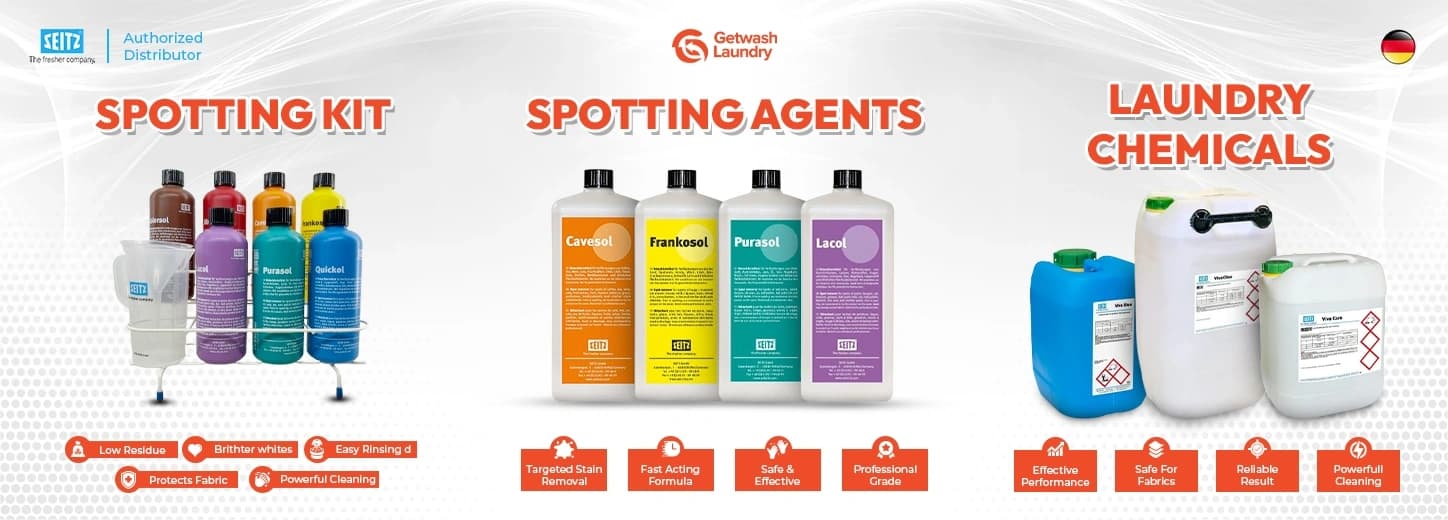
For professional laundries that want to build the most complete spotting table standard possible, having all five SEITZ products below is a smart investment for handling nearly every stain category you might face.
Frankosol handles sugar, milk, sweat, urine, honey, ice cream, and street dirt stains.
Cavesol handles coffee, tea, wine, soft drinks, fruit juice, and grass stains.
Blutol handles blood, albumin, milk, cream, chocolate, and other protein stains.
Quickol handles paint, nail polish, lipstick, tar, ink, grease, shoe-cream, and mineral oil stains that can still be rinsed through a dry-cleaning machine.
Lacol complements all four by handling the most complex stains — paint, lacquer, adhesive, resin, metallic abrasion, and unknown-origin stains — with the specific note that it must only be rinsed with water or steam, never a solvent dry-cleaning machine.
With all five products available at your spotting table, your laundry team is ready to handle nearly any stain that might come up in daily operations, from home-based laundries to industrial-scale dry cleaning.
Getwash supplies authentic SEITZ products, ensuring a safe and effective solvent formula that meets SEITZ's official safety standards.
Available in both 1-liter bottles and 5-liter jerrycans to match your business's scale.
The Getwash team is ready to guide you on proper use and provide the Safety Data Sheet (SDS) — just reach out to our admin via chat, especially important given Lacol's specific safety restrictions.
Because Lacol contains solvent that poses a serious hazard if mixed with the hydrocarbon or silicon solvents used in dry-cleaning machines. Always rinse only with water or steam after treatment.
Quickol handles standard water & solvent soluble stains (paint, ink, lipstick, oil) and can still be rinsed through a dry-cleaning machine. Lacol handles more complex stains (paint, lacquer, adhesive, resin, metallic abrasion) but with the restriction that it can only be rinsed with water/steam, never a solvent dry-cleaning machine.
Not for all types. Lacol can damage the dye of acetate fabric, so a hidden-area test is an absolute requirement, especially for fabric with unknown composition.
Yes. Lacol is specifically formulated to handle grease-bound stains of unknown origin, making it a reliable solution for mystery stains on customer garments.
For laundries with high paint/glue/resin stain volume, such as dry cleaners or laundries serving construction/creative-industry customers, the 5-liter jerrycan is more cost-efficient per liter than repeatedly buying 1-liter bottles.
Lacol by SEITZ is an essential complement to your professional laundry's spotting table, specifically as a pre- and post-spotting solution for complex stains like paint, lacquer, adhesive, resin, oil/grease, nail polish, metallic abrasion, ink, lipstick, and wax — including stains of unknown origin. Combined with Frankosol, Cavesol, Blutol, and Quickol, your laundry business gains the most complete solution possible for nearly every type of stain it might encounter on a daily basis.
Available in 1-liter bottles and 5-liter jerrycans, Lacol offers the flexibility to match your business's scale. Get the genuine SEITZ Lacol today at Getwash.
Want to learn more or need the Safety Data Sheet (SDS)? Chat with the Getwash admin today.